Neurotypes are neither pathological nor adaptive in themselves; they’re living fossils, embodied memories of the environments that shaped us and the demands they imposed. Their survival, their persistence, tells a story whose details have been lost but for the person in front of you. Old worlds abide in my flesh. And in yours.
Category: Uncategorized
-
Fidelity to the Group Vs Fidelity to Reality (blue pill vs red pill)
Can you select against reactivity (and for pro-sociality) without selecting against truthfulness? I don’t think you can.
In Wrangham’s phrasing, pro-sociality seems to be about “friendliness,” tolerance, cooperation. But on the ground, what pro-sociality really looks like is going along with the group, even when the group is wrong (especially when the group is wrong, maybe). Let’s be honest…coalitions don’t just punish aggression, they punish non-conformity. It’s autonomy vs consensus.
Loyalty to the truth and conformity are simply incompatible.
What is reactivity? The kind of reactivity that a group takes issue with? It’s registering error signals and acting on them. And what is loyalty to the truth if it isn’t that? Refusing to override error signals even when everyone else does. If selection is for compliance, then loyalty to truth (which in a group looks like stubbornness, pedantry, dissent) gets you punished by the coalition. Over evolutionary time, that makes loyalty to truth maladaptive inside control systems.
Like most things in evolution, it’s a trade-off. Sure, you can have pro-sociality without truth if the goal is harmony. But you can’t have both pro-sociality and true fidelity to reality. Truth is often disruptive. And so, to preserve group stability, coalitions consistently select against those who react too strongly to contradictions…even if they’re right. Think whistle-blowers…Socrates…Galileo.
In predictive processing terms, the mutual exclusivity of these two drivers becomes even clearer. Pro-sociality is the inflation of social priors and the down-weighting of individual prediction errors. Truth-loyalty is the up-weighting of prediction errors, social priors be damned. A system can’t simultaneously select for both…they’re opposing precision-weighting strategies. The emperor’s either wearing clothes or he isn’t.
-
Scarcity -> Conflict
I believe it was Geoff Lawton who said the next war would be fought over water. A liter of clean water is already more valuable on the market than a liter of crude oil…and in the systems we’ve created, scarcity always leads to conflict.
In ecology, scarcity is feedback. Hunger pushes foraging…drought pushes migration. And in small-scale human societies, conflict over scarcity was usually managed by mobility, sharing, or groups splitting. But once we settled, scarcity became inescapable. Fixed fields…stored food…property…nobody wants to leave those things behind. We became “invested” and conflict became largely unavoidable.
To prevent collapse from the inside, human coalitions developed ways to suppress reactivity. Strong reactivity (aggression, dissent, or any kind of stubborn autonomy) is dangerous in a sedentary groups subsisting on scarce resources. So selection shifted toward compliance and conformity…enforced first by gossip and ostracism (see Wrangham), then law, ideology, and force.
It’s dangerously tempting to read civilization as a suite of conflict management “technologies.” But they’re not technologies…they’re stories. They’re descriptions of what is.
Religion frames inequality and misfortune as God’s will. The doctrine of free will reframes poverty or failure as your own fault. Markets channel conflict into competition, but “solve” scarcity by creating…(artificial) scarcity. States monopolize violence to keep conflict from fracturing the states themselves. And AI is already talked about as a promise…a promise of an environment managed so perfectly that conflict never arises…where error signals are resolved (i.e. smoothed) even before they appear.
These are stories. Post-hoc rationalizations and buffers. Each of them suppressing the conflict signals they themselves generate.
What do I mean by that? Think of scarcity as resulting in prediction errors…unmet needs…violated expectations. Conflicts are behavioral responses to those errors. And civilization is the inflation of social priors (shared fictions, ideologies, gods) so that individuals suppress their error-driven responses in favor of compliance. This produces short-term stability…but it also severs feedback. And where feedback is severed, ecological and social errors accumulate.
In other words, you should never see civilization as a solution to scarcity. It’s never been that. At best, at the smallest scale, it’s a short-term solution to conflict. By suppressing reactivity, it buys stability at the cost of accumulating and unregistered error. Like everything else civilization touches, it makes conflict less surprising…by smoothing, scripting, or relocating it.
-
WILL
I’m considering whether concepts like free will and God’s will function like a civilizational equation for neutralizing the “error signal” of inequality.
Every society, at every time and place, faces inequality. And inequality doesn’t feel right…does it? And not feeling right, in neuroscientific terms, means error.
Some people are born poor, sick, or generally shit out of luck. Others aren’t. They’re born fine and seem to do fine. And without any sort of explanation as to why that is…it looks arbitrary and unjust. It’s destabilizing because human nervous systems are sensitive to fairness. (I believe that because it seems to hold true for most people once I get to know them.)
Civilization flattens errors for its members. That’s what it does. And here we have an error, don’t we? Unfairness. Inequality. But civilization has a two-part story to keep inequality from being experiences as an error by its members.
The first part of that story is free will. That part tells us inequality is the individual’s fault. You could’ve chosen differently. Your poverty is the logical result of laziness. Your suffering comes from bad decisions.
But that doesn’t account for all inequality, does it? Some inequality fall through the cracks of that argument.
That’s where God’s will comes in. Inequality is the cosmic order. God chose your station…or suffering purifies you…or justice comes later for you (in heaven, or via karma).
Add these two stories together, and you get a closed loop. If you’re disadvantaged, either you chose badly (your free will) or God chose it for you (divine will). In both cases, whatever system you live in is absolved. It’s on you or God. Case closed.
What’s really happening here? In the brain?
Inequality is a prediction error. You expect fairness, but you see unfairness. Taken together, free will and God’s will reframe that error as expected, meaningful, or “deserved.” It’s a story that neutralizes surprise for you. It lets you accept conditions that would otherwise feel intolerably incoherent.
In medieval Europe, you’re a serf because of God’s plan…but also because you don’t have the virtue to “rise.” In Calvinism, your wealth shows God’s favor…but your hard work (free will) proves it. In American capitalism, anyone can succeed (free will), but if you don’t, maybe God didn’t bless you. In communism, even, a secularized version appears. History’s laws are inevitable (God’s will), but you have to freely devote yourself to the case (free will).
This is yet another example of civilization flattening the error landscape. Otherwise, inequality would feel like raw incoherence. We need to make it explainable…”just,” even. We wrap it in narratives of freedom and divine order.
These stories are post-hoc rationalizations, of course. They do nothing to solve inequality. They’re explanatory patches applied after the fact.
Historically, the pattern is clear. The inequality comes first (land hoarding, hierarchy, wealth gaps). People register it as an error signal…it’s unfair. And civilization comes to the rescue…not by reducing the inequality, but by retrofitting a story. Free will (you could have done otherwise!) or God’s will (it’s meant to be this way!). These stories reframe perception so you can tolerate inequality.
-
No…autistic people are not rigid thinkers.
Autistic people have challenges with cognitive flexibility. Autistic people are black-and-white thinkers. There’s no in-between with us…something is either good or bad. We’re rigid thinkers…stubborn. We oversimplify the world. We’re immune to nuance. We catastrophize. We’re all-or-nothing.
Different words for the same thing…you’ve heard the bullshit. In diagnostic manuals. On YouTube. In therapy.
You’ve also heard the other bullshit. Autistic people are inductive thinkers. We focus too much on the insignificant details and miss the big picture. We can’t see the forest for the trees.
Different words for the same bullshit…but the opposite bullshit…?
So, am I a paradox? Am I both a reductive and inductive thinker?
If there’s anything I’m allergic to, it’s paradox…contradiction. A feeling rises in me. My bullshit detector starts to ring out louder than usual. And, like every paradox I encounter, I know this one is wrong…the reason it’s wrong simply needs to be discovered. (Incidentally, this is the stage in my thinking at which I look most reductionist.)
And so I think. A lot. I have no choice. My brain won’t leave contradictions unresolved. And here’s what I’ve been thinking these past few days.
The contradiction (autistic people focus on the smallest details instead of the big picture and autistic people have oversimplified models of the world and refuse to account for contradictory details) comes from where you zoom in on my cognitive process.
Let’s look at what I’m accused of first: black-and-white thinking (aka dichotomous thinking, rigid thinking, etc.). It means I come to snap categorical judgments like right vs wrong, fair vs unfair, safe vs unsafe. I see it written in descriptions of autistic behavior everywhere…rigidity, over-simplification, an inability to tolerate ambiguity. In predictive processing terms, it’s framed as a strategy to minimize error fast. The autistic person overweights a clear prior (“this is wrong”) instead of juggling noisy or contradictory signals.
Confusingly, I’m complimented for being the polar opposite…for being an inductive thinker. In the same conversation, even. Apparently, I’m good at building generalizations from specific instances. I’m good at noticing patterns in particulars. In predictive processing terms, my attention to detail and my ability to detect anomalies (in patterns, like contradictions) is attributed to the fact that I don’t start with strong priors (think of them as expectations or assumptions). I let patterns “emerge” from the ground up instead of forcing a theory I have. In other words, compared to your “average” person, I give more weight to incoming data and less weight to stories (whether my own, or a group’s). Bottom-up signals drive my learning. I have to learn the “hard way.’
The feeling of this paradox is….it’s like you’re catching me at different stages of my thinking process, and naming the stages as opposite things.
I’ll do my best to describe what my process feels like, from the inside, as me.
When I first try to make sense of something, I weight raw input heavily. I don’t iron out inconsistencies with conventional stories. That probably explains why I notice details that you seem to miss. But when contradiction or incoherence (i.e. bullshit) piles up, and disengaging from the situation isn’t an option, I need to force coherence. I need to escape the stress of unresolved error. For example, if I’m among a group of people who are trying to solve a problem irrationally, who won’t listen to reason, and I don’t have the option of leaving? I might snap to a categorical judgment. I have a very hard time persisting in insane environments.
You can think of me as having two modes, maybe. In my inductive mode, I’m open to raw feedback. I’m pattern-sensitive. In my dichotomous mode, I close myself off to pointless ambiguity. This second mode is protective (especially in incoherent environments, where I can get fucked up real fast). But that mode isn’t final. What you call my “black-and-white thinking” is a first-pass strategy to isolate a pattern. I grab hold of a signal (true/false) before I layer nuance back in. And in coherent environments, nuance does get layered back.
Let’s keep circling this.
In coherent environments (where feedback is timely, proportionate, local, and meaningful), my particular weighting of error signals looks inductive and nuanced to you. I follow details, I update my view of things flexibly, and I build very fine-grained patterns. Here, you admire me. You say things like, “See? You’re so smart! I couldn’t do that. Why can’t you apply this brain of yours to _______?”
What you don’t realize, maybe, is that the ______ you just mentioned? It’s an incoherent environment. In that environment, rules are contradictory, consequences are delayed arbitrarily, and abstractions are layered on abstractions for reasons of control, etc. And in that environment, the flood of irreconcilable errors becomes intolerable for me. My nervous system reaches for coherence at any cost. On my first pass in every situation, if I’m forced to “share my thoughts,” you’ll see me collapse complexity into a binary frame (“this is right” “that is wrong”). That’s what you see. What you don’t see (if you never let me get to it), is that I follow that by testing it, and testing it, and testing it…adding details at each step and adjusting my frame as I go. But that first pass? That first pass looks like reductionism or “black-and-white thinking” to you.
I think if Andy Clark were here, he would say that I have weak priors and that I weigh errors strongly. (He’d probably use words like “underweight” and “overweight,” which I hate…but forgive him for.) That in stable conditions, mine is as inductive, adaptive and precise process. But that in unstable conditions (unstable as in a room full of flat-earthers, not unstable as in a tornado is coming or a bear is running toward me), my process leads to overwhelm.
My brain clamps onto the simplest model…and when it isn’t allowed to move on from there (the flat-earthers are trying to solve intercontinental flight, and the lawn-zombies are trying to figure out how to keep their biological deserts green) that looks like reductionism. Those are problems that are so decontextualized they have no resolution. And when resolution doesn’t seem possible, my system is forced into a kind of emergency closure because feedback has become utterly fucking useless.
Let’s look at the lawn example.
I’m fond of saying that North Americans mowing 40,000,000 of lawn is sheer stupidity. Lunacy, hands-down, from any perspective. When I voice that opinion, intelligent people hear it as an oversimplification. And if they know I’m autistic, they put it down to a difficulty with (or outright inability to comprehend) multi-variable causality. This confuses me greatly. (And I suppose I confuse them.)
This is probably a case of double empathy. Let’s look at it from both sides.
I see a signal…mowing tens of millions of acres is, at best, a colossal waste of time, fuel, water, and soil. And I voice it simply: “Stupidity.” To me, that isn’t reductionist. I’m cutting through incoherence to register a glaring error. Something that simply doesn’t make sense. An argument not worth having in this lifetime.
But when my intelligent (and I’m not using that term facetiously) neurotypical listener hears my opinion, they hear an inability to process nuance. Lawns have cultural history. They have aesthetic value. There are economic incentives involved, municipal codes, homeowner psychology, and so forth. They interpret my clarity as an inability to juggle multi-causality, instead of as a refusal to rationalize nonsense.
Let’s anchor this gap in neuroscience.
Neurotypical people put a lot of weight into their priors, which is a fancy way of saying they assume the world is coherent. When they hear “Mowing 40,000000 acres of lawn is complete fucking idiocy on every level,” they automatically begin to search for legitimizing narratives. In other words, they start to search for an explanation for why millions of lawns do make sense (i.e. are comprehendible).
I, on the other hand, put a lot of weight into error signals, which is a fancy way of saying I can’t ignore contradictions. And from my perspective (and from every epistemic perspective that doesn’t involve human fictions), it doesn’t matter how many variables you pile in to the lawn argument…the outcome is wasteful and absolutely fucking absurd.
There’s a mismatch here. You see consensus as coherence, and complexity as explanatory. In cases like these, I see complexity as a distraction from the basic error. I collapse your absolute mess of contradictory justifications (shorter grass = less ticks (why grass at all?!?), long grass = an eyesore (what does that mean in reality-terms?), we need to think of neighbors/property value/invasive species (why, why, why among all the things you could “think” of in your 80 summers on this planet, are you “thinking” of those particular bullshit abstractions?). I can process multi-variable causality just fine. But I refuse to let causality excuse incoherence (even typing that makes my head hurt).
I’m misread, socially. Constantly misread. Neurotypical people equate “nuance” with adding mitigating factors until the critique blurs. And when I resist that, they frame it as over-simplification. I’m the one trying to hold onto the full causal picture. Something can be complex and stupid at the same time. Complexity and stupidity are hardly mutually exclusive in civilization…in fact, they might be positively correlated.
I can call something stupid without denying complexity. So can you. Try it.
-
What IS domestication?
At its core, domestication is a selection process shaped by control objectives. I want a cow that is easiest to extract milk and meat from. I want a chicken for the easiest scrambled eggs and sweet and sour wings possible. I want a dog for the best companionship or easiest hunting experience possible. When we domesticate a plant, animal, or person, we have an objective. We’re trying to extract something and we want that extraction to be as quick and easy as possible. So what gets favored or suppressed in a breeding program or a training regimen depends on what makes the organism more compatible with our human-defined system of control. And across species (including humans), here’s what that looks like…
We select for individuals that are calmer, more tolerant of handling, and more willing to defer to authority or hierarchy. We want reduced variability in responses to stimuli (think “calm” dog vs “reactive” dog)…steady, less surprising behavior is easier to manage. We consistently reward (or at least end up with) juvenile traits (neoteny) like playfulness, submissiveness, and prolonged dependency. These make the domesticate easier to mold and keep in a controlled state. Traits that allow reproduction on human terms are also heavily favored…earlier sexual maturity, more frequent cycles, larger litter sizes (or in humans, lineages that adapt to arranged marriages, “concubinage,” follow religious edicts to “go forth and multiply,” etc.). Finally, the ability to navigate symbolic or artificial rules is prized…dogs attuning to human gestures, and humans adapting to bureaucracies or religions.
There are are a few qualities fundamentally opposed to control. These are the traits that selected against in a domestication process. Reactive aggression and impulsivity clearly disrupts group or handler control. High sensory reactivity and vigilance are problems, as well. Skittishness, flight responses, or overreaction to confinement make animals (and people) harder to control. Next, any overt sign of autonomy / resistance to control is obviously and inherently something that needs deletion. Whether that’s a dog that won’t stay in the yard, sheep that have a habit of jumping fences, or a human who won’t accept various forms of subjugation…it simply can’t be tolerated. Broadly speaking, unpredictability needs to trained / bred out. Any trait that makes outcomes less stable…irregular reproduction, volatile behavior, refusal to follow routine. Excessive independence has no home here. Animals that refuse to bond with humans and humans that refuse to bond with institutions are destined for the slaughterhouse, prison, shelter, behavioral therapy, the streets, the margins.
Taken together, this suite of traits produces the domestication syndrome. Smaller brains, reduced sexual dimorphism, more juvenile features, dampened stress responses, and greater and greater compliance. It’s clearly a stunting process…but one that optimizes survival inside artificial systems of control.
So, what is domestication?
You could say it’s the selection against an animal’s drive to act independently of a system of control.
-
Where does the real control begin? (How did we get from egalitarianism to building permits and marriage licenses?)
Let’s start with scarcity.
When resources are abundant and accessible, individuals and small groups can meet their needs independently…there’s little to no incentive for hierarchy or some kind of enforced coordination. Scarcity (whether it’s real or engineered) creates conditions where access might need to be regulated. Control systems (chiefs, priests, bureaucrats) emerge to decide who gets what, when, and how. This doesn’t just apply to food…think of land, water, labor, and information. The more scarce these things are, the more power seems to concentrate in the people who manage distribution.
As populations grow and density increases, resource demand outpaces availability in a given area. This creates a new kind of scarcity, call it structural scarcity…resources aren’t always “gone,” they might just be stretched or hoarded. Anthropologists (James C. Scott, Mark Nathan Cohen) argue that the rise of agriculture wasn’t a leap forward. It was a trap…higher population density leads to soil depletion, which leads to periodic famine, which leads to tighter and tighter social controls. Scarcity and density rise together, since density both consumes more and makes groups easier to control (rationing).
Think of control as a feedback loop or a vicious cycle. Scarcity leads to control…and the more “successful” that control is, the more scarcity results. In irrigation states like Mesopotamia, drought and a high population necessitated a sort of irrigation bureaucracy. But irrigation caused the salinization of soils, which led to even more scarcity, when led to even stronger central control. Once a system of control exists, it doesn’t go away when scarcity disappears…it invents new scarcities (taxes, debts, borders, artificial shortages) to keep power. This happens regardless of the ideology or political system. This isn’t a fascism or capitalism story.
Let’s look at this from a predictive processing angle. Scarcity increases prediction errors (will I eat tomorrow?). Control systems offer social priors (“obey the priest, follow the ration schedule”) that reduce uncertainty at the cost of autonomy. People trade independence for predictability. The control system becomes what guarantees your survival.
Can you guess what peaks with resource scarcity and population density? You got it…human domestication (and domestication in general).
After the last glacial maximum (12,000-20,000 years ago), we saw mass megafauna extinctions and human population growth. In other words, serious local scarcity. During the early holocene (10,000-12,000 years ago), human population density rose in fertile regions (Levant, Yangtze, Andes).
And this is where we really see scarcity management become chronic.
The average human brain shrank by ~10-15% beginning ~30,000 years ago, with the sharpest decline between 10,000-20,000 years ago…exactly the same window when density/settlement intensified. Bones became lighter and less robust ~15,000 years ago (this is linked to sedentism/reduced mobility). Male and female skeletal differences narrowed in the same timeframe. And signs of hierarchy and control systems all emerge right as density and scarcity peak.
The feedback loop is hard to miss. Density produces scarcity (real and perceived), scarcity drives new control systems, control systems select for predictability/attenuation (flattening diversity of responses to it), domestication traits become more pronounced, and those traits, in turn, make populations more compatible with density and hierarchy…accelerating the cycle.
The loop shapes landscapes, plants, animals and people. What thrives under high-density scarcity-control systems is predictable, compliant, and attenuated. And across millennia, this produces the domesticated phenotype…flatter, more manageable humans. The loop is called civilization. It entrenches domestication traits and expands until it collapses.
(Christopher Ryan and some archaeologists have an abundance-first model…but it leads to the same loop…once the abundance is gone, you have a sedentary group of people living in scarcity…I think this probably happened in certain places at certain times.)
-
Domestications V1.0 / V2.0 (hunter-gatherers / suburbanites)
If the egalitarian hunter-gatherers I talk about so much are the “stall point” in the runaway process of domestication, then why do they carry the same suite of domestication traits seen in your average 2025 city-dweller? The same smaller brains (~10-15%) compared to archaic Homo. The same reduced sexual dimorphism (males and females less divergent in body size and head features). The same gracile skeletons, shorter faces, and smaller teeth. The same prolonged juvenile traits.
Physiologically, they’re as domesticated as farmers, CEOs, and everyone else alive. The domestication syndrome is species-wide, and at first glance that seems to be a hole in my hypothesis.
I’d argue that where HGs differ isn’t in the physiological baseline, but in the social use of those traits. They maintain egalitarian checks (mocking, ostracism, flexible band membership) that prevent runaway hierarchy. They don’t fully overweight social priors at the expense of sensory/environmental feedback. And their “flattening” is limited…diverse behavior is tolerated, as long as no one seizes too much control. I see them as domesticated bodies living in relatively non-domesticating systems.
This is how I see it: a certain suite of traits emerges once as part of Homo sapiens’ domestication arc. Different systems (e.g. HG bands vs. states) then determine how that suite is expressed/reinforced/suppressed. Think of it as baseline domestication (the whole physiological package…universal by ~30,000 years ago) and runaway domestication (social systems amplifying the control side and pushing traits further…heavier attenuation and greater conformity).
Runaway domestication is where some extra behavioral flattening happens. The very strong selection against independence within control systems. Hunter-gatherers do exert control, but on a much smaller scale. You could say their control systems, while not allowing runaway hierarchy (kings and presidents), still weeded out the most disruptive unpredictability…people who can’t cooperate at all, or who are violently antisocial. But under agriculture and states (post Younger Dryas), that weeding out is magnified into systems of slavery, bureaucracy, and mass coercion. The driver is the same (selection against independence)…it’s the degree that’s different.
We’re talking about a 2-stage process, then. The species-wide baseline (enough selection against reactivity/autonomy to stabilize a group) and a civilizational runaway (the selection against independence becomes way more aggressive).
If that sounds like bullshit to you, consider the Australia case.
Anatomically modern humans reached Australia around 65,000 years ago. That’s before the sharpest phase of human brain-size shrinkage ~30,000-10,000 years ago (a known marker of domestication in animals and humans). The original Australian populations diverged early and developed in almost complete isolation from later Eurasian agricultural/civilizational pressures. They remained foragers until very recently (colonial contact), and while they engaged in complex land management systems (fire-stick farming and aquaculture), there was no large-scale ag, urbanism, or state hierarchy. In other words, they had far less exposure to the kinds of control systems that I accuse of driving runaway domestication.
And what do we see?
Sure enough, fossil and skeletal data from Australia populations don’t show anywhere near the same degree of gracilization that appears in Holocene Eurasia. They have robust cranial and skeletal features compared to Europeans of the same era. That suggests to me that the full domestication suite probably didn’t occur in the same way there. You could say they carry the “baseline” domestication package, but not the civilizational package.
If full domestication is selection against unpredictability in control systems, then societies without large-scale control systems (like foragers in Australia) should show less of what I’m calling runaway domestication. And that’s exactly what we see.
-
Why Wrangham’s Hypothesis is Hobbesian (again)
Wrangham’s “reactive aggression hypothesis” carries an unmistakable Hobbesian flavor.
His baseline assumption is that early humans, like chimpanzees, were naturally violent, impulsive, and prone to destructive outbursts. What made us “human” was learning to suppress these brutish tendencies through coalitionary control (groups executing overly aggressive males). Society gets framed as a kind of pacifying mechanism…a necessary check on our otherwise nasty, volatile nature.
That’s basically Hobbes’s worldview in Leviathan…life in the “state of nature” is “solitary, poor, nasty, brutish, and short,” and order only emerges once violence is curbed by collective enforcement. Wrangham’s twist is to naturalize that process into evolution. Rather than a social contract, it’s genetic selection against hotheaded males.
He’s shoehorned self-domestication into the same tired civilization-as-the-pinnacle-of-human-achievement narrative. We tamed ourselves, became more peaceful, and thus enabled cooperation and culture. But he overlooks that cooperation can be coercive, that proactive aggression thrives inside systems, and that flattening diversity isn’t the same as “progress.” He gives us what might be the rosiest view of civilization so far…as though its violence is an aberration, rather than built into the very logic of control.
To his credit, however, Wrangham doesn’t dismiss hunter-gatherers as “brutish” in the Hobbesian sense. In fact, he often emphasizes that foragers, especially recent and modern ones, are comparatively egalitarian, cooperative, and less violent than chimpanzees. The Hobbesian tone only creeps in his baseline assumption about the deep evolutionary past, with regard to earlier humans (who were, in his view, originally chimp-like in temperament). The shift toward hunter-gather egalitarianism, in his model, only becomes possible after reactive aggression is curbed (beginning about 300,000 years ago). Meaning we were…chimp-like up to that point? That discounts a lot of pre-domesticated human behavior that clearly indicates coordination (as far back as Homo erectus).
Wrangham’s view of hunter-gatherers is positive, then, but conditional. He treats them as the first beneficiaries of domestication…the evidence that our “self-taming” worked, rather than evidence that humans were never that brutish to begin with.
I agree, of course, that hunter-gatherers are fiercely egalitarian…but I don’t treat that as “proof of tameness”. On the contrary, I see that as the feedback mechanism that keeps domestication in check.
Domestication is attenuation and control, with disruptive reactivity being flattened (in plants, animals, landscapes, and people). Hunter-gatherer egalitarianism works differently…the group prevents runaway control. They do this by enforcing sharing, mocking or ostracizing would-be dominators, and keeping hierarchies shallow. That’s negative feedback at the group level…it resists concentration of power.
Seeing early humans as brutish is largely our own bias. We can’t seem to fathom wild pre-civilized people as being cooperative. They were cooperative, but their cooperation didn’t require heavy attenuation. They didn’t demand sameness for its own sake…only enough coordination to keep the group functional. In predictive coding terms, they didn’t overweight social priors. Reality (food, predators, ecology) was the primary anchor. Where’s my evidence for this? I’ll get to that.
For now, suffice it to say that hunter-gatherers sit before runaway selection (for control/compliance/consensus). Their egalitarianism is a brake on domestication. It ensures no one individual (or coalition) gets too much control. This is why hunter-gatherers show humans living in species-appropriate systems…feedback-rich, low hierarchy, high tolerance for diversity of behavior.
In short, Wrangham’s story is that egalitarianism is what domestication made possible. But I’m saying that egalitarianism was the protective mechanism that kept humans from being fully domesticated (until agriculture and states removed it).
-
Was Hobbes right? (and other holes in Wrangham’s narrative)
Wrangham’s reading becomes “Hobbesian” only if I treat modern Homo sapiens as a transparent example of “what nature does.” But if I see most modern humans as the outcome of a runaway selection process (which I do), then what he’s describing isn’t “the natural course of things”…it’s one very peculiar path, shaped by group-enforced control, ecological shocks, and self-reinforcing dynamics.
In Wrangham’s frame, humans reduced reactive aggression “naturally,” like bonobos, by killing off bullies. This made us more cooperative and domesticated, enabling civilization. This makes our docility some kind of moral progress…proof of “better angels.”
But when we look at this as runaway selection, we see that humans reduced disruptive reactivity not because it was inherently maladaptive, but because control systems selected against it. Those who resisted were killed, enslaved, or excluded, while compliant individuals reproduced. It wasn’t a noble trajectory toward peace. It’s a feedback loop of domestication…each round of control flattens diversity, narrows behavior, and strengthens the system’s grip.
I propose that modern “cooperation” isn’t evidence of a gentle human nature, but of attenuation. A domesticated phenotype optimized for predictability. And what Wrangham calls “our success” is really a fragile state of overshoot. More docile humans and larger coordinated systems make for the massive ecological extraction we see today. Instead of Hobbes’s “nasty, brutish, and short” as the baseline, the baseline was probably messier but more adaptive…with greater tolerance for autonomy, variability, and feedback from the environment.
I think the Hobbesian story is itself a product of domesticated minds narrating their condition as “progress” (I’m in full agreement with Christopher Ryan here). What looks like the triumph of peace is really the triumph of control which, taken far enough, undermines both autonomy and ecological survival.
I want to take a second (third? fourth? tenth?) look at Wrangham’s take on reactive aggression now. Because there’s a lot about it that doesn’t sit comfortably with me.
Reactive aggression (the “heat of the moment,” crimes of passion) is still recognized as human. It may be tragic or destructive, but the law often interprets it as impulsive, unplanned…an overflow of feeling. That makes it mitigating. Proactive aggression (premeditated, calculated), on the other hand, is seen as more dangerous. It reflects intentional control, not eruption. Society punishes it more harshly because it reveals a deliberate strategy of harm. This suggests (to me, anyway) that people intuitively grasp that reactivity is part of being alive, whereas proactive aggression is a sort of deviation…weaponizing intelligence for domination.
Wrangham says that humans became “civilized” by suppressing reactive aggression. But I think everyone can agree that cultural practice indicates we still see reactive aggression as understandable, even forgivable. What we really can’t tolerate is schemed violence…the kind of proactive aggression that builds empires, executes slaves, or engineers genocide. I think the very logic of law undermines Wrangham’s claim. If reactive aggression were the great evolutionary danger, why is it less punished than the thing he ways persisted unchanged?
Which brings me back to the better explanatory model…domestication didn’t simply reduce hot tempers. It systematically removed resistance (any kind of reactivity that disrupts control). But at the same time, it rewarded (and still rewards) the forms of aggression that can operate through the system…planned, symbolically justified, and bureaucratically executed. This is why the “banality of evil” (Hannah Arendt’s term for the bureaucratic normalcy of atrocity) feels so resonant: proactive aggression is what really flourished under domestication.
My next bone of contention with Wrangham is that most examples of reactive aggression he provides in his written work and lectures sounds a hell of a lot like bullying. Proactive bullying.
With one hand, he defines reactive aggression as impulsive, hot-blooded, emotionally charged aggression…triggered by provocation or frustration and more or less immediate (not pre-planned). But in the same breath, he gives examples that clearly indicate planning, calculation, and strategic targeting. He cites situations where aggression is used to produce submission in the victim…not some kind of heat-of-the-moment explosion. I don’t know of any psychological taxonomies in which that behavior is a fit for reactive aggression.
Why? Again, I think part of it has to do with his bonobo comparison. He needs “reactive aggression” as the thing bonobos and humans both suppress, to link his self-domestication theory. It certainly makes the story cleaner, too. “We eliminated bullies” sounds more like moral progress than “we empowered the strategic aggressors.” And it smells like simplification to me. By labeling bullying “reactive,” he folds it into his main category, even if the behaviors clearly involve planning.
And by stretching his definition of reactive aggression, Wrangham masks the real driver. It wasn’t just hot tempers that got culled. It was all forms of disruptive autonomy. Including resistance, refusal, and yes, sometimes reactive outbursts. What flourishes is strategic aggression aligned with control systems (raids, executions, conquest, slavery). He’s essentially misclassifying proactive violence as the very thing his model claims was eliminated.
The reason I’m attacking Wrangham so much is (likely) that there’s so much else I like about his hypothesis that makes the abrupt turn he takes extra upsetting. First, coalitionary enforcement absolutely matters. Once language and symbolic coordination were possible, groups could target individuals who disrupted group order. Second, domestication traits absolutely show up in humans. Smaller brains, more gracile features, extended juvenility…these parallel what happens when animals are bred for compliance. And Wrangham’s distinction between proactive and reactive aggression is useful, even he overcommits to one side.
I get upset when he emphasizes a moral arc…we became “nicer” by suppressing reactive group members. The archaeological and historical record (slavery, bottlenecks, harems, systemic violence) points to a far darker dynamic…proactive aggression, control, and planned violence were selected for because they succeed in hierarchical systems. I don’t know how he doesn’t see this. How doesn’t he see the removal of disruptive resistance to control systems when he browses a history book through a domestication lens?
I like Wrangham’s theories without the irrational optimism. For me, that looks like scarcity and group size growth leads to more need for control and coordination. Coalitions form, but instead of only targeting bullies, they target all disruptive reactivity (anyone who won’t conform to the group’s “world-as-it-should-be” model). Reactive individuals (autonomous resistors) are killed or excluded…predictable, compliant individuals survive and reproduce. And, as a byproduct, proactive aggression thrives…because it’s the aggression most compatible with systems of control. Paradox solved.
-
Human Self-Domestication…selection against autonomy, not hot heads.
Richard Wrangham frames selection against reactive aggression (he uses the term “hot heads”) as the driver of human self-domestication and argues that our level of proactive aggression largely remained the same. He describes these as distinct evolutionary strategies, each with different adaptive costs and benefits.
To be clear, reactive aggression is impulsive, emotionally-driven violence in response to provocation or frustration (e.g. bar fights, chimpanzee dominance squabbles, etc.). Proactive aggression is calculated, planned violence deployed strategically for advantage (e.g. ambushes, executions, coordinated raids).
Wrangham’s central point is that self-domestication arises when reactive aggression is consistently punished (and culled), while proactive aggression not only persists but is sometimes institutionalized (authorities get a monopoly on violence).
His reasoning is as follows.
In small-scale societies, reactive aggressors were costly to group stability. They disrupted cooperation, created unpredictability, and risked alienating allies. With language and coalitionary power, groups gained the ability to collectively punish or kill these “hot heads.” Over many generations, this reduced the frequency of impulsively aggressive temperaments in the gene pool. The result is a calmer, more tolerant baseline disposition in humans compared to chimpanzees…one of the classic “domestication syndrome” traits.
What rubs me the wrong way is how quickly Wrangham assumes, out of all the traits that make up domestication syndrome, that reactive aggression is what was being selected for. Why wouldn’t the selection pressure be for proactive aggression, for example? Wrangham admits that proactive aggression was reinforced in human evolution. We became better at planned violence (executions, warfare, conquest) than any other primate. Crucially, proactive aggression is socially sanctioned…it’s framed as justice, punishment, or defense of the group. That makes it evolutionarily advantageous, not disadvantageous. In Wrangham’s model, the ability to conspire and kill reactively aggressive individuals is itself an expression of proactive aggression, and therefore part of what made us more cooperative at scale.
This hypothesis feels reductive to me. Domestication in other species involves selection for predictability, docility, and compliance, not just low reactivity. By centering only on reactive aggression, Wrangham treats self-domestication as a paradoxical success story…calmer humans enabled cooperation, and cooperation enabled civilization. It leaves out what civilization actually does…the flattening of error landscapes, where any form of reactivity (not just aggression) becomes maladaptive in large, controlled groups.
I’ve been thinking seriously about whether an argument could be made, just as strong or stronger than Wrangham’s, that selection for proactive aggression was the real driver in the human domestication story.
Large-scale violence is a consistent theme in the emergence of complex societies…from the mass graves of the Neolithic to the conquest states of Mesopotamia, Mesoamerica, and beyond. Warfare, conquest, and raiding were not incidental to civilization. They were the engines of state formation, with proactive aggression (planned and coordinated violence) clearly rewarded at both the genetic and cultural level.
Take the Y-chromosome bottleneck (5,000-7,000 years ago). It shows that ~90-95% of male lineages were extinguished, leaving only a few dominant bloodlines. This is genetic evidence of the real pattern of civilizational “coordination”: violent conquest and reproductive monopoly by elite men. Where in civilization’s history is Wrangham’s “peaceful coalitionary suppression of “bad apples”?” I just don’t see it. “Super-ancestor” events (e.g. Genghis Khan’s lineage) show the same thing in miniature. Proactive, organized aggression yields massive reproductive skew.
In fact, let’s turn to reproductive skew and polygyny. Even convention historical narratives tell a story of high-status males (kings, chiefs, emperors, warlords) with harems, concubines, and multiple wives. these are outcomes made possible by proactive aggression…conquest, enslavement, and the monopolization of resources. Lower-status men were excluded from reproduction, not because they were “too reactive” (though those certainly would have been excluded as well), but because they lost wars, were enslaved, or killed.
Proactive aggression isn’t just violence. It’s long-term planning, coalition-building, deception, and symbolic justification (myths, laws, and religions sanctifying violence makes up most of the human history book). These are precisely the traits that expand during the civilizing process…organizational capacity, abstract rule-following, and symbolic reasoning, all in service of controlling large groups.
I have a few thoughts on why Wrangham favors the other story (selection against reactive aggression). It links directly to his bonobo analogy (their lower reactivity compared to chimps). And it fits with domestication syndrome traits (softer faces and reduced baseline violence), of course. But these seem weak to me. What it comes down to, I believe, is Wrangham gravitating toward an age-old optimistic narrative…humans becoming more cooperative (from the “less hot-headed” angle), writing poems, and painting the Sistine Chapel. To me this is yet another just-so story tilted toward optimism. Real, documented human history (and the present, to a large extent) reads like selection for manipulative, proactive violence. Those who excel at strategic violence and symbolic control reproduce disproportionately. Full stop. This fits much better with what we see in the pages of history…runaway systems of control, hierarchies, and narrative manipulations that still structure our domesticated condition. These are better explained as the costs of selecting for proactive aggression than as some sort of “goodness paradox”.
In fact, it might be a silly thought experiment, but who’s to say that if were possible to actively select for proactive aggression in other species, that domestication traits wouldn’t appear?
To me, domestication syndrome (floppy ears, smaller brains, prolonged neoteny, pigmentation changes, altered reproductive cycles) arises because selection pressure narrows the error landscape of a species. The mechanism most often discussed is neural crest cell changes…but the reason for those changes could be any number of selection pressures. In foxes, it was tameness toward humans. In humans (Wrangham), he says it was lower reactive aggression. But it could also plausibly be selection for predictability, planning, and controlled aggression if that’s what the system demanded (and did, and does!).
The core idea is if you reduce the payoff for being “unpredictably reactive” and increase the payoff for being “strategically compliant,” the biology shifts. The neural, hormonal, and developmental systems adapt to reward that niche. The syndrome may look similar (the smaller brains, juvenilization, etc.) because what’s really being selected for is attenuation of wild-type reactivity in general.
Let’s move away from what I see as Wrangham’s too-narrow focus and broaden this narrative a bit.
Let’s look at the human story from a predictive coding lens, and consider scarcity as a selector. In times of ecological stress, groups face more prediction errors (crops fail, animals migrate, rivers dry up). Some individuals resolve error by updating their model (adjusting expectations, moving). Others resolve error by updating the world…forcing it into alignment with their model. The latter is the logic of domestication…bend plants, animals, landscapes, and people into predictability.
From here, we can see proactive aggression as control in action. On the ground, this isn’t abstract. Pull up wild plants and keep only the docile grains. Cull the fence-jumping sheep and reactive roosters…breed the calm ones. Raid nearby villages, enslave, execute dissenters, and reward compliance. This is proactive aggression. Planned, systemic, future-oriented control. It’s violence as policy.
This makes me think of how Robert Kelly frames humanity’s cultural revolution. He proposes that symbolic thought makes it possible to imagine not just “what is,” but “what should be.” And “what should be” becomes a shared prior (model of the world) that groups can coordinate around…even if it doesn’t match reality. Once you can coordinate around a model, you can impose it, and enforce conformity within the group. To me, that’s proactive aggression (if we’re still calling it that) elevated…control not only of bodies now, but of perception and imagination.
What disappears under a system like that? Well, for one, reactive aggression clearly becomes intolerable. It represents autonomous feedback (an individual saying “no” in the moment). In control systems, that kind of unpredictable resistance is punished most severely. You know that. Slaves who rebel are killed. Chickens that cause problems are culled. Men who resist capture are killed first. The system slowly culls “reactors” and favors the predictable (those who update their selves rather than the system).
This is what I see as the flattening of the civilizing process…the rock tumbler effect. Proactive aggression is the abrasive force that flattens everything…landscapes, genetic diversity, behavioral variation, etc., etc. Reactive aggression is just one of the first “edges” to be ground away. A byproduct of selecting for proactive control. A footprint of the real selection pressure. And what remains is a domesticated phenotype…more compliant, less volatile, more predictable.
Not convinced? Try this experiment.
Write these two hypotheses out on a sheet of paper:
- “Coalitions punish hot-heads -> reactive aggression selected against -> cooperative, domesticated humans emerge.”
- “Coalitions punish (in- and out-group) resistors to group control -> resistance (often expressed as reactive aggression…rebellion, resistance to domination) -> compliant, predictable humans emerge.
Now read as many history books as you can, testing these as you go. Take notes.
Only one of these hypotheses explains why proactive aggression thrives where reactive aggression doesn’t. There is no paradox. Proactive aggression isn’t punished because it aligns with group objectives, and what disappears isn’t “bad tempers” but unmanaged defiance. Resistors are killed. Compliant captives are taken. Rebels are executed. Compliant laborers survive.
This is selection against the unpredictable expression of autonomy that disrupts control.
-
Different Maps of Reality
Predictive processing has a theory for autism.
First, a general review of predictive processing (PP) itself…
According to PP, my brain is always predicting what’s about to happen and what input means. These predictions are called priors (I think of all the priors in my brain as my model of reality). The data coming in via my senses is compared against priors. If it fits (my prediction is correct), my perception feels smooth (I see this as that “autopilot” mode that autistic people envy neurotypical people for in social situations). If it doesn’t fit, I experience a prediction error…and my brain will attempt to update my priors so that I don’t experience that error in the future (or update the world so that it fits my model of reality…but we’ll leave that for now). The experience of a prediction error is experienced as discomfort, or pain, or frustration, anger, etc…
Essentially, the brain has a map of reality that it navigates the world with. Or rather, it navigates the map (the brain is trapped in that dark cavity I call my skull), and updates the map only when incoming data causes an error, forcing it to (and when updating the world to fit the map isn’t an option).
Social priors are the part of the map labeled “other people” and “me, in the world of people”….predictions about other people and me-in-relation-to-other-people.
More than any other part of life/reality, social life is full of ambiguous signals…tone of voice, facial expressions, body language, context-dependent words and actions, irony, “unspoken rules,” etc. The neurotypical person leans on strong social priors (predictions) like, “A smile means friendliness,” “If someone asks ‘how are you,’ they don’t want a literal health report,” and “This situation calls for deference/compliance.” I think of these as learned shortcuts. They smooth ambiguity so quickly that the (neurotypical) person doesn’t notice how much interpretation they’re really doing (think of a game engine rendering details in real time and high resolution).
PP proposes that in “autistic” perception, these high-level social predictions are either less weighted (weaker…signals don’t get automatically collapsed into expected meanings…the brain says “hmm, not sure…keep checking the data) or over-precise (too narrow…the brain locks a prediction too tightly on detail, so it flags even small deviations as error). Regardless of which it is, functionally the result is similar…more error signals, less smoothing.
According to this explanation, as an autistic person, my experience of interacting with other people isn’t the “typical” experience. I need more explicit clarification (because cues don’t self-resolve). Social situations feel volatile or unpredictable to me (because I’m tracking details others are smoothing over). And I need extra cognitive effort to “keep up,” because I’m building my model of reality more deliberately…less automatically.
Imagine me around a campfire with a few (neurotypical) people. A rustling sound comes from a nearby bush and attracts everyone’s attention. One person says something like, “It’s just the wind.” In short order, everyone returns to whatever they were doing. The person who spoke has a strong prior (prediction) that the world is stable and there’s no danger to worry over. And everyone there (other than me) has a strong prior that someone saying “It’s just the wind” means it really is just the wind. A sort of bias where, out of all the data coming in, the data coming from other people is prized most highly. My response is different. I say something like, “It could be the wind, but it could be something else.” I have a weaker reliance on predictions…I weigh sensory input more highly than my fellow campers.
You can see how weaker social priors (predictions/map of social reality) would make it hard for me to collapse ambiguous social input into the “expected” consensus meaning . I see more of the true uncertainty of the world…I don’t have it smoothed away by some automatic internal mechanism.
That’s the gist of it. And I generally agree with this description of how I experience other people. And as an explanation for the frustrations I experience socially, it certainly feels spot on.
But is it only social priors that are weaker (or overly precise) for me? Or is it priors in general? Depending on who you ask in predictive coding circles, the answer is different.
Early accounts (e.g. Pellicano & Burr, 2012) suggested that autistic people have weaker priors across the board, not just social ones. That would mean that I rely less on prediction in all areas of life. Their evidence for this included the fact that autistic people are less fooled by certain visual illusions (like the hollow mask illusion or context-driven size illusions) and the whole savant piece (enhanced perception of detail and irregularities in non-social patterns…sounds, textures, math, mechanics). The story told was that my “weak priors” are my global style of perception…my world is simply less smoothed…more data-driven.
Later accounts (e.g. Van de Cruys, Lawson, Friston) argue it’s not globally weaker, but misallocated precision. In other words, overly precise priors at one level (rigid routines, intense interests), too little precision at another (ambiguous social interference), and sometimes overly precise weighting on prediction errors (making every mismatch I feel seem urgent). This would explain why some autistic people are incredibly good at pattern-based forecasting (weather models, coding, chess) but struggle in fluid, implicit social contexts.
Both camps agree that social priors are a “special case,” I think. Social environments rely heavily on very fuzzy priors like shared norms and implicit meanings. In the predictive coding model, those are exactly the kinds of priors autistic perception would likely either underweight (“I need to check the data”) or overweight in detail (“I expect exactly X, so any deviation throws me”). In other words, social priors are where my difference shows up most glaringly…but the difference itself might apply everywhere.
Ok, the neurotypical neuroscientists have had their turn. Pass me the mike now, please.
My first reaction to all this…well, anger. And perplexity. I simply don’t understand how, given all the forms of data you can base your map of reality on, that you would choose….other people? With their confusion, and duplicity, and moving moralities, and drives, and, and, and….Why? Why that?
It’s not that I don’t “get” what social priors are. They’re about shared assumptions that keep groups coordinated. What counts as polite, what role you’re supposed to play, what’s “normal” in a given social setting, which explanations everyone in the group nods along to, even if they’re flimsy….that all makes sense to me so long as there is a group goal. As a sort of necessary evil in service of achieving an objective that requires group coordination…I get it. But as a way to live your life? Intentionally mapping your reality on the fuzziest, most contingent, and most contradictory signposts you can find? That confuses the fuck out of me.
Let’s take a closer look at social priors (the part of my reality map that has to do with other people). They’re arbitrary…different from group to group, era to era. They constantly shift…flipping overnight (today’s taboo is tomorrow’s norm). They’re completely detached from ecology…attached instead to abstract concepts like appearance, hierarchy, interpersonal signals. And they leave the door open 24/7 to gaslighting…if everyone else insists the emperor has clothes, the “consensus” is real enough to punish me even if it’s bullshit.
Why not map your reality on data that makes sense? Ecological priors like gravity, cycles of day/night, seasons, and biology are stable, and are directly tethered to reality (what happens predictably and significantly for survival). Embodied priors like the way your body predicts balance, hunger, threat that are constantly and deeply tested through feedback loops that are largely transparent. Social priors? The least tethered? The most prone to drift and self-reference? Really? Really?
On a theoretical level, I try to understand why neurotypicals lean exclusively on this messiest area of the map. Social priors smooth uncertainty, which must feel good. They also enable fast coordination in groups…and those neurotypicals sure like being in groups. There, they’re rewarded…”getting along” matters more (socially, professionally) than being right. But treating them as reality itself? To the point where questioning them is seen as dysfunction rather than discernment. Jesus Christ.
I know this is the double empathy problem at work. I’ll never be able to truly empathize with the neurotypical condition. And if I had to state my position in relation to theirs, as dispassionately as possible, I’d simply say that I’d rather my anchor my sense of the world in ecological and embodied feedback than in fragile, shifting group models. And that this position of mine (it’s not a choice) is not dysfunction unless group coordination is forced upon me as my only means of survival. That my position is arguably closer to “baseline life” than the civilizational overlay.
-
ramble (predictive coding, autism,simulation)
I have predictive coding (ala Clark, Friston, Vermeulen), autism, Schmachtenberger, Baudrillard, Hoffman, and some recent experiences tumbling about in my brain, desperately looking for synthesis. I feel threads that are impossible to ignore.
Quick recap of predictive coding and autism.
In predictive coding models of the brain, perception is made up of prediction and sensory input. “Normal” brains lean heavily on priors (models of what the world usually is) and only update when error signals are strong. Most accounts of autism describe either weak priors (less predictive or top-down bias…meaning each sensory signal hits with more raw force), or overly precise priors (my predictive model is too narrow or rigid…meaning any deviation is a kind of error for me. Either way, in practice, the world feels less stabilized by consensus for me. I don’t get to lean on the stories most people use to blur and smooth reality.
While listening to a recent interview with Daniel Schmachtenberger, I was reminded that all models of reality are simplifications…they leave things out. Neurotypical perception is itself a model, with a heavy filtering function…a consensus map. From this perspective, if my priors are weaker (or overly precise)…I’m closer to a raw reality where models break down. For me, the “gaps” are almost always visible.
From there, it’s an easy jump to Baudrillard’s warning, that modern societies live inside simulations (self-referential systems of signs, detached from reality). If I feel derealization…less of a “solid self” (I do)…that’s probably simply what it’s like to live in a symbolic order but not buy into it fully. The double empathy problem is essentially me feeling the seams of a simulation that others inhabit…seamlessly.
This “self” itself is a model. It’s a predictive story your brain tells to stabilize your experience. And because my priors about selfhood are weaker (or less “sticky”), my sense of “I” feels fragile, intermittent, unreal, etc. In this fucked up place that the majority of people call “reality” (where everyone’s popping anti-depressants and obliterating the planet), my experience looks like “derealization” or “depersonalization,” but to me, it’s a kind of clarity…a deep unignorable recognition that the self is a construct. What becomes a deficit in this place (“I can’t hold reality/self together the way others do”) is a form of direct contact with the limits of models of reality (vs reality itself).
Which leads me to a burning question I’ve had for a while now: What are the chances that predictive coding’s distinction between “normal” and “autistic” actually points to the neurotypical configuration being one of priors/assumptions about the world that (in contrast to a healthy adaptive baseline) are simply imprecise (overfitted to some inaccurate model of reality)?
Neurotypical perception leans more on shared, top-down priors (context, expectations, social norms, etc.). That makes perception stable and efficient but extremely bias-prone. (Studies show that neurotypicals are more susceptible to visual illusions than autistic groups.)
Like I mentioned before, autistic perception has been described as weaker/less precise priors (Pellicano & Burr), or over-precise prediction errors and simply different precision allocation (Van de Cruy’s HIPPEA; Friston/Lawson’s “aberrant precision”). Functionally, both mean less smoothing by priors and more “bottom-up” detail, with (what they say) are costs for generalization and volatile environments. Their conclusion is that autistic people “overestimate” environmental volatility (we update too readily), while NTs are able to charge through with their predictive models intact.
And I have a real problem with this interpretation that I’ll get to shortly. But first, let’s explore the trajectory of the sort of consensus reality that I consider most neurotypical people to be living in….that set of strong priors/assumptions about the world that civilization shares. Because I have a hunch that its divergence from reality is an inevitable feature, not some sort of “bug” to be tweaked for.
If we treat civilization itself as a kind of giant predictive-coding system, its “life story” looks eerily like the brain’s, where the priors are consensus itself.
I see consensus reality as a stack of expectations or assumptions about the world shared by enough people to make coordination possible. Religion, law, money, the idea of a “nation”…these are all hyperpriors (assumptions so deep they’re almost never questioned). They make the world legible and predictable (people can trust a coin or a contract or a census).
And just like in individual perception, civilization’s priors aren’t about truth…they’re about usefulness for coordination. A shared model works best when it ignores inconvenient detail and compresses messy reality. Divergence from reality is a feature…the system actually becomes stronger by denying nuance. For example, “grain is food” (simple, measurable, taxable). But reality is actually biodiversity, shifting ecologies, seed autonomy, etc. See how that works?
This divergence from reality deepens in a few ways, the most obvious being self-reinforcement. Once a model is institutionalized, it defends itself with laws, armies, and propaganda. It also suppresses signals…inputs that contradict priors are treated as “prediction errors” to be minimized, not explored. And, back to Baudrillard, the model (that is civilization) refers increasingly to itself than to external reality (markets predicting markets, laws referencing laws, etc.). The longer it runs, the more this consensus model fine tunes and solidifies its own reality.
From a civilizational perspective, divergence from reality is coherence. If everyone buys into the strong priors (money is real, my country is legitimate, my god demands I go to church), coordination scales up and up. The obvious cost is that the model loses contact with ecological and biological feedback…the “ground truth.” Collapse shows up when prediction error (ecological crises, famines, revolts) overwhelm the significant smoothing power of the priors.
The bottom line is that civilization’s consensus model requires detachment to function. Life-as-it-is needs to be turned into life-as-the-system-says-it-is. In predictive coding terms, civ runs on priors so heavy they no longer update. In Baudrillard’s terms, simulation replaces reality. And in my own lived experience (as a “neurodivergent” person), derealization isn’t some kind of personal glitch…it’s what the whole system is doing, scaled up.
This whole thing gets even more interesting when I think more deeply about the term “consensus.” It implies something everyone’s contributed to, doesn’t it? But that clearly isn’t the case. What’s actually happening is closer to consent under conditions…most people adopt civilization’s model because rejecting it carries penalties (exile, poverty, prison, ridicule). It seems to me that the “consensus” is really an agreement to suspend disbelief and act as if the shared model is real, regardless of who authored it.
Whose model is it, then? It depends when and where you’re living. It could be state elites…kings, priests, bureaucrats historically defined categories like grain tallies, borders, and calendars. It could be economic elites…merchants, corporations, financiers shape models like money, markets, and “growth.” It could be cultural elites…professors, media, and educators maintain symbolic order (morality, legitimacy, and values). I don’t think it’s contentious to say that whatever the model, it reflects the interests of those with the leverage to universalize their interpretation. Everyone else gets folded into it as “participants,” but not authors.
The commonly accepted narrative is that homo sapiens won out over other human species due to our ability to coordinate, and that nowhere is this coordination more evident than in the wonderous achievement we call Civilization. But why isn’t anyone asking the obvious question…coordination toward whose ends? Because coordination certainly isn’t “for humanity” in some neutral sense…it’s for the ends of those who set the priors. Grain-based states are coordinated bodies for taxation, armies, and monuments. Modern market democracies are coordinated bodies for consumption, productivity, and growth. The “consensus” isn’t valuable because it’s true…it’s valuable because it directs billions of bodies toward a goal profitable or stabilizing for a ruling class.
Now we come up against the double bind of participation (as an autistic person, I’m intimately familiar with double binds). You may not have authored civilization’s model, but you can’t opt out without huge costs. Not participating is madness or heresy. I’m a dissenter and so I’m “out of touch with reality.” The pathologization of neurodivergent mismatch translates to me as: “You’re wrong. The consensus is reality.” To which I say, not only is consensus reality not reality…it isn’t fucking consensus, either. It’s a cheap trick….the imposition of someone else’s priors as if they were everyone’s. Calling it consensus simply disguises the extraction of coordination.
I want to talk now about Vermeulen’s (and others’) conclusion that the weaker (or overly precise) priors that characterize autism come at the cost of not being able to navigate volatile environments.
To me, this is just another example of the decontextualization rampant in psychology and related fields (I see it all grounded in a sort of captivity science). And, in this case, the context that’s not being accounted for is huge. I think Vermeulen and others falsely equivocate volatile SOCIAL environments and volatile environments in general.
It’s been my experience (and that of others), that autistic people perform quite well in real crisis situations. When social smoothing has no real value (or can be a detriment, even). But Vermeulen seems to think that my ability to function is impaired in the face of volatility (he makes some stupid joke about how overthinking is the last thing you want to do if you cross paths with a bear…ridiculous). I find the argument spurious and context-blind (ironic, considering he defines autism itself as context blindness).
The argument is as follows:
Because autistic perception is characterized by weaker or overly precise priors, each signal is taken “too seriously” (less smoothing from context). In a volatile environment (fast-changing, noisy, unpredictable), this supposedly leads to overwhelm, slower decisions, or less stability. Therefore, autist priors are maladaptive in volatility. B-U-L-L-S-H-I-T.
Let’s pull the curtain back on Vermeulen’s hidden assumption.
When researchers say “volatile environments,” they clearly mean volatile social environments. All you have to do is look at the nature of the studies, where success depends on rapid uptake of others’ intentions, ambiguous cues, unspoken norms, etc. In that kind of volatility, having weaker social priors (not automatically filling in the “shared model”) is costly. But it’s a category error to generalize that to volatility in all domains.
In environments characterized by social volatility, strong priors (the ones neurotypicals rely on) smooth out the noise and let them act fluidly. I’ll grant you that. But what the fuck about ecological volatility? Physical volatility? Hello?!? Sudden threats, immediate danger, technical breakdowns, real-world crises…where over-reliance on priors blinds you to what’s happening (“This can’t be happening!!”, denial, social posturing). Here, weaker/precise priors are a fidelity to incoming data and clearly convey an advantage.
-
The Cost of Food = A Seed
“Cost of Food Expected to Continue to Rise in 2025”
Turn off the news for a minute and turn on your brain.
From the perspective of life itself (plants, seeds, regenerative cycles…YOU), the basic act of food production is always possible. Civilization doesn’t make this fundamental fact of biology easier or harder…it just distorts how we access it (turning it into grain, surplus, taxation, property, etc.). If you step outside this very odd mindset, you’ll see that food is everywhere and always was…seeds, tubers, nuts, fruit, hunting, foraging.
Any human, in any era, could plant a seed or gather wild foods. Seeds save themselves (regeneration is literally built in). Really think about this deeply for a second: the basic abundance of food hasn’t changed from prehistory to now. What does change with civilization is the control of food.
James Scott points out that civilizations narrowed food to grain because grain is legible (easy to count, store, tax, ration, hoard), enables surplus (standing armies, bureaucracies, empires), and makes populations dependent (you can seize a granary…you can’t seize scattered nut groves and rabbit warrens). “Food scarcity” in the civilizational story means something very specific: scarcity of state-managed, taxable grain…NOT actual absence of food in the landscape.
It isn’t hard to see that growing, saving, and replanting seeds (or gathering perennials, or hunting, or fishing) wouldn’t have been significantly easier or harder across eras. What changes is whether you’re permitted to do so. Fences? Enclosures? Tax? Slavery? Monsanto seed patents? These are civilizational interruptions of a regenerative baseline (that will feed you).
Think of it as two logics. Life logic? Regeneration means food is always there. Civilization’s logic? Appropriation means food is turned into scarcity (funneling it through grain, storage, control, and rationing)…dependency.
-
“The Dark Ages” (a civilizational propaganda campaign)
What evidence do we really have of life between “great civilizations”?
Most of what we know about (recent) past human activity comes from civilizations…they wrote the texts, built the monuments, and taxed the scribes. Between empires, and especially after collapses, the trail goes quiet. Still, there are important windows…
Archaeological evidence tells us that after collapses (like the Late Bronze Age, ~1200 BCE), urban centers empty out and people scatter into villages, hill forts, and rural hamlets. It also tells us that nutrition improves after collapses…less dental decay, taller average height, fewer stress markers, etc. Peasants eat more varied local food when they’re free from (elite) grain monocultures. And they live in simpler dwellings with more egalitarian layouts (vs. palaces and temples), and engage in more local craftmanship (potter, textiles) when centralized trade breaks down.
Some examples…
Elite historians call the period after the collapse of the Roman Empire a “Dark Age,” but isotope and skeletal data show rural populations ate better when imperial taxation and grain export systems collapsed. Commoners gained land access (while the people at the top cried, “Barbarism!”).
When (classic) Mayan civilization collapses around 900 CE, monumental building stops, but villages persist…there’s plenty of evidence of crop diversification and local resilience. People didn’t vanish, in other words…they just stopped paying for the fucking pyramids.
In the Andes, after Spanish conquest destroyed centralized (Inca) systems, Indigenous ayllu (kindship networks) reasserted themselves as the real basis of survival.
Anthropology also helps fill in these “dark” gaps by studying groups who lived outside or on the margins of states. Foragers like the Hadza, San, and Inuit show what lifeways look like without taxation, markets, and state coercion…and, again, what we see are rich social bonds, leisure, and diverse diets. In The Art of Not Being Governed, James Scott argues that much of Southeast Asia’s highlands were deliberately outside of state control, and people chose to exit civilization (they didn’t “fail to develop”).
Skeletal trauma indicates that gaps between civilizations are marked by less mass warfare, and stress markers decrease in periods between states (life is much less of a chronic grind).
Basically, the evidence we have suggests that during “dark ages,” ordinary people lived better. They were healthier, freer, less taxed, and more autonomous. They engaged in local culture and kinship that is probably invisible to historians.
I think that what we call collapse now only looked catastrophic at the time to the few…scribes and kings. For most of the people we would relate to, it meant relief.
-
The sooner civilization collapses, the better.
The “saving civilization” narrative smuggles in a bunch of assumptions.
That civilization = humanity.
This ignores the fact that for most of human history we lived outside of states, agriculture, empire…with better nutrition, more leisure, stronger community ties, and little to no hierarchy.That collapse = tragedy.
In reality, archaeological and anthropological evidence shows that “collapse” of states meant ordinary people’s lives improved: fewer taxes, fewer wars, and more autonomy. The “dark ages” framing is a civilizational bias…the people writing history were the elites who lost power, not the peasants who gained freedom.That continuity of institutions is the goal.
But life itself (biological, ecological, communal) can clearly persist (flourish, even) without those institutions.I enjoy reading and listening to thinkers like Schmachtenberger, Bostrom, Harari, etc., but they also frustrate the hell out of me. In their paradigm, civilization is taken as the frame of reference. The metrics are survival of states, stability of markets, and the continuity of technology. The assumption is always that if civilization collapses, humans (and meaning, and progress) go with it.
It’s a selective view and I think it’s bullshit. It privileges what’s easiest to archive (stone, steel, writing, empire) over what’s hardest (oral culture, kinship bonds, lived quality of life). But the archive is far from the reality. Ruins, coins, monuments, and GDP have fuck all to do with lived experience.
How do you look back and measure quality of life? There are some things we can roughly quantify…
We know that declines in biodiversity track pretty damn closely with agriculture and state expansion. We know that height, bone density, and dental health were better among hunter-gatherers than early agriculturalists. We know that foragers worked ~20 hrs/week on subsistence, vs. 60+ in most agrarian/civilized contexts. We know that rates of disease, parasites, and epidemics increase with population density and domestication of animals. We know that foragers lived in fluid, egalitarian bands with profound interdependence between members. We know that inequality really only appears with agriculture and the state. Likewise mass/organized violence (wars, enslavement, genocide). We know that hunter-gatherers were happier because their needs were modest and easily met. We know that physiological stress markers (enamel hypoplasias, bone lesions) spike with agriculture and that culminate in today’s mental health crisis.
Civilization leaves us records of itself and erases precisely what made life rich and bearable (simply being alive in small communities and the sensory ecology of a biodiverse landscape). We use those records to determine what’s important in life rather than seeing them for what they are–roads to failure. Repeated failures.
Imagine a series of layered graphs (I’m shit with tech, so you’ll actually have to imagine them), not just with the usual axes (population, GDP, technological complexity), but overlayed with several “shadow metrics”…stress hormones (rising with states), storytelling hours per night (dropping with industrial time-discipline), biodiversity curves (next to depression rates), average hours of unstructured play for children (falling over time), etc. These graphs would show you a visceral contrast…material monuments climbing skyward as lived human experience goes to shit.
I’m talking about an alternative history of experience (it’s increasingly the only sort of history that interests me)…”what did it feel like to live then?” instead of “what shit did we build?”
-
Tribalism, Consensus Reality, and Domestication
I think it’s safe to say that feedback-sensitive (neurodivergent) people are less susceptible to tribalism. Under most circumstances (I’ll get to the exceptions), we’re less likely to be a conservative, a democrat, a fundamentalist, etc.
Tribalism (the tendency to take your group’s beliefs as your own and enter into conflict with other groups) depends on high-precision social priors…shared norms, loyalty cues, in-group/out-group boundaries. But we rely more on direct sensory evidence or logical consistency than on these socially constructed signals. The pull of group identity isn’t as strong for us.
I don’t experience the same automatic emotional reward for aligning with group opinion. I don’t get that warm and fuzzy feeling called “patriotism,” for example. I’ve never understood it. If an in-group belief contradicts observed reality, I can’t help but question it…even if it costs social standing. And tribal systems clearly punish that.
Tribalism thrives on broad, simplified narratives (“they’re all like that”), which smooth over (or blind people to) exceptions. But exceptions are what catch my attention the most. Outliers that break the spell of group generalizations stand out to me, and I’m constantly stupefied that this isn’t the case for most people.
Neurodivergents aren’t always resistant to tribalism, of course. In environments where belonging feels existentially necessary (which is just about every fucking environment in 2025), we can certainly conform strongly…overcompensate even.
But I’d argue that for most of human history, where the “opt-out” option was real, if the group became oppressive, coercive, or incompatible with our temperament, we simply….left. And that escape valve probably served as a check on group conformity and control.
We’d leave for a number of reasons. If group norms are arbitrary or contradictory, sticking around creates constant prediction error. As hard as it is, departure is often the path of least resistance for someone like me, and probably would have been for people like me in the past. We were also probably self-reliant in certain domains. Many autistic skill sets (deep knowledge in specific areas, tracking environmental patterns) would translate to survivability outside rigid social structures. And a drive for integrity over belonging means that physical separation would have been (and still is) preferable to constant self-betrayal.
Wherever civilization spreads, the option to leave disappears. Agricultural and industrial societies lock people into fixed territories, usually controlled by central authorities. Survival becomes tied to participating in a single dominant system (currency, markets, legal structures), removing just about every parallel option. And instead of many small groups to choose from, there’s effectively one “tribe” (the society and its cultural apparatus). The option to “simply leave” is gone now, I’d say.
Without the option to leave, those of us who would naturally walk away face a stark choice…either overcompensate (learn to mimic, mask, and fit despite the cost) or withstand isolation (remain noncompliant and absorb the social/economic consequences). I think this goes a long way in explaining why in the modern era autistic burnout and mental health crises are more visible (Breaking News: Autism Epidemic!!). The evolutionary safety valve is….gone.
I’m not wired for tribalism. It looks ridiculous to me. I hate that people have this sort of neediness for it. Especially when, in 2025, we recognize it as the greatest barrier to humanity effectively addressing global crises…from planet destruction to systematic inequality and democratic collapse. It creates moral elasticity, where harm is justified by group loyalty. It creates rivalries purely for identity’s sake (beating the shit out of each other over a fucking soccer match). It makes coordinated responses impossible. It’s fucking dumb.
This is all deeply bound up with what I call consensus reality (the shared social priors/expectations that a group holds about “what is real,” how the world works,” and “what matters”). In that context, I see tribalism as the emotional and identity-binding mechanism that keeps people committed to those social expectations, defends them from contradiction, and rejects competing models from out-groups. Consensus reality (what people call “the real world”) gives tribalism content…stories, values, and assumptions the group agrees on. And tribalism, in turn, gives consensus reality teeth…social rewards for conformity and penalties for deviation. You could see it it as the social immune system that suppresses any error signal that might disrupt the shared model people consider “reality.”
Which brings me back to a core idea of my book: every degree of separation from reality (unmediated feedback) creates space in which lies and manipulation can be used to control human behavior. Symbolic representation, bureaucracy, technology, propaganda…all stand between an action and its consequence. From a predictive processing perspective, these separations replace sensory precision with social priors. Once your perception of consequence is dominated by priors handed to you by others, your model of reality can be steered by whoever’s controlling the narrative (regardless of what’s actually happening right outside your window).
In the human domestication frame I’m building, this explains how a control system matures. Reduce a person’s direct contact with feedback, fill the gap with consensus reality (shared fictions), and use tribalism to keep the consensus coherent and defended.
It also explains why nothing changes. Everyone’s wondering why humanity can’t seem to course-correct, but this isn’t rocket science. Mainstream “solutions” operate entirely inside mediated spaces, accepting layers of separation from reality as normal or inevitable. They try to optimize those spaces…fact-checking information, creating better messaging, nudging behavior with persuasive campaigns. They ignore the gap itself. The underlying problem (that people’s models of reality are no longer tethered to direct, embodied, ecological feedback) is left untouched.
In other words, people just swap one set of social priors for another, without increasing the precision of sensory input from the real world. Their brains are still mostly being updated by other people’s models instead of reality itself. That’s like improving the entertainment or fairness of the feedlot without questioning why the fuck the animals can’t simply graze in the field anymore. The control system remains intact (strengthened, maybe) because the medium of control (the gap) is preserved.
This is why giving people access to more information isn’t solving anything. We may have created gaps between action and consequence, but evolution hasn’t removed the cognitive biases and drives that were calibrated for direct feedback. Those drives still operate, but now they need something to work on in the absence of reality’s immediacy…and that “something” becomes bullshit. Shared fictions.
Why? Why do people need so much bullshit?
For one, I think hard-wired biases still expect input. Traits like negativity bias, advantage-seeking, and status monitoring evolved to process real-time environmental cues. Without direct cues, they grab onto representations (bullshit) because the brain just can’t seem to tolerate informational vacuum.
Bullshit comes in to fill prediction gaps. Without high-precision sensory input, shared social fictions are used to predict outcomes. Those fictions become the scaffolding (myths, ideologies, propaganda) that keep the model “stable” even if it drifts from reality (like when it starts baking the planet).
Next thing you know, manipulation rides in on necessity. Because social fictions are now the only widely shared basis for action, whoever controls them effectively controls the behavior of the group. Domestication leverages this (the feed is always narrative feed…never the real field).
The further the separation from unmediated feedback, the more elaborate the fiction has to be to sustain group coordination and suppress error signals. Fast forward to 2025, and people are acting entirely on their group’s fictions…with reality surfacing only in the form of the most immediate and extreme crises (which then get reabsorbed into new narrative).
Where are feedback-sensitive people in this story? Where’s that autistic guy?
Well, if your brain assigns low precision to social priors, then the fictions that fill feedback gaps for most people feel…jarring, flimsy, or outright hostile. My brain gives more weight to sensory or logical evidence, and that means constant prediction error when I interact with a model that’s running entirely on narrative rather than reality.
In domestication terms, that makes me an outlier in a control system that depends on narrative compliance. For the “typical” person, the fiction is not only tolerable but necessary for coordination. For me, it’s a constant source of friction (because the group’s stabilizing story is exactly where I detect the misalignment most vividly).
I’m heavy into predictive coding literature (Friston, Clark, etc.) right now, so I’ll try to frame some of my main arguments in those terms. (I’ll probably get it wrong)
Consensus reality is….encultured hyperpriors. Culture installs hyperpriors (very high-level expectations about “how things are”). They’re learned and built up by language and institutions, and they set the precision economy (which signals get trusted).
Human domestication is a sort of niche construction. One that rewards minds able to thrive in symbol-dense, delayed-feedback environments. The effect is a recalibration of precision…social model-based predictions gain weight and raw sensory error loses weight. This is the flattening of the error landscape, so to speak.
Social priors are what let us coordinate at scale (which is rarely necessary…unless you’ve fucked up at scale), but trouble starts when precision sticks to bad priors in rapidly shifting or bullshit-heavy niches (media, bureaucracy), drowning out any errors that might have resulted in correction.
An autistic person’s low tolerance for fictions is a different precision setting. It continually surfaces mismatches others smooth over. Which largely feels like shit (derealization, friction) for the autistic person, but is epistemically valuable (less “consensus-blindness,” wink wink, Peter Vermeulen).
I’ve been talking about human domestication as selection against reactivity, but I know I have to be careful with single-trait stories like that. Maybe what’s selected are policies that minimize expected free energy in a given niche. In dense, rule-ridden societies, that means predictability-friendly (?) minds. Compliance. Delayed reward. Role fluency. Some kind of energy-efficient inference under control niches.
This is where I’d be on my own, I think. This is the final “gap” where most of the highest-level thinkers are sort of playing…the control niche as a given. Someone like Andy Clarke (were he to agree with my line of reasoning so far), might say the solution is about tuning the system to balance priors and sensory input more adaptively. But in a domesticated, control-oriented society, “tuning” quickly becomes prescription…setting parameters so people remain useful to the system, not so they reconnect with (unmediated) reality).
The more fundamental problem is that any centrally managed adjustment to perception keeps people inside a mediated model. It doesn’t restore autonomy…it optimizes compliance. And the last thing I want is to compliant in a system that is clearly out of touch with reality.
-
What Wrangham Gets Wrong About Human Domestication
(Hint: 900,000 cows are slaughtered daily. They shit where they eat and wouldn’t have a hope in hell at surviving without human care. But they’re nice.)
In The Goodness Paradox, Richard Wrangham argues that the main selection pressure in human (self-)domestication was the weeding out of reactive aggression. It’s a nice story that makes the net gain of human domestication harder to argue against. But, to me, it’s clear that selection against reactivity in general (or unpredictability) is the bigger, truer story, of which the reduction of “reactive aggression” is simply the most visible (and PR-friendly) chapter. Taken as a whole, and across species, the domestication package is clearly a general downshift in arousal/reactivity with a re-tuning of social expectations…not just the loss of hair-trigger violence.
Let’s look at domestication again while entertaining this broader (and inconveniently less moralistic (duller, rather than nicer humans) selection pressure.
For one thing, physiology moves first…and it’s general. In classic domestication lines (e.g. Belyaev’s foxes), selection for tameness blunts the HPA axis and stress hormones overall…fewer and fewer cortisol spikes, calmer baselines. That’s not “anti-aggression” specifically; it’s lower stress reactivity across contexts. Brain monoamines shift too (e.g. higher serotonin). That’s a whole-system calm that would make any behavior less jumpy (including but not limited to aggression).
Developmental mechanism also points to a broader retune. The “domestication syndrome” is plausibly tied to mild neural-crest hypofunction, a developmental lever that touches pigmentation, craniofacial shape, adrenal medulla, and stress circuitry. In humans, BAZ1B (a neural-crest regulator) is linked to the “modern” face and is part of the self-domestication story. None of that is news…but if you tweak this lever, you clearly soften the whole reactivity profile…not just aggression. And my guess is that whoever’s fucking with the lever has his eye on the “compliance” dial more than any other.
Comparative signals align, too. Genomic work finds overlaps between human selective sweeps and domestication-candidate genes across species…showing a syndrome-level process rather than some sort of single behavioral knob. Craniofacial “feminization” over time in H. Sapiens fits reduced androgenic/reactive profiles, too.
Domesticated behavior tracks a “global calm.” Domesticated animals are less fearful, less erratic, and more socially tolerant than their wild counterparts. Your dog’s tendency to “look back” to you in unsolvable tasks is a manifestation of that…when arousal is lower and social cues are trusted, help-seeking beats reactive persistence. That’s a broad predictability play (that has nothing to do with aggression).
Obviously, Wrangham’s focus still matters. His key point, the decoupling of reactive vs proactive aggression in humans (we got tamer in the heat-of-the-moment sense, but remained capable of planned, coalitionary violence), is real and important to explain. It’s part of the story, but not the whole story. As general reactivity is reduced, strategic (planned) aggression is preserved…because strategic aggression isn’t a startle reflex; it rides on executive control and group coordination. But selection against reactive aggression isn’t the driver in this story. It’s just one behavioral readout of a deeper arousal/volatility downshift. A nice part (maybe) of an otherwise quite shitty story (from life’s vantage point). The beef industry might point out how nice the cows are, but I don’t think even they would try to argue that “nice” is what it’s aiming for. Dull. Compliant. And so it goes with all domestication. There is an objective in the domestication process, and any and all traits that impede progress toward that objective are pruned. (adding “self-” to domestication when it comes to humans, while accurate in the sense that the domesticating agent was of the same species, gives it a voluntary flavor that has no evidence in history…the domestication of humans was driven by systemic enslavement and reproductive control just as it was for all domesticates)
Why is it so important to me to find the driver of human domestication at all? Why not just start from the broadly-accepted premise that we are a domesticated species and go from there? Because I need to know what’s truly going on in the brain during this domestication process. How do we get to the brain we call “typical” now? What was it selected for? Was it selected for something broadly adaptive? Or is it more like runaway selection? An overfitting?
To me, cognitively, domestication looks like a down-weighting of volatility and a reallocation of precision (in predictive-coding terms). Brains with lower expected volatility (that have “the world is less jumpy” as a hyperprior…fewer LC-NE-style alarm bursts…a calmer autonomic tone), higher precision on social priors (human signals are treated as the most trustworthy ones…ecological “noise” gets less weight), and policy canalization (high confidence in proximity/compliance/help-seeking policies).
I think that human self-domestication primarily targeted behavioral and physiological volatility (a population-level reduction in phasic arousal and unpredictability) of which lower reactive aggression is a salient subset. And that the result is down-tuned HPA/LC reactivity, strengthened social priors, and canalized, low-variance action policies. Think of what happened as some sort of reactivity pruning (where reactive aggression was one prominent branch that got lopped off).
What is the domesticated brain? Zoomed out, it’s clearly an instrument that’s been made dull. One that exhibits blunted responses to non-social unpredictability (startle, sensory oddballs, metabolic stressors), not just to dominance threats. And anti-aggression alone doesn’t suppress those.
If I’m reading the studies properly, there are signatures of what I’m talking about in stress-regulatory and neuromodulatory pathways (HPA, serotonin, vasopressin) and neural-crest development…not just androgenic or specifically aggression-linked loci. Recent multispecies work pointing at vasopressin receptors and neural-crest regulators certainly seems consistent with this.
Wrangham’s story doesn’t account for lower intra-individual variance in exploratory/avoidant switches and faster convergence on socially scaffolded policies (like help-seeking) across types of tasks (anti-aggression predicts biggest effects only in conflict contexts). It doesn’t explain the psychotic consensus reality holding everyone in, as it rolls off a cliff.
(In fact, I question how much of the reactive aggression branch got lopped off…surely, not nearly as much as we think. What self-domestication mostly did was gate when, where, and how the majority of people show reactivity. When accountability and real-world consequences are high, most people keep a lid on it. When consequences drop (anonymity, distance, no eye contact, no immediate cost), the lid starts to rattle…online, in cars, in fan mobs, in comment sections. I don’t think reactive aggression was bred out so much as trained into context…and how well you do in that context will largely determine the story you tell. Harvard professors are clearly doing quite well in the civilizational context and consequently have pretty stories to tell.)
-
I’m sorry.
In this backward place, every part of me that others like is an act.
In this backward place, every part of me that is repulsive to others is me.
And, so, each morning before I leave my bedroom, I face a choice: be my repulsive self or kill it.
Lately, for the first time in decades, I’ve allowed myself to be me. Repulsive.
In a backward place, the only motion for me is oppositional. Every moment a disagreement. A conflict. A solitary war that quickly begins to feel like insanity. Alone.
I’m weak. The abyss is too cold and too dark for me. So I’ll go back to killing my self, if I can. Rejoin the dreamworld…the normalized insanity. If I can.If you found this because you’re alone in this fucking nightmare…trying to be sane…I’m sorry. I am so sorry. You missed me…maybe by days, months, years…I don’t know when you’re here. I’m sorry that you are the way you are in a world like this. I wouldn’t wish sanity on anyone in this place. I don’t see a happy ending for sanity in this place.
-
The Predictive Brain: Autistic Edition (or Maybe the Model’s the Problem)
There’s a theory in neuroscience called predictive processing.
It says your brain is basically a prediction engine that’s constantly trying to guess what’s about to happen (so it can prepare for it). In other words, you don’t just react to the world…you predict it, moment by moment. The closer your model (of predictions) matches reality, the fewer surprises you get. Fewer surprises, less stress.
The model applies to everything…light, sound, hunger, heat. But also to something far messier: people. From infancy, we start modeling the minds of those around us. “If I cry, will she come?” “If I smile, will he stay?” It doesn’t need to be conscious…it’s just the brain doing what it does (building a layered, generative model of how others behave, feel, and respond). Social expectations become part of the predictive model we surf through life on. (nod to Andy Clark’s Surfing Uncertainty)
From the predictive processing perspective, autistic people aren’t blind to social cues. (That’s outdated bullshit.) But we weight them differently. Our brains don’t assign the same precision (the same level of trust) to social expectations as most people do. So we don’t build the same nice, tight models, make the same assumptions, or predict the same patterns.
For example, I can read derision just fine. But I don’t use it to auto-correct my behavior unless it directly impacts something I care about. For better or for worse, my actions aren’t shaped by unspoken norms or group vibes…they’re shaped by what feels real and necessary in the moment.
If you sat me down in front of Andy Clark or Karl Friston (smarty- pantses in the predictive processing world) they’d probably agree. I think. They’d tell me I’m treating social priors as low precision. That my brain doesn’t update its models based on subtle social feedback because it doesn’t trust those models enough to invest the effort. And that my supposed “motivation” is actually baked into the model itself (because prediction isn’t just about thinking, it’s about acting in accordance with what the brain expects will pay off).
Ok. But something’s missing…something big. Context.
Implicit in the predictive model is the idea that social priors are worth updating for. That most social environments are coherent, that modeling them is adaptive, and that aligning with them will yield good results.
But what if they’re not? What if you turned on the news and saw that the world was….kind of going to absolute shit? And that, incomprehensibly, people seemed fine enough to let clearly preventable disasters simply unfold and run their course?
What if the social signals you’re supposed to model are contradictory? What if they reward falsehood and punish honesty? What if they demand performance instead of coherence?
In that case, is it still a failure to model social cues? Couldn’t it be a refusal to anchor your behavior to a bullshit system? A protest of the organism rather than a failure?
Because from where I sit, if social information is incoherent, corrupt, or misaligned with ecological / biological reality, then assigning it low precision isn’t a bug…it’s a protective adaptation. Why would I burn metabolic energy predicting a system that specializes in gaslighting? Why would I track social expectation over reality? “Why do THEY? ” is the question I ask myself every day. (Just when I start to accept that people simply love the look of grass instead of nature, they go out and cut it….then just when I start to accept that people love the look of grass that is a uniform height (rather than actual grass)…they go out and cut it under clear skies when it’s 35 degrees, killing it…just when I start to accept that people are born with some sort of pathological compulsion to mow landscapes, they replace a portion of their yard with a pollinator garden…because enough of their neighbors did.)
In predictive processing terms, maybe we (autistic people) are saying, “This part of the world isn’t trustworthy. I’m not investing in modeling it.” or just “I don’t trust the model you’re asking me to fit into.”
Of course, saying that comes at a real cost to me. Exclusion, misunderstanding, misalignment. I can sit here all day telling you how principled my stand is…but that “stand” is clearly exhausting and has resulted in long-term adaptive disadvantages (in this place).Systems (“good” or “bad”) almost always punishes non-modelers. But that doesn’t make me wrong. Reality is reality.
-
Social deficit? Or social defi…nitely-don’t-care?
Don’t get all worked up. This is just me thinking out loud.
I have problems with social settings. I really do. But I often find myself wondering if it’s less a deficit in social awareness, and more a different motivational structure (a different why, not a failed how). Let’s pull this apart.
The standard narrative is that autistic people struggle to social cues. But, hell, I do read them…especially the negative ones (derision, exclusion, mocking). What I don’t do is monitor them constantly as a way to regulate my behavior. Because I don’t think my behavior is rooted in alignment with other people…it’s rooted in functional or internal need.
When I was a kid I got bullied a lot. A psychologist might say that I failed to perceive signals from the group that would have allowed me to integrate successfully…and that bullying is a sort of result of failed integration. But I’ve come to realize that it’s not that I failed to perceive the signals that led up to being punched in the face…it’s more like those signals weren’t previously relevant to my goals. I had a different value hierarchy, maybe.
Your average neurotypical person is conditioned to constantly scan for social matching, conformity, “sameness” (gestures, interests, tones). They seek safety in blending in…self-protective group behavior built on the belief that sameness = acceptance.
I don’t do that…thing. Not by choice, anyway. I act based on what makes sense to me in the moment…functionally or internally. I’m constantly baffled by people’s need to ‘check in’ with each other. I really don’t know what that’s all about. It seems an awfully wasteful use of limited energy considering what else you could be doing. But I digress. People seem to think I act “differently” to stand out. BUT I HATE STANDING OUT. I act…based on needs. Not social mirroring. And I guess it only becomes “wrong” to me once someone points it out (over a lifetime, of course, I become able to anticipate what others think is wrong and sort of shape my behavior according to some invisible and shifting standards that I wish I’d never become aware of).
In any case, this confuses people. They think or say something like, “But you could tell we were uncomfortable!” Right, probably. But I didn’t prioritize your discomfort over my own need…or, it didn’t register with me as something needing immediate modification (until you named it, punished it, or laughed at it).
This is where the mythology of “mindblindness” fails…I’m not blind at all. Think of me as being non-compliant with unspoken conformity protocols…until I’m forcibly reminded. Then I mask, try to adjust, do my best to match your shifting standards and needs…but it’s reactive, not internalized. Please hear me when I say: I don’t mask because I want to be same (but don’t know how)…I mask because I’ve learned (the hard way) that you demand sameness.
Let’s say I’m right about this. Let’s say that, as an autistic person, I don’t actually have a problem reading social cues at all…I simply don’t allocate any time or energy to the task because, on some fundamental level, the cost/reward ratio doesn’t add up for me.
Then that would open the door to a radical reframing of how autism is interpreted within the predictive processing (PP) framework (which I’m a huge fan of).
In the dominant PP interpretation (e.g. Pellicano & Burr, Friston, Van de Cruys, Clark), autism is characterized by:
- High precision prediction errors (Autistic brains assign more weight to sensory data (bottom-up input), and less weight to prior beliefs (top-down models)…which leads to a reduced ability to generalize, filter noise, or tolerate uncertainty.)
- Low tolerance for ambiguity (Unexpected outcomes cause larger error signals in the autistic brain, leading to discomfort, rigidity, or repetitive behavior.)
- Excessive demand for model updating (Because priors aren’t stick enough (i.e. I leave my model of the world more open to adjustment to real-time data), everything feels novel, and the brain is constantly working to remodel the world.)
From this lens, autism is seen as a kind of overactive reality-checking mechanism…hypersensitive to mismatch between prediction and perception.
But back to me. What if I can perceive social cues, but don’t automatically adjust behavior to match, and only respond when the consequences are made explicit? Well, then maybe it isn’t about being overwhelmed by error. Maybe it’s about being uninterested in minimizing certain kinds of social prediction errors (until they become functionally relevant).
In standard PP, error minimization is assumed to be globally prioritized (that’s my understanding of it). But what if I simply don’t care about being socially in sync unless it affects my access to something I need? So I don’t treat social mismatch as important prediction error?
That would mean some sort of hierarchy of predictive concern. Maybe my brain isn’t trying to minimize all errors…only the ones that interfere with internal coherence or functional outcomes. Maybe social expectations only matter once they constrain resources, safety, or autonomy. That would mean autistic perception may not be about error overload, but about prioritization mismatches (neurotypical brain treats social alignment as a high-priority prediction task but autistic brain treats functional clarity, pattern integrity, or sensory truth as higher priorities).
I’m almost definitely wrong…but if I’m right….if I’m right!!:
Autistic predictive systems don’t globally overweight prediction errors. They assign selective precision to biologically or perceptually grounded domains (e.g. sensory input, moral consistency, physical logic)…and lower precision to social expectations unless those expectations become explicit and consequential (like a punch to the head or being fired from a job). A different optimization strategy…more ecological/biological than performative. And “severity” would be the slider on that scale.
- High precision prediction errors (Autistic brains assign more weight to sensory data (bottom-up input), and less weight to prior beliefs (top-down models)…which leads to a reduced ability to generalize, filter noise, or tolerate uncertainty.)
-
Human self-domestication, Pathological Demand Avoidance, and “self-control” walk into a bar…
I’ve been circling something for a while now…trying to find the thread that runs through human self-domestication, self-control, and this term people throw around, PDA.
I think it comes down to:
Who (or what) is in control? and
How do we decide what counts as a legitimate signal?Self-Domestication
Over thousands of years, humans slowly became tamed. Depending on who you ask, they either tamed themselves (social pressure and mating preferences) or they tamed each other (slavery and control of reproduction). I’m of the latter opinion, but the point here isn’t the process, but its consequences…like less reactive aggression, more social tolerance, tighter symbolic governance, and the gradual internalization of rules. We stopped punching each other and starting performing for each other.
Domestication was physical (smaller faces, softer jaws, reduced sexual dimorphism), but the the real shift was behavioral. We began outsourcing our regulation…from our gut/instinct to law and role. We made and obeyed rules…and over time became people who needed rules. You might say control became internalized (caged from the inside?).
And I think this is where something like “self-control” shows up (and wearing a halo, no less).
“Self-control.” Anyone with a brain should find that term suspicious. It splits the self in two: some sort of wild part that has to be restrained, and a righteous part that does the restraining? (what weird fucking animals we are) Honestly, I think it’s just a theological concept dressed up as psychology. And like most civilized “virtues,” it smells like bullshit once you sniff past the incense.
Here’s what I think “self-control” really is: the cognitive costume of domestication.
Think about it. It’s what supposedly lets us suppress emotion, delay gratification, comply with symbolic norms, and function in environments totally divorced from our biology…schools, offices, courtrooms, churches. Self-control sure as hell doesn’t mean living wisely…it’s about sitting still when your body says move, smiling when your nervous system screams no, and nodding along when everything inside says get the fuck out.
In a natural system, “regulation” evolved to keep us alive (avoid cliffs, dodge snakes, read the tribe’s mood, etc.). But what is regulation in civilized systems? In modern society? It’s self-suppression in the name of some symbolic performance.
Now enter “PDA” (Pathological Demand Avoidance). Or as I prefer to think of it…one of many glitches in the domestication software.
Here’s the narrative: PDA is often seen in autistic and ADHD individuals. It’s marked by an intense resistance to demands (even “reasonable” ones) along with panic, shutdown, or rage. Notice the language: it’s “pathological” and it’s “avoidance.” Some smart people have suggested we change the P to “persistent,” and I think that’s a good start. But what about avoidance? Is resistance to control really “avoidance?” Defiance? Oppositional? I don’t think so. I think it’s a nervous system that reacts to control like poison…civilization-induced anaphylaxis.
What if PDA is part of a broader biological resistance to domestication that still rattles the bars?
Let’s go back to human self-domestication (which I’d argue is synonymous with the process we call “civilization).
Civilization built a) systems and b) people who fit them. It selected for internal submission…people who could smile through exploitation, obey without understanding, perform without protest. And over time, the organism (us) adapted to control (because it survived).
Great…it’s adaptive then….what’s the problem?
The problem is that not all control is created equal.
In living systems, control is ecological. Emergent. Immediate. You overhunt, food disappears. You act like a jerk, the group boots you. You walk through stinging nettles to take a pee…you learn. The feedback is timely, proportionate, local, and meaningful. And it regulates your behavior in ways that support life.
Compare that to the feedback in our civilized systems.
You break a dress code and lose your job.
You poison a river and get a bonus.
You speak truth and get punished.
You conform and get promoted.This isn’t feedback…it’s symbolic distortion (bullshit mostly). Consequences are delayed, inverted, or entirely fake. We no longer act based on what is…we act based on what signals approval.
What are you up to today? Are you going to school to pass tests that mean fuck all? Filing a report that no one will read? Obeying rules that no one really understands? Working a job that’s killing you…because your health insurance depends on it?
It’s control as abstraction / simulation and it severs feedback from function. And when a system loses real feedback, it can’t adapt anymore. It can’t course-correct. I can only punish, delay, distract. (This is how collapse happens.)
I’m rambly and angry today…
PDA isn’t rebellion for its own sake. It isn’t resistance to structure. It’s resistance to unlinked structure…to rules with no grounding, demands with no meaning, performances with no reality beneath them. To papers with numbers on them. To digital clocks and alarms and metrics and schedules….
It’s an involuntary response to any sort of control that bypasses sense and body and consequence.
And yeah, I get it…some people will say I’m romanticizing resistance or prehistory…that “nature controls too,” and I’m just pissed off at society.
Maybe. But have you ever asked yourself what the purpose of the control is? Or what the quality of it is?
Does it really keep you alive…or does it keep you in line? I’d say ecological feedback is the only feedback that teaches you anything real.
When we resist a meaningless demand, we’re not being defiant…we’re being awake (even if we don’t know it). We feel some distortion and some lie behind the request. We’re not okay performing a role that destroys something real. To me, that’s a sign that some part of the original organism (human) still exists and resists and still rings the alarm when the world goes insane.
-
Domestication and the Warping of Sexual Dimorphism
Here’s something we don’t talk about enough: Civilization didn’t just domesticate us. It domesticated us differently, depending on whether we were born male or female.
In our pre-domesticated state, humans showed moderate sexual dimorphism (differences between the sexes in size, shape, and behavior). Men tended to be larger, stronger, and more prone to take risks, compete, and throw punches over territory or mates. Women carried broader hips for childbirth and bore the energetic costs of gestation, nursing, and food gathering. Nothing too extreme. It was a functional division…not a caste system.
Then came the leash.
If you want to understand what happened next, look at what domestication does to animals across the board…the males change more.
You get smaller bodies, smaller brains, softer jaws, lower testosterone, and a whole lot more docility. You don’t need to fight other males for access anymore…you just need to behave. Domestication tamps down that volatile, high-testosterone edge and replaces it with social compliance. The women change too, but less dramatically. Domestication is hardly an equal-opportunity employer.
What happens when this process is scaled up across hundreds of generations of humans?
Let’s take one of my favorite little detours: the Y-chromosome bottleneck…an evolutionary funnel that occurred around 7,000 to 5,000 years ago. Despite the population growing, genetic evidence shows that only a tiny handful of men were passing on their genes (think roughly 5 out of every 100 men). Why? Because systems of coercion (slavery, war, patriarchy) turned reproduction into a rigged game. And those systems selected hard for one thing: control.
Control doesn’t love testosterone. It doesn’t want unpredictability, brute force, or guys who flip tables when they lose status. It wants compliant, trainable males who can navigate symbolic ladders, defer to hierarchies, and follow rules. Over time, the male phenotype got reshaped: smaller, less aggressive, more socially performative. Instead of fighting for mates, men competed for power within abstract systems (religion, wealth, reputation).
Women didn’t experience this reproductive bottleneck, and therefore weren’t domesticated in a biological sense, the way men were. At least nowhere near the same degree. But they were domesticated culturally. Their roles were dictated by ideological control…veils, chastity cults, arranged marriages. inheritance laws, and lineage games. Woman as symbol. Woman as vessel. Woman as territory to be defended and exchanged. Arguably, as men become more civilized, women were controlled every more tightly (as was anything men saw as a “resource”).
And so sexual dimorphism got scrambled…intensified in the weirdest way possible. Physical differences shrank but role differences widened incredibly (differences that we still take for granted and fail to associate with domestication). Men became public actors, enforcers of systems they didn’t design. Women became private property, repositories of symbolic purity and repositories of symbolic purity and reproductive value. Both became performative shells…flattened into scripts civilization could use.
Now forget the anthropology textbooks for a second. This process we’re talking about…what’s happening on a psychological level? What do these changes mean? How do they feel? How do people begin to experience life differently?
Testosterone in utero shapes everything from brain lateralization to threat response. A civilizing system selecting against reactivity (for tameness) is selecting against certain kinds of minds…minds that question, that bristle, that break rules when rules break people. And so, over generations, you get men who are more verbal, more deferent, more emotionally masked. And because we live in the end product of that, we call it “progress”…as if there were a master plan to arrive at us, and…here we are! But you first need to acknowledge (at least) that there was no such plan, and that tameness was never anyone’s goal, it was simply something that the system rewarded. If you acknowledge that, we can have a conversation.
And though women may not have been suppressed biochemically…they were certainly suppressed. Their suppression was the visible one. Mythological. Ideological. Institutional. They don’t need to be reshaped from the inside out when they can be controlled from birth to death by symbols, stories, and ceremonies.
“Civilization made us peaceful.”
“Civilization turned brutish men into cooperative citizens.”
Right. These are nice Matrix-y narratives. Fairy tales. Statements that have just enough truth to squeak by as overarching explanations.
But what did civilization do? Where was intention? What was it trying to do? (and still trying) It neutered rebellion. It privatized violence. It engineered predictable humans. Manageable ones. And because we are those humans, we call the end product “better,” and the process itself, “progress.” Against all evidence, we insist that life in civilized systems is happier, healthier, safer, and sustainable. Insanity. An insanity made possible by the changes made to us by domestication. By the civilizing process. It bred a species capable of living in complete contradiction to the signals around it.
Docile males and constrained females. All marching toward a cliff’s edge to the beat of someone else’s drum. Marching peacefully. Unless they’re dropping nuclear bombs on each other. Or gassing each other. Or exterminating every other species. Or poisoning air, water, and food. Nice men and women.
-
Domestication at the Top (When Wolves Build Kennels)
If civilization is a long, grinding process of domestication (that’s my argument), selecting for docility, compliance, and symbolic performance…then what’s going on with the people at the top?
Because they sure as hell don’t look tame, do they? They build empires, command armies, rewrite laws the rest of us have to follow. They don’t defer…they conquer.
Are they exempt, then, from this domestication process?
Let’s rewind to the Y-chromosome bottleneck…that strange stretch of human history, 7,000 to 5,000 years ago, when genetic data tells us most men stopped passing on their genes, and a tiny handful of “winners” (guys like Genghis Khan) took it all. We’re not talking about cooperative foragers here. These are men who were clearly strategic, coercive, and absolutely fluent in domination.
But not in the old-school neanderthal way. Apparently, punching you way to power doesn’t scale. These men had to be able to read rooms and redraw maps…think founders of priesthoods, inventors of kingship, codifiers of laws, and masters of narrative, ritual, and symbolic control (bullshit).
They weren’t “submissive” in the normal sense, but they were domesticated in a different way. They were hyper-adapted to symbolic systems. Law, religion, custom, money…these weren’t just ideas to these guys, they were weapons. Far more effective weapons than fists.
Let’s sketch out a hypothetical profile for one of these bottleneck assholes.
He dominates by strategy instead of brute force. He’s hierarchically fluent (can operate within or redesign pecking orders). He can tolerate the the horrors of oppressing others (especially if someone else is doing the dirty work). He’s emotionally detached. And he shows great capacity to scale coercion through symbols, structures, and beliefs.
He’s not the village psychopath….worse, he’s the village priest.
But there’s a twist. That system he builds to extract compliance from others? It eventually tames him, too.
Why?
Because once the machine is running (once you’ve got states, kingdoms, priesthoods, inheritance lines) you don’t need wild visionaries anymore. You need clerks, protocols, safe hands. Even the sons of kings get domesticated. They’re raised in bullshit, married for alliance, and punished for improvising.
A conqueror’s grandson is a functionary. The great-grandson is essentially a clerk.
The same hierarchy that rewarded strategic aggression begins selecting for ritualized obedience…symbolic performance…following rules. The alpha male is a bureaucrat in a velvet robe now, parroting the very scripts that once gave him power. Eventually, even elite males are just well-dressed livestock, performing authority within a system they no longer control.
So no…elites were hardly immune to domestication. They may instigate it. They certainly perpetuate it. And they seem to benefit most from it in the short-term. But they’re clearly the biggest “victims” of their own process, in the end. The smallest brains. The most disconnected from reality. Bloated pale bodies riddled with civilizational disease.
-
The Great Culling: How Civilization Engineered the Modern Male
Somewhere between 5,000 and 3,000 BCE, something strange happened to the human genome. Specifically, the Y chromosome.
Over a 2,000-year stretch, human genetic diversity experienced a massive contraction. At one point, only about 1 in 20 men were reproducing. That means 95% of male lineages vanished…poof…gone. Most men alive today descend from a shockingly narrow slice of the male population that lived during that window.
So…what the hell happened?
Civilization happened.
Not in the TED Talk sense…with aqueducts, murals, and democracy, but in the REAL sense…with hierarchy, slavery, and reproductive monopoly.
The dawn of social stratification. More specifically, the sorting and discarding of people under systems of control. Yet more specifically, men controlling and flattening each other, themselves, women, and their environments with castes and dynasties, priesthoods and palaces, slavery and statehood, patrilineal inheritance, and elite polygyny (harems). And a certain kind of man systematically slaughtering every other kind of man.
This wasn’t a simple population dip (women were still passing on their genes)…it was a selection event. And it coincides with when the process we call “civilization” was going into hyperdrive. Let that sink in for a moment. The selection event, where the genetic lines of 95 out of 100 men ended….wasn’t random. It was engineered by emerging systems that rewarded a very specific type of man…and erased the rest.
Let’s be clear about what this means.
When only a tiny elite of men get to reproduce (thanks to war, rape, slavery, or sheer status monopoly), you get a collapse in Y-chromosome diversity. Genetic drift goes wild. Founder effects explode. Suddenly, the behavioral and physiological traits of those few “winners” echo through the generations.
What kinds of traits? What did the 5% of men still reproducing have in common?
Well, to survive a slave system (on either side of the equation), you need emotional suppression. To survive a caste system? You need to be obedient to the hierarchy. A priesthood? Symbolic fluency (be good with complex bullshit). To reproduce in a monarchy? Performative loyalty.
You simply don’t need egalitarianism, independence, or sensitivity to injustice. In fact, those traits will get you killed (or at least reproductively erased). It’s naive to think that a process like this just weeded out bodies…it weeded out minds.
Over generations, civilization reshapes the species to favor male behaviors that reinforce civilized systems (status-seeking, dominance within rules, emotional control, strategic conformity). We call this “civilized” behavior. It sounds great, because it implies that the only alternative is (and was) resource-seeking, dominance without rules, little to no emotional control, and constant rebellion. But before we even explore whether that’s true, let’s acknowledge the fact that “civilized” behavior is nothing but system-optimized behavior, filtered through thousands of years of brutal selection.
Meanwhile, female mitochondrial DNA (passed maternally) shows no such bottleneck. This means women kept reproducing across a much broader spectrum of lineages. The narrowing came from the top down, not the bottom up. Elite males reshaped the species by erasing vast swaths of it. A bit different from the civilizing / human self-domestication story you hear, isn’t it? The nicer people in the cave cooperating to get rid of the bullies? That happened, but the majority of the domestication story isn’t there. It’s in shackles, pits of bodies, chastity belts, slave raids, human sacrifices, and all manner of horrors.
And it changed everything.
It disrupted ancestral balances…between empathy and assertiveness, “wildness” and restraint, autonomy and obedience. It’s not something interesting side note. It altered hormonal profiles, sexual dimorphism, and the developmental timing of traits like aggression and cooperation. Civilization didn’t just change how we live…it reprogrammed what we are.
And it looks a fuck of a lot like animal domestication. Bottlenecks, Enclosures. Selection for traits that serve the system, not the organism.
The domestication of plants, animals, and people has implications that, when not accounted for in just about every important conversation we have in just about every field, results in the biggest example of decontextualization I can think of. Not acknowledging the maladaptively high level of attenuation of the modern human when discussing psychology, anthropology, history, sustainability, etc….means solutions simply aren’t found. The entire thing becomes self-referential.
We’re not aware of what we are. We’re a domesticated phenotype…biologically tamed, groomed to perform in systems of symbolic order, no matter how insane that order becomes. And we try to find solutions within those insane systems. Solutions to the systems themselves, within the rules of the systems. It’s dizzying.
We’re still living in the domesticating system. We operate inside its psychological architecture. And we carry the genetic consequences of a civilizational edit that decided which kinds of men would carry forward, and which kinds wouldn’t.
The modern man isn’t just a descendant of random survivors. He isn’t a product of “survival of the fittest.” He’s the product of selective obedience. He’s a creature designed (quite literally) to fit the cage.
-
The Genome in Chains
Biomass: the total mass of biological material in a given space.
I’ve always liked that concept. You hear it in permaculture a lot…this plant produces more biomass, ecosystem edges teem with it, generate biomass to regenerate a landscape, etc.
Biomass is life, quantified.
Sometimes I wonder if you could look at human genetic material the same way. Imagine the total weight of the human genome…billions of copies, stretching across continents and centuries…stacked like cordwood. What percentage of that mass, that genetic biomass, came from people who were free? Not politically free…biologically free. Emotionally free. Cognitively free…
Not much.
How much of the DNA currently in circulation came through bodies that were coerced, owned, bred, conscripted, suppressed, raped, or systematically tamed?
My guess? Most of it.
Let’s talk some bleak history.
Chattel slavery wasn’t a one-off horror…it was a civilizational feature for thousands of years. From Sumer to Rome to the cotton fields of Georgia…it was a foundation.
Female reproductive coercion…rape, forced breeding, marriage as transaction…was the norm.
Serfdom, debt bondage, child labor…also not freak events. These were normal life for most people, for most of human civilization.
Throw in conscription, arranged marriage, and forced settlement. All designed to control reproduction and to channel genes in service of a system (not the individual).
And then there’s caste, colonization, and mass incarceration…all of which reshaped survival odds, mating patterns, and the filtering of traits.
And when I ask, What made it into the gene pool? I’m not just asking about biology…I’m asking about systemic conditioning. Because the traits that made survival possible under the conditions I listed above…obedience, emotional detachment, suppression, tolerance for unreality/contradiction…got passed on. They had to. That traits that didn’t? Coherence. Sensitivity. “Wildness.” Embodied distress in response to insanity. These got culled. Not completely, but enough to shift the signal.
Civilization is domestication…by volume. It tames populations. It edits the genome the same way it edits forests…selectively…for yield…for compliance.
We’re left with a species that wears its captivity in its genes. Shaped by submission…adaptation to cages. A genome that might just be a palimpsest of captivity.
-
Human Self-Domestication–Passive Drift or Violent Control?
I don’t know why, but I started with a view of self-domestication as a kind of passive and benign drift that came with sedentism, agriculture, and symbolic sociality (i.e. we domesticated plants and animals but were, in turn, domesticated by them). But I’ve been reading James C. Scott recently, and he points out that early states (and much of the “civilizing process”) were neither passive nor benign. At the very least, human domestication wasn’t just self-domestication. It was also (largely, even) the domestication of other humans.
In Against the Grain, Scott shows beyond a doubt that civilization depended on enclosure, grain taxation, raiding and enslavement to maintain labor populations, and that flight and resistance were common responses. Civilization was never attractive…it had to be enforced.
Slavery is the foundation of civilization.
And when this becomes clear, you see that rather than some sort of soft selection for docility, the domestication of humans is the product of millennia of deliberate constraint of movement, enforced labor routines, punishment of disobedience, and breaking of wild behavior. These are textbook domestication techniques…and, yes, they were applied to humans.
If slaves, captives, and conquered populations were the ones who had to survive in early states, then compliance, emotional suppression, and symbolic fluency would have been necessary for survival. Over generations, these traits could be biologically and culturally selected (and feedback sensitivity selected against). This is what captivity breeding looks like.
The “self” domestication that gets talked about (the one that doesn’t involve slavery, castration, rape, harems, etc.) probably only occurred among the elite. As the systems they built (for domesticating a labor population) gained internal momentum, rewarded behaviors that served them, and punished deviation (even in elites)…they became autonomous. And to maintain their position, the elite had to perform their role, suppress feedback, and inhabit their own abstraction. Some sort of hyper-domestication (powdered wigs?) where they weren’t just compliant, but enslaved by the structures they created to dominate others. This might explain why civilization doesn’t produce sovereign elites…it produces Donald Trumps. Actors, symbol manipulators, technocrats, surrogates. Hollow men.
-
So what is “neurodivergence,” really?
We know it isn’t a disorder.
Based on everything we know about human self-domestication, it’s hard to argue with the theory that neurodivergence is a retention of traits that were less attenuated by domestication…preserved in pockets where selection for tameness (compliance, suppression, abstraction) was weaker or more variable. And that during times of civilizational incoherence (when systems break down, contradictions multiply, symbolic structures fail), less “domesticated” people seem to appear in greater numbers (despite always being there), or become more visible because the gap between civilization and reality widens, or finally start to make sense, because their traits are adaptive in collapse.
Let’s build this…
Domestication selects for neural crest attenuation (compliance, docility, symbolic fluency, sensory tolerance).
But not all populations or individuals experienced this equally (geographic, cultural, environmental diversity produced pockets of lower attenuation…these groups retained more feedback sensitivity…emotional reactivity, moral alarm, sensory intensity, literalism).
Civilization pathologizes these traits (labels them as autism, oppositional defiance, “hyper-sensitivity,” etc.).
But during periods of systemic incoherence or collapse, these individuals become more noticeable. Their “maladaptive” traits now map reality more accurately. They begin to show up in number…not because they’re new, but because the system’s illusions are failing.
Fast-forward to 2025, and you have an apparent “epidemic” of neurodivergence.
The explanation seems simple to me. We have greater exposure to feedback-inverted environments, a reduced ability of symbolic systems to contain contradiction (literal minds become more visible), more diagnostic categories and more surveillance (capturing traits that were overlooked), and a spike in environmental toxicity and noise (which dysregulates people with low attenuation).
We don’t fit civilization because we weren’t (as) shaped by its full domestication loop.
Why the hell is this so controversial or offensive? Clearly, some dog breeds retain more wolf-like traits. Clearly, some animals resist captivity better than others. And clearly, some humans retain more ancestral (feedback-sensitive) traits. Why? There’s only one explanation…and it’s the same one that explains why any “minority” trait persists. Their lineages were less selected for it (tameness), or more recently disrupted from (feedback-rich) contexts.
For fuck’s sake, neurodivergent traits aren’t “new conditions.” They’re old configurations that make sense, especially in systems that don’t.
So, what’s next?
In evolutionary biology, we have to challenge the assumption that domestication is purely beneficial or benign. We have to reinterpret human evolution not as progressive refinement, but as selection for attenuation. We have to connect neurodivergent traits to ancestral or undomesticated configurations (if you insist). And we have to invoke runaway selection, neural crest theory, and feedback-driven adaptation when we do it.
In neuroscience and developmental biology, we have to leverage the neural crest hypothesis to explain multi-trait shifts in domesticated species. We have to run with the theory that neurotypical traits are a developmental cascade triggered by early suppression feedback responsiveness. And we have to embrace the fact that what we classify as “autism” or “ADHD” probably reflect less attenuation of limbic, sensory, or integrative functions.
In anthropology and archaeology, we have to reframe the civilizing process not as moral evolution, but as feedback severance and systemic control. Otherwise, we’ll continue to idealize it and our endpoint will be collapse. Again. And again. We have to challenge the dominant narrative of the “agricultural revolution” and the idea that domestication was progress. We have to recognize the fact that cultural and cognitive diversity in prehistory was shaped by differential exposure to domestication pressure.
In psychiatry and psychology (it’s hard to be nice here), we need to reinterpret diagnostic categories as misread adaptive traits in maladaptive systems. We need to frame neurodivergence as a mismatch with an incoherent system, not as dysfunction. We need to challenge (or just burn) assumptions about “normalcy” and “functionality” in the DSM framework. And we need to wipe the slate clean and open the floor to all questions regarding moral injury, masking, and performance pathology.
In systems theory and cybernetics, we need to look at feedback inversion as the main civilizational process. We need to apply runaway selection and closed-loop dysfunction to human cognition and culture (as painful as that will be). And we need to define neurodivergent distress as diagnostic error signals in failing systems.
In cognitive science (and philosophy of mind), we need to challenge predictive coding’s assumption that accuracy is the goal…it needs to be acknowledged that civilization selects for predictive stability over truth. We need to demonstrate the link between literalism and feedback sensitivity to uncompromised model updating. And, come on, we need to admit that what we call “neurodivergent” cognition is closer to epistemological integrity (reality).
In collapse studies/political sciences, we need to recognize that what we call “civilization” consistently suppresses the very traits that can correct its course. We need to see that collapse isn’t an anomaly, but the endpoint of systemic feedback suppression. And we need to say this: “Neurodivergent people are early responders in this collapsing feedback loop we find ourselves in.”
-
The Domesticated vs. The Wild
Let’s have some fun. Imagine you’re an alien scientist, looking at domesticated humans and animals and their wild counterparts. You have no historical context…just the before-and-after. And your objective is to figure out what kind of selective pressure would explain the shift.
You look at physical changes and note significant brain shrinkage and facial neoteny. You look at behavioral changes and note reduced reactivity (including reactive aggression) and increased compliance. You look at neurological changes and note less vigilance and more dependence. And you look at cognitive changes and note a greater tolerance for contradiction or command. Now you need to reverse-engineer the pressure that accounts for those changes.
You’d conclude that attenuation was being rewarded not for survival, but for something like a tolerance of constraint. Reduced reactivity to imposed conditions that would normally trigger avoidance, protest, flight, or rupture.
In domesticated (civilized) animals and people, it’s clear that attenuation is being rewarded for enabling them to do certain things. Namely, remain in proximity to unpredictable others, function under external control, inhibit instinctual responses to pain, crowding, or contradiction, and perform behaviors for social approval or symbolic reward…not direct need fulfillment.
What if you were pressed to take a shot at describing the environment that produced such a pressure?
If you had no cultural context and just observed the shift, you’d infer something like the following: a system that imposes artificial constraints, limits autonomy, suppresses immediate feedback, and rewards non-disruption. A system that rewards animals that don’t bolt at loud noises, humans who don’t resist moral contradiction, and minds that prioritize external signals (orders, rules, appearances) over internal ones (intuition, emotion, sensory experience). One that filters out traits that protest, question, disrupt, flee, or grieve.
Your hypothesis might be something like, “Attenuation was being selected for to enable life inside an imposed system that contradicts natural feedback.” Of course, that’s the very definition of captivity, domestication…civilization.
Now, you’re handed the conventional narrative. The history and anthropology books. The studies. You’d feel validated somewhat as you read the theory of human self-domestication…a process that “weeded out aggression” in favor of cooperation, social harmony, and prosocial behavior. But you’d also feel something was off. That this framing is deeply incomplete (and dangerously flattening). Because there’s no mention of the actual trade-offs.
Let’s look at the conventional framing of human (self) domestication and see what it gets right.
Anthropologists and evolutionary psychologists argue that early humans began to select against reactive aggression, especially in small bands where group (coalitionary) punishment could be used to ostracize or kill bullies. Over time, this likely contributed to facial feminization, reduced sexual dimorphism (differences between the sexes), and more juvenile (neotenous) behavior…hallmarks of “domestication syndrome.” Also, a reduction in testosterone-linked traits, stress-reactivity, and impulsivity…which likely made groups more stable/cohesive.
What’s this framing missing?
For one, I think it confuses (or leads people to confuse) submission with peace. Just because someone isn’t fighting back doesn’t mean the system is just. A domesticated animal isn’t peaceful, necessarily, it’s conditioned or selected not to protest. Likewise, a “civilized” human isn’t necessarily cooperative…they’re trained to suppress resistance. In other words, to the extent that we eliminated (reactive) aggression…we eliminated resistance to coercion.
And it fails to distinguish between types of aggression. Reactive aggression (fight-or-flight, self-defense, boundary enforcement) was suppressed. Moral aggression (anger in response to injustice, betrayal, or cruelty) was pathologized (too sensitive or oppositional). But instrumental aggression (cold, planned, goal-oriented violence) is clearly rewarded in civilization. To the extent that it “succeeds,” it always has been.
And the conventional explanation for human self-domestication doesn’t seem interested in what was lost. It treats the process as a moral victory. But I don’t think it was “bad behavior” that got weeded out…it was the ability to react honestly to harm. Domestication selected for attenuated perception, emotional buffering, and following symbolic rules…not any kind of inner peace. It reduced reactive violence while it reduced truthful response to violence. And I think the intention (of those driving the domestication process) was in the latter, with the former being largely inadvertent.
Because we know that selecting for one behavioral trait (like tameness or compliance) cascades into structural, cognitive, sensory, and emotional changes. We know this. Traits aren’t modular. They’re entangled…especially when they involve the neural crest.
The neural crest hypothesis of domestication (2014, Wilkins, Wrangham, Fitch) suggests that domestication syndrome in mammals is caused by mild deficits in neural crest cell development during embryogenesis.
The neural crest contributes to all sorts of things…facial morphology (jaw, teeth, skull), adrenal glands (stress response), pigmentation, autonomic nervous system, peripheral nerves and glia, and parts of the limbic system (emotion, reactivity, threat detection).
If you select for tameness (or, in humans, for docility/compliance), you’re not just changing a particular behavior…you’re reconfiguring the organism’s whole developmental trajectory. And here’s what you get:
- Smaller brains
- Flattened faces
- Lower stress reactivity
- Blunted sensory input
- Neoteny (more juvenile traits retained into adulthood)
- Reduced startle or protest response
- Delayed or diminished emotional signaling
Where does that show up in humans? Increased social pliability. Extended childhood dependence. Lower physiological sensitivity. Greater performance tolerance under contradictory or symbolic norms.
In other words, your “modern human” wasn’t just bred to be nice…it was bred to feel less and to respond less to what would once have been danger, injustice, or disorder. That isn’t a linear trade. It’s a network-wide reorganization of the system (what Bateson would call a change in the system’s pattern of constraints).
-
Compliance vs. Resilence (to Incoherence)
I know the civilizing process / civilized systems select for both…but are they really the same thing? Are they both forms of attenuation (of feedback sensitivity)?
Compliance is the willingness / tendency to conform to external demands, rules, or expectations (regardless of your internal state or of the environmental logic). It’s a behavioral adaptation. Your behavior becomes externally guided, socially enforced. You’re rewarded for obedience, predictability, and following rules. The more compliant you are, the better you’ll function in hierarchal or symbolic systems. But this adaptation (necessarily) suppresses agency, spontaneity, and moral resistance. I think of compliance as a way to survive within incoherence, by submitting to its logic…even when it contradicts reality.
Resilience to incoherence is a bit different. I see it as the ability to tolerate cognitive dissonance, sensory overwhelm, moral contradiction, or systemic absurdity (without breaking down). Unlike compliance, this is a cognitive/emotional adaptation that’s internalized over time. You get rewarded for emotional detachment (“thick skin”), optimism, and stability. This adaptation enables prolonged function under conditions that would distress a more sensitive person. But the the adaptation (becoming resilient) suppresses emotional fidelity, sensory reactivity, and ethical boundaries. Think of it as the dampening of error signals…it allows the dysfunctional systems you participate in to keep running even when they no longer map to reality.
They both suggest selection for high attenuation (reduced capacity to detect, register, and act on biologically meaningful feedback). That includes sensory attenuation (tolerating noise, crowds), emotional attenuation (suppressing distress, grief, anger, empathy), moral attenuation (compromising truth for harmony or success), and relational attenuation (roleplay instead of reciprocity).
So I see attenuation as being the core functional trait being selected for in civilization. Not intelligence, strength, or adaptability, but attenuation…especially in domains that would otherwise threaten systemic continuity. That’s the falsifiable hypothesis I’m running with. That civilization (as both a process and a system) is runaway selection for attenuation.
But attenuation is relative, isn’t it? I can’t say something is “attenuated” without specifying what signal or input has been diminished, and relative to what baseline/context.
So in the context of domestication/civilization…what signals are being attenuated (and compared to what prior or natural baseline)? I listed some above and I keep adding more.
Again, it’s not that “civilized” or “neurotypical” people are less capable in general. But we need to acknowledge that they’ve been conditioned (or selected) to attenuate very specific categories of feedback (categories that threaten the coherence of symbolic, hierarchal, or artificial systems they depend on). It isn’t hard to see when you think of how and why we domesticate animals…attenuation is the system’s way of silencing disruptive signals (and only “adaptive” in relation to a system in which truth is inconvenient).
-
Is there such thing as a “baseline human?”
I describe the configuration of the human nervous system known as “neurotypical” as being divergent from an adaptive baseline. But is there such thing as a “baseline” human? A “baseline” wolf? After all, every organism is the result of ongoing evolution. Am I just comparing one phase of adaptation to another?
If I were talking about evolutionary drift, or ecological selection within an intact system, then yes…I’d be fucking up. But the civilizing / domesticating process isn’t that.
Domestication is artificial selection, not natural selection. In wild systems, traits are selected by feedback…what works, persists. In domesticated systems, traits are selected by suppression…what submits, survives. That’s a forced bottleneck, not an evolutionary trajectory. A wolf doesn’t become a dog by evolving, but by being confined, starved, bred, and rewarded into compliance. Same with us.
And I’m comparing different conditions, not forms. This isn’t wolf vs. dog, or Paleolithic vs. modern human…it’s organism regulated by coherent feedback loops vs. organism surviving in a distorted, feedback-inverted environment. This isn’t some kind of nostalgia for prehistory…it’s about system integrity.
It’s laughable that we live in a “world” where we have to be reminded that there is a functional baseline…you could call it feedback coherence, I guess. Coherent behavior is maintained through timely, proportionate, meaningful feedback. That’s the baseline…it’s a system condition (not a species). When a system becomes functionally closed, symbolically governed, and/or predictively trapped, it loses that baseline (even if it survives in the short term).
You might respond that evolution got us here. But evolutionary processes don’t “justify” maladaptive systems. Saying there’s no baseline is a post hoc rationalization for harm. And I hear that all the time. People justifying obesity in dogs because it’s common in the breed. Or calling office work “adaptive” because it pays well. Or saying modern humans are just “evolved” for abstraction and control…even as the world burns and mental illness becomes the new norm.
Evolution doesn’t care about health or coherence. It simply tracks what survives. But feedback is what sustains life, and it’s being severed.
Ask yourself: what is selected for in society, as you know it? If you had to name one thing? Honesty? Hard work? Ambition?
I think it’s compliance. I think the civilizing/domesticating process replaces selection for survival with selection for compliance.
Let’s look at wild systems first. There, the selection pressure is for ecological coherence. Traits are favored because they enhance survival in a feedback-rich environment (keen senses, strong affective bonds, situational learning, pattern recognition, adaptability). An organism has to remain in sync with reality, or it dies.
But in civilized systems, it’s easy to see that traits are favored because they enable success within an artificial, abstracted system (obedience, rule-following, role performance, suppression of emotion and instinct). You have to fit the symbolic structure, or you’re punished, excluded, pathologized, or discarded.
It sucks because what was adaptive (sensitivity, integrity, etc.) is maladaptive in this odd place we call “civilization.” And what was dangerous (passivity, abstraction, dissociation) is rewarded.
Think: selecting for people who can function without reality (instead of people who thrive in it).
It’s not far fetched. At all. Sickly animals that can’t survive in the wild. Office workers who ignore chronic pain and emotional numbness (and get promoted). An entire species driving itself toward collapse while calling it “progress.”
This whole trainwreck we’re on is a case of runaway selection, but instead of selecting for extravagant traits like peacock feathers, it selects for compliance with abstraction and resilience to incoherence. And like all runaway selection processes, it becomes self-reinforcing, decoupled from reality, and ultimately self-destructive.
Don’t believe me? Let’s track it.
Quick review of the basic concept. In biology, runaway selection occurs when a trait is favored so intensely within a closed feedback loop (e.g. mate choice, social signaling) that it amplifies beyond functional limits (it doesn’t serve survival anymore…it just signals compatibility with the system).
Peacocks grow huge, draggy tails because other peacocks think it means they’re fit (not because it helps them survive). Humans undergo surgeries, wear restrictive clothes, or starve themselves for “attractiveness” under runaway cultural ideals. Same dynamic. And civilizations grow more complex, abstract, and self-referential not because it’s sustainable, but because “Complexity” signals legitimacy and control.
Let’s run through it again.
Civilization creates a system (think classrooms, corporations, governments) where success depends on suppressing natural feedback. Then it rewards those most tolerant of abstraction, delay, hierarchy, and contradiction. This filters out feedback-sensitive traits. That keeps happening until the system becomes so self-referential that it can’t correct course anymore…it’s bred out the ability to perceive correction.
So it’s a runaway selection for dissociation. For the kind of human who can survive it (even if it clearly can’t survive the world).
Like all runaway systems, the trait (in this case, compliance) accumulates beyond adaptive range. The system grows more fragile and less correctable. Feedback from the real world becomes too painful or too late. And collapse happens from the inability to stop succeeding at being disconnected (not from a single failure).
We’re not evolving.
We’re overfitting. Civilization is a runaway selection loop for traits that thrive in unreality.
And the “neurotypical” configuration is a collection of those traits. It’s not a neutral or natural norm…it’s a phenotypic outcome of this runaway selection.
A configuration that is tolerant of contradiction (doesn’t break down where reality and narrative diverge). That is emotionally buffered (can perform even when distressed). That is low in sensory vigilance (can endure loud offices, artificial lights, social facades). That is socially adaptive (mirrors norms, infers expectations, suppresses authenticity). That complies with rules even when rules are nonsensical. That’s able to delay gratification, ignore bodily needs, and maintain appearances.
I’m not saying these traits are bad per se…but I think we can all agree that they’re not the “baseline human.” They’re the domesticated phenotype, selected over generations to survive in systems where truth no longer matters.
And, of course, the more a system rewards these traits, the more they proliferate (socially, genetically, culturally). It becomes harder for feedback-sensitive individuals to survive. Reality has to be increasingly suppressed to preserve the illusion of normalcy. Eventually, the only people who appear “well-adjusted” are the ones most disconnected from feedback…and the entire system becomes incapable of detecting its own failure. That’s the endpoint of runaway selection.
I have a hard time with the dominant narrative…that the neurotypical profile is some kind of gold standard of human functioning. To me, it’s clearly the domesticated outcome of a system that rewards compliance (and “stability,” such as it is) over coherence or contact with reality.
* When I say “neurotypical,” it’s not meant as some kind of medical category. I think of it as the cognitive-behavioral phenotype most rewarded by civilization (modern society, yes, but also throughout the history of civilization). I don’t see it as a person. Not every “neurotypical person” fits this mold. I’m almost certain no one fits it perfectly. I’m describing a directional pressure, not a binary condition. And it isn’t “bad.” It’s simply optimized for the wrong environment (one that destroys life). Neurotypicality isn’t unnatural…it’s civilizationally adaptive (in a system that’s maladaptive to life).
-
The Civilizing Process IS Domestication
Domestication is the process by which organisms are selectively shaped to be compliant, predictable, and dependent on human-controlled environments…often at the cost of sensory acuity, autonomy, and ecological fitness.
Civilization is the expansion of symbolic control over individuals and groups through norms, rules, abstraction, and institutions…suppressing direct feedback, internal regulation, and spontaneous behavior in favor of obedience and symbolic order.
They’re one and the same.
They both suppress feedback sensitivity. (To control an organism or a population, you have to prevent it from reacting authentically to harm, injustice, or incoherence.)
They both favor neoteny. (Juvenile traits like compliance, passivity, and external regulation are selected and extended into adulthood.)
They both shift behavior from function to performance. (The wild animal hunts; the domesticated animal waits. The wild human responds; the civilized human performs.)
They both create dependence. (On artificial systems…pens, laws, currencies, screens…rather than ecological loops.)
They both sever feedback loops. (To domesticate is to disable the plant’s / animal’s relationship with “wild” cues. To civilize is to disable the human’s relationship with embodied, emotional, and ecological reality.)
Domestication is the biological manifestation of the civilizing process, and civilization is domestication scaled, abstracted, and systematized. This isn’t metaphor…they’re identical. Different names for the same thing.
So what?
- What we call “progress” is maladaptation. If civilization selects against feedback-sensitive traits, then most hallmarks of progress (obedience, emotional detachment, performance under duress) aren’t improvements. They’re symptoms of ecological and cognitive degradation.
- “Neurotypical” is a pathology of fit. In other words, the “typical” mind in civilization is one that fits a feedback-suppressed system…not one that is healthy or coherent. What we call “mental health” is largely the ability to suppress warning signals.
- Collapse is the endpoint. A system that inverts feedback can’t self-correct. It accumulates error until it fails catastrophically. Collapse isn’t a failure of civ…it’s its logical endpoint.
- Modern humans aren’t baseline humans. Just as dogs aren’t wolves, modern humans aren’t the baseline human phenotype. We’re shaped by millennia of selection for compliance, abstraction, emotional control, and symbolic performance.
- Resistance to this process (civilization / domestication) is a biological signal. Individuals who resist conformity, abstraction, or symbolic authority aren’t broken…they’re retaining functional traits that no longer fit the dominant system. Autism, ADHD, sensitivity, oppositionality, and “mental illness” often represent intact feedback systems in an inverted environment.
What are the real products of civilization? Not culture, but civilization?
We have some intentional products (ones designed to enforce control):
- Laws / punishment systems (enforce behavior abstracted from context or consequence)
- Religions of obedience (codify submission and moralize hierarchy)
- Schooling (standardizes cognition and behavior to serve symbolic roles)
- Currencies / bureaucracies (replace direct reciprocity with quantifiable abstraction)
- Surveillance (ensures conformity without requiring local trust or co-regulation)
- Cages / fences / walls / uniforms / schedules (tools to overwrite instinct)
And we have some inadvertent ones (usually denied or pathologized):
- Mental illness epidemics (result from prolonged feedback suppression and coerced performance)
- Chronic disease (where natural regulation is replaced by artificial inputs)
- Addiction (coping mechanism for living in a system where natural pleasure and feedback loops are severed)
- Anxiety and control-seeking (nothing is safe, responsive, or coherent)
- Loneliness / alienation (loss of meaningful co-regulation and mutual reliance)
- Ecological destruction (consequences are insulated against)
- Pathologization of feedback-sensitive people (framing coherence-seeking organisms as dysfunctional because they can’t / won’t adapt to incoherence)
-
What’s the “civilizing process,” really?
Here it is, real fucking simple:
- A need for control emerges. Scarcity, fear, or hierarchy drives the impulse to command others, landscapes, or outcomes. Control is applied against natural feedback (hunger, resistance, erosion, protest).
- To sustain that control, you need to suppress feedback. Deny pain. Punish dissent. Delay ecological consequences. All kinds of symbolic systems (laws, gods, spreadsheets) start replacing direct experience. Well done!
- Accomplish full feedback inversion. You need people to internalize the system. You need them to override their bodies, emotions, and instincts to fit the abstraction. The more disconnected they become, the more compliant they’ll be.
- Reward feedback-insensitive traits…compliance, social performance, dulled cognition (dumbness), emotional suppression. These traits reproduce the conditions for control.
- Expand control. New territories. More refined hierarchies. Tighter schedules. Now you’ll see new forms of feedback inversion emerge (currency, bureaucracy, digital metrics).
- Repeat. Spiral. Expand.
What is this loop? It’s civilization!! It’s domestication in both human and nonhuman systems.
Civilization is a positive feedback loop between control and feedback inversion. Don’t be fooled by the shiny poetry and porta potties…it’s:
- hierarchy
- standardization
- surveillance
- predictive modeling
- coercive compliance
- ecological collapse
…and it punishes:
- sensitivity
- divergence
- embodiment
- ecological attunement
- spontaneity
- truth
Civilization isn’t just TikTok and Trump…it’s so much less than that. It’s cancer. It’s entropy. It’s a runaway control-feedback inversion loop that selects against reality-responsive traits.
And domestication is that loop embodied…in animals, plants, and people.
- A need for control emerges. Scarcity, fear, or hierarchy drives the impulse to command others, landscapes, or outcomes. Control is applied against natural feedback (hunger, resistance, erosion, protest).
-
Feedback Inversion
The way domesticated humans and animals diverge from their wild counterparts isn’t random…it follows a predictable systems pattern that has analogues in ecology, cybernetics, even thermodynamics.
What is it? What’s the key transformation?
The organism shifts away from being regulated by feedback to being regulated despite it.
That’s what domestication does (in animals or humans). It removes or blunts the organism’s natural ability to respond to environmental signals, and replaces that responsiveness with compliance to an imposed system. And the divergence unfolds along a bunch of predictable dimensions…
Cognitive Shift (From Adaptation to Control)
Wild mind: constantly updating based on local, real-time feedback
Domesticated mind: defers to rules, roles, or authority (even when they contradict experience)
Behavioral Shift (From Function to Performance)
Wild behavior: serves a real purpose (find food, avoid danger, bond)
Domesticated behavior: serves a symbolic or imposed role (obedience, etiquette, branding)
(In cybernetics, this resembles a loss of negative feedback…the system stops adjusting based on outcome, and instead preserves form through positive feedback, locking in behavior.)
Sensory Shift (From Vigilance to Tolerance)
Wild senses: alert, acute, tuned to survival-relevant input
Domesticated senses: dulled, filtered, or overridden to tolerate noise, confinement, social overload
Affective Shift (From Co-regulation to Suppression)
Wild emotions: socially functional, tied to reality
Domesticated emotions: repressed, misdirected, or disconnected from actual stimuli (chronic anxiety, performative joy)
Structural Shift (From Efficiency to Excess)
Wild bodies: lean, efficient, stress-adapted
Domesticated bodies: neotenous (juvenile traits), prone to disease, dependent on infrastructure)
So what’s going on in this domestication process? Particularly in human behavior?
You could call it feedback inversion. A systemic reversal of the role of feedback…from a guide to coherence to a threat to be suppressed, ignored, or distorted.
And I’d argue that the domesticated (“neurotypical”) human mind is a product of feedback inversion…trained to override bodily, sensory, and ecological signals in favor of symbolic, delayed, or externally enforced rules.
Let’s track this.
Control comes first.
- A group (or system) seeks to stabilize its environment, secure resources, prevent loss, dominate others, etc. This is an impulse that demands predictability and reduced uncertainty.
- And to exert control, you have to ignore certain inconvenient signals. The hunger of others. The pain of subordinates. The ecological damage you’re causing. Your own body’ needs. In other words, you begin inverting feedback. You treat reality’s signals as noise.
- Once you have symbolic systems (laws, money, ideologies) in place to maintain control, they begin rewarding those who suppress feedback and punishing those who respond to it. Now we have a positive feedback loop. The more control you assert, the more feedback you need to ignore. And the more feedback you ignore, the more “brittle” your control becomes…so you assert even more.
- Over time, the system selects for feedback-insensitive participants. Now control isn’t just enforced…it’s embodied. Now feedback sensitivity looks like deviance.
Once embedded, feedback inversion maintains control by filtering out any kind of destabilizing truth, prevents course correction, and confers survival advantage on the most disconnected people (until the system crashes). It starts as a tool of control but becomes a systemic pathology.
-
What is “neurotypical” across living systems?
A nervous system is neurotypical when it supports survival by maintaining coherence within the environment through feedback.
This includes:
- Sensory Integrity
- Acute responsiveness to relevant environmental cues
- Filtering of irrelevant noise (but not suppression of important input)
- Modulation (not dulling)
- Predictive Flexibility
- The ability to form and update internal models based on real consequences.
- Resistance to rigid schemas when contradicted by experience.
- Local, bottom-up learning prioritized over top-down imposition.
- Emotional Fidelity
- Emotions arise in response to actual relational, bodily, or environmental signals.
- Expression aligns with inner state (no chronic masking or performative dissonance).
- Emotional responses guide adaptive behavior (e.g. flee danger, seek connection).
- Behavioral Coherence
- Behavior is driven by needs, feedback, and context (not abstract rules).
- Repetition and rhythm serve regulation (not compulsion).
- Disruption in the system leads to adaptive signals (e.g. withdrawal, stimming, protest).
- Relational Reciprocity
- Social interactions involve mutual regulation (not dominance hierarchies).
- Communication is functional, honest, and oriented toward shared understanding.
- Deception is rare and costly.
- Feedback Sensitivity
- The system changes in response to reality.
- Pain, hunger, conflict, beauty, and pleasure all serve as real-time guidance systems.
- When feedback loops break, pathology arises…not in the organism, but in the system.
Neurotypicality (in an ecological sense) is the default wiring for coherence with life.
By this definition, most modern humans are neurodivergent…not in a pathologized way, but in a systemic distortion way. They’ve been selected or conditioned to override feedback, suppress affect, and conform to symbolic systems detached from biological reality.
- Sensory Integrity
-
The Double-Empathy Struggle
So a big part of this book is figuring out how people can do the stupid or terrible things they’ve done (and continue to do).
The answer to that question has really proven a challenge. Frustating.
It’s occurred to me that part of the challenge (maybe the biggest part) is that I’m trying to figure out where people diverge from reality in a way that I can understand. I keep looking for reasons I can relate to. Some sort of trap that, when I see it, I say, “I could see myself falling into that, too.” But I can’t find that trap.
Because if the divergence of reality I see in the people around me happens at a point I would never have chosen…it feels alien, false, deductive. I need it to be human. Comprehensible to me. I want to believe that had I been there, I’d at least have seen how the mistake happened.
It’s in this line of thought that I had a breakthrough.
Maybe the difference isn’t in the choice…but in the threshold.
I and others like me might just have a lower tolerance for unreality (a more sensitive detection system for contradiction). Because I think most people DO feel dissonance, but they just have more social circuitry telling them to ignore it. What is that social circuitry? And isn’t that the deviation from life’s baseline?
When faced with serious problems, statements like, “This isn’t my place to question,” “It’s probably fine,” Everyone else seems convinced,” “It’s safer not to say anything,” and “It is what it is,” do more than annoy me. They fucking enrage me.
So maybe the divergence is recognition. One group feels the glitch and names it…the other feels it and smooths it over. Because their nervous systems are somehow tuned to avoid rupture instead of detecting and responding to it.
Maybe I feel reality differently. That certainly tracks. That would mean a problem of empathy across feedback thresholds. That mystery choice I’ve been looking for? The one I can comprehend as how people mistook fiction for reality? Maybe I’m not missing it at all. Maybe I’m simply seeing that, for me, there was no choice. There’s something that I would have felt that didn’t register with them.
So let’s look at our fork again.
Is it a different mix of people in the groups? We’ve ruled out innate cognitive superiority. Could there simply be a different mix of dispositions, thresholds, or nervous system types?
Probably.
Let’s say Group A has more people whose nervous systems respond strongly to contradiction, unreality, or unresolved pattern. And Group B has more people whose nervous systems prioritize social cohesion, comfort, and continuity.
No talk of virtue…just configuration.
Same species, same environment, different sensory weighting. It seems plausible that a small difference in feedback sensitivity across a few individuals could tip a group’s response to contradiction.
Or is it really external conditions? Because I think these matter…but not in the way most people think. It’s not about environment determining outcome. It’s about environment shaping when and how feedback arrives. A harsh environment returns frequent, sharp signals (You’re wrong. FIX IT.) A forgiving environment allows more drift before consequences appear.
So external conditions shape the urgency of model correction, and internal sensitivity shapes the likelihood of correction. Low sensitivity + gentle conditions? Drift compounds. Fast. High sensitivity + harsh conditions? Feedback (reality) stays close.
Are “low tolerance for unreality” and “need for stable patterns” the same thing? I don’t think so…but they feel close.
A low tolerance for unreality is detecting and suffering from contradictions between reality and model…it’s affective and stress-inducing. A need for stable patterns is seeking and requiring patterns that hold over time to feel safe…it’s predictive and structural.
But they’re structurally linked, aren’t they? I need stable patterns because unreality feels intolerable. And I reject unreality because it violates the patterns I need to hold. They both express an orientation…a high-fidelity feedback requirement.
SO…some groups contain individuals for whom predictive error is viscerally intolerable. Others contain fewer. Whether the group listens to those individuals determines whether the model corrects or compounds. The environment determines how quickly error becomes obvious. The culture determines how early error is acknowledged. And they nervous system determines how strongly error is felt.
-
No…autistic people don’t struggle with complexity.
We struggle with complex bullshit. Complexity that doesn’t stay in contact with reality. Complexity built to preserve delusion…systems of thought that multiply explanation instead of reduce error. It’s not the number of layers…it’s whether the layers track the thing they claim to represent.
I’m fine with complexity when it emerges from feedback, remains falsifiable, stays anchored in pattern, can be broken open and examined, and responds when something stops working.
I’m not fine with just-so stories, self-reinforcing abstractions, theories immune to contradiction, semantic inflation (changing definitions to preserve belief), or socially protected bullshit that silences doubt.
I’m just fine with structure…it’s insulation I have a problem with.
Bullshit = complexity that survives by outmaneuvering feedback.
And yet………in the early stages of understanding something, I do feel averse to complexity.
Like why the people around me seem fine when just about nothing in the world is fine. How did they get like this? Surely their disposition isn’t life’s baseline, or the earth wouldn’t have lasted as long as it has.
I don’t like lists of reasons. I don’t look for explanations as much as singularities. Something that collapses the list. Something that makes that fork I’ve been writing about…the one where some groups of people stayed connected to reality and others adopt fictions that ultimately lead to genocide / ecological plunder / extinction…inevitable, traceable, and unambiguous (without resorting to mysticism, virtue, or accident).
I’m allergic to narrative sprawl (I know, I know) masquerading as theory. I don’t want an ecosystem of causes…I want a keystone fracture.
If the starting conditions are the same, why does one group protect an erroneous model of reality, and another let it break?
I can’t help but feel that the first real difference is what the group is optimizing for, and whether that goal is visible to them or not. I think one group is optimizing for predictive accuracy, and the other is unconsciously optimizing for social coherence. There. I said it.
I don’t claim they know they’re doing it. But every signal, every decision, every reaction is weighed (subconsciously) against one of those metrics. When the model breaks, that internal orientation determines the response. If the priority is accuracy? “The model must adapt.” If the priority is coherence? “The contradiction must be contained.”
So not values or beliefs, but a deep system preference for truth-tracking versus conflict-minimization. And based on everything I’ve encountered…that really feels true. It clicks.
And it begins long before it’s visible…it shows up in how children are corrected, how dissent is handled, how stories are told, whether doubt is sacred or dangerous, and whether speech is relational or investigative. One group sharpens awareness and the other flattens tension.
Because social coherence “works,” doesn’t it? It feels good. It stabilizes something.
So the first difference, the root divergence, the fork, is not belief, structure, or insight. It’s which pain the group is more willing to feel: the pain of being wrong, or the pain of disagreement. When error appears, will we change the story…or suppress the signal?
-
Is compounding error to blame?
Maybe.
Any group that seeks advantage needs a model of the world to interpret cause and effect. This is true post-Dunbar (when a group is made up of more than ~150 people). Once behavior depends on symbol, the group is no longer responding to the world directly, but to its model of the world (this is consistent with the predictive processing model of human behavior). So what matters now is model error (and what happens to it)…not truth.
Do you treat predictive error as signal, or noise? This is the fracture.
One group encounters contradiction, failure, discomfort, and says, “We misunderstood something.” They adjust their model.
Another group encounters the same and says, “This isn’t a real error.” Their model is preserved and signal is suppressed. Then the compounding begins.
Every time the world returns unexpected feedback and you refuse to update, you embed the error into the structure. You reframe the contradiction as a test, or anomaly, or enemy action (think Trump). You revise the interpretation of feedback, not the model itself. You build insulation layers to protect the model from reality.
Each move makes the model more coherent internally, but less aligned with the world. The simulation becomes smoother and the fit becomes worse. And because each act of suppression makes the model harder to question next time, the cost of correction increases exponentially.
What’s being “compounded,” exactly? Error, because each misfit is hidden rather than corrected. Confidence, because the model appears to keep “working” internally. Power, because the system selects for those who uphold the model. And fragility, because the longer the feedback is ignored, the harsher its return.
This is how collapse becomes inevitable, not from evil or chaos, but from a feedback loop about feedback itself.
Collapse begins the first time a group decides that a predictive error is not worth adjusting for. The cause is this treatment of error, and the decision to protect the model rather than let it break where it no longer fits.
A man dances. It rains. It happens again. And again.
He (and eventually the group) builds a model: “Dancing causes rain.”
So far, this is rational…based on a perceived pattern. This is just pattern sensitivity, not delusion. Everyone does this. Animals do it too. The brain is a pattern detector, not a truth detector. No problem yet.
Others begin to believe. The dancer is now “Rainbringer.” His status rises and the ritual becomes culturally encoded. It’s a model with structure. It’s a social artifact now, not just a belief. And still no collapse. This can all exist within feedback sensitivity if error remains possible to acknowledge.
He dances and it doesn’t rain. Or it rains with no dance. The group now faces a contradiction between model (dance = rain) and feedback (it didn’t work). This is the first point of model failure, and it opens two paths.
If the group treats the error as a signal, it says, “Hmm. Maybe the connection wasn’t causal. Maybe dancing helps, but doesn’t guarantee it. Maybe something else matters too…clouds, season, soil. Maybe we were wrong. The model updates. Maybe the ritual stays as a tradition, but it loses its literal power claim. Now the worldview remains tethered to feedback.
If the group treats the error as noise, it says, “He mustn’t have danced correctly. Someone in the group was impure. The gods are angry about something else. Rain did come, it’s just coming later. Don’t question the Rainbringer.” The model is preserved. But now, additional structures must be created to explain away the contradiction. And those structures will have their own failures, requiring even more insulation. This is compounding error in action. The model survives at the cost of truth.
So the arc has a curvature. In the first path, the model continues to reflect the world, even if imperfectly. In the second path, the model begins to simulate reality, and each new contradiction deepens the simulation.
Eventually, rain becomes something that doesn’t just happen…it becomes something that has to be narrated. And the system becomes a feedback-sealed loop. Until the drought is too long, belief no longer sustains coherence, and collapse forces the signal through.
The divergence between sustainable worldview and collapsing worldview is not belief itself. It’s how the group responds when the pattern breaks.
But why does one group treat error as signal, and another as noise? What’s the difference between the two?
Is it in the quality of a group’s pattern detection? Maybe. But both groups saw a pattern where one didn’t exist. That’s normal…it’s how learning starts. So pattern detection alone doesn’t explain the difference. It might influence the likelihood of correction, but not the structural response to error. Everyone sees false patterns, but not everyone protects them.
Is it how long the pattern appears to work? Maybe. The longer a pattern appears to be true, the higher the social and symbolic cost of abandoning it. If the rain-dancer’s model “works” for 20 years before failing, the group’s going to have a hell of a time letting go of it. It’s now embedded in ritual, hierarchy, identity, morality, and possibly even infrastructure. So when error comes, it’s no longer a mere contradiction, but a threat to the entire structure. The longer false coherence holds, the more catastrophic its loss becomes. Still, this is a compounding factor, not the root cause.
Is it a group’s tolerance for uncertainty? This feels closer. Some groups may be more willing to live inside ambiguity…to say, “Maybe we don’t know.” Others require certainty, especially when power, identity, or survival are at stake. When uncertainty is seen as dangerous, contradiction is repressed. But even this is downstream of a deeper variable.
So what’s the root difference?
I’d say it has something to do with the group’s willingness to let its model break. In other words, a group’s relationship to truth. Some sort of functional truth orientation…a cultural posture that says: “Our model exists to serve reality, not the other way around. We are allowed to be wrong. The map is not the territory.”
Groups that survive over time have ritualized humility at the model level. They embed model-breakability into the structure and build a bit of slack around belief. Maybe collapse becomes inevitable when belief becomes non-negotiable. When a group treats its model as the world itself instead of something that’s subordinate to the world.
And none of that word salad comes even close to satisfying me. I still can’t locate the inherent difference in people that would explain why a group would choose fictions over reality…fictions that lead to destruction.
Even when we level the playing field…no genetic difference, a shared environment, same cognitive equipment, same feedback events…one groups loosens its grip when the model breaks, and the other tightens that. It feels like a difference that came from nowhere, and my brain doesn’t tolerate that well. I want a mechanism.
I’m not willing to say, “Some people are just wiser.” Or, “Some cultures are born better.” And definitely not, “Some mystical essence preserved them.” It’s lazy and just names the difference instead of explaining it. And it’s not agriculture. Or symbolic thought. Or state-formation. Or a very precise list of environmental conditions at a very precise time. I’ve thought these through for months, and I just don’t see it.
Maybe the difference isn’t in the people, but in the first error and how it interacts with attention.
Let’s go back to the dancer.
Two groups experience the same failed rain-dance. The only difference is in one group, someone notices and the group listens. In the other group, the same doubt arises…but it’s silenced, ignored, or never spoken. The system begins to shape attention instead of truth. Maybe.
If this were true, we could say that the divergence doesn’t begin with different kinds of people. It begins with different positions within the social system…or different degrees of attentional slack. Small variations in who’s allowed to speak, who’s believed, how disagreement is treated, and how closely someone is still tracking the world (hunters, children, women, outsiders) can determine whether the group detects error when it first appears. Maybe it’s the structure that lets signal in (or doesn’t).
But I don’t buy it. I think it comes close (it does have something to do with WHO is listened to)…but the structural argument feels too top-heavy. Too contrived. It’s something about the people. It has to be.
And I keep coming back to that silly rain dance example.
“Oh, he moved his left leg differently last time. The dance is off this time. That must be why the rain isn’t coming.” Is this where it begins? With compounding error? A first act of model preservation over model revision?
It’s like an inoculation against contradiction. The dancer failed to bring rain, and instead of letting the model break, the group makes a seemingly reasonable micro-adjustment that preserves its frame. But it proves to be anything but reasonable. It’s the beginning of something else entirely.
Because it says, “The model is still valid. The error lies in execution…not in assumption.” I think that distinction is everything. Because once you decide the model must be true, every contradiction becomes a problem to explain away, not learn from. You start adjusting the dancer’s position, the timing, the offerings, the purity of the audience, the phase of the moon, the moral status of dissenters. Each change adds complexity without re-examining the core claim…each layer distances you further from reality and makes it harder to walk back.
The “left-leg hypothesis” might feel like a natural progression of curiosity…but I don’t think it is. Because it isn’t asking, “What’s true?” It’s asking, “How can we keep the model intact?” And that’s compounding error in its earliest, most innocent form. It starts as protective curiosity, evolves into explanatory gymnastics, and ends in systemic delusion. In constantly mowing 40,000,000 acres of grass for no sane reason.
It’s a wall that begins…error becomes a problem to solve inside the model, a threat to those who challenge it, and a signal no longer heard. And eventually you’re living in reference only to the model (the dance, the roles, the rituals, the scapegoats) while the sky goes dry. “He moved his leg wrong. And so began the drought.”
-
Is technology to blame?
We know that as worldview fidelity decreases, time to collapse shortens. But what bends the line? What actually introduces feedback distortion or delay.
Let’s look at technology, because it complicates things. It doesn’t break the above model, but it introduces time lags and feedback insulation.
At its core, technology is a buffer. It extends capacity, softens consequences, and postpones the return of feedback. Irrigation lets you farm longer before drought matters. Antibiotics let you survive behaviors that used to kill you. Fossil fuels let you scale production far beyond ecological yield. The pain that wouldn’t corrected your behavior is deferred.
So low-fidelity worldviews survive longer if backed by high-powered technology. Collapse is delayed, not avoided. The worldview says, “We’re right.” The tech says, “We’ll make it look that way…until we can’t.”
But tech doesn’t just delay feedback…it also creates false signals. GPS replaces intimate knowledge of land. Social media simulates community. Processed food simulates nutrition. Air conditioning simulates a habitable climate. This builds confidence in the system, even as it drifts further away from reality. “Look how well it’s working!” (Says the thermostat on a house with a collapsing foundation.) It enables deeper detachment from feedback, which enables more elaborate simulation.
But is technology neutral? Clearly its effects depend on the worldview using it.
In high-fidelity cultures, technology extends sensitivity, preserves balance, and enhances feedback clarity (e.g. indigenous fire-stick farming, soil renewal techniques, wind-based navigation).
In low-fidelity cultures, technology conceals damage, extracts faster, delays correction (e.g. industrial agriculture, geoengineering, financial modeling). Tech isn’t a villain…but in hands of a distorted worldview, it’s something of a sorcerer’s apprentice.
Here’s the twist: tech amplifies either trajectory. It’s an amplifier, not a course corrector. It can scale either sustainability or simulation / collapse. It gives a low-fidelity culture (like the one we’re part of) more time and reach, but also makes the eventual collapse larger and more system-wide.
-
Is abstraction to blame?
Let’s make some assumptions. Let’s assume that, at the outset, there are no genetic factors significant enough to account for one entire group’s remaining connected to its environment and another choosing disconnection. Let’s assume that individuals (and groups) will seek advantage where they can find (or create) it. Let’s assume that Dunbar’s number is a hard limit (~150 people). Scale beyond that demands abstraction. Let’s assume “worldviews” emerge to maintain cohesion of groups beyond 150 people. Let’s assume worldviews exist on a spectrum of fidelity to the world…some more grounded, others more distorted. And let’s assume that collapse risk increases as worldview diverges from world…an inverse correlation between realism and resilience. Let’s do our best to let go of our “civilization vs. tribe” bias and see the whole thing as feedback fidelity across scale.
At ~150 individuals, a group’s relational coherence (previously maintained by direct sensory, ecological, and social feedback…fragments…prehistoric keyboard warriors appear). Shared stories start to replace shared experience. Symbols replace presence. And roles, laws, and systems emerge as prosthetics for lost immediacy. Now we have a fork: fidelity vs. simulation.
The group with the high-fidelity worldview uses myth, ritual, and language to model the world as closely as possible. Symbols are tethered to reality, authority is distributed (and accountable to ecology and relational norms), growth is still limited by feedback and encoded in story, and abstraction is used with care and periodically re-grounded (e.g. vision quests, initiation, seasonal rituals). These are stories that serve to remind the group of how the world works.
This group persists. Its worldview preserves adaptive behavior even at scale. They may never become “civilizations” in the classic sense, because they resist the abstraction that enables runaway scale.
The group with the low-fidelity worldview uses abstraction to model desire, not the world. Symbols become detached from feedback…power, wealth, status grow by internal logic. Authority is centralized and increasingly self-referential. Growth is pursued independent of ecological context. And simulation becomes self-sustaining…a loop that no longer checks against the world. These are stories that tell the group it’s right, even when the world says otherwise.
This group expands faster, but at the cost of delayed collapse (feedback). The tighter the internal simulation, the longer it can suppress reality…until reality returns with interest.
And so this gives us a nice, simple predictive model: collapse is the repayment of feedback deferred by low-fidelity worldview. The greater the distortion, the greater the build-up, the harder the crash. You could almost graph it. Fidelity to reality on the X-axis and time to collapse on the Y-axis. And you’d see an inverse exponential curve.
This model has falsifiable (testable) implications.
If accurate, you should see that high-fidelity groups maintaining ecological balance over time, resisting large-scale empire formation, embedding taboos, rituals, and stories that enforce ecological or social limits, and being harder to conquer ideologically, but easier to conquer militarily. And we do see that, don’t we?
If accurate, you should see that low-fidelity groups expanding rapidly and dominating others, delaying collapse through buffering, abstraction, and extraction, pathologizing feedback-sensitive individuals, and experiencing sudden systemic failure. And we see that as well, don’t we?
If accurate, collapse events will often mark the point where simulation becomes completely unmoored from reality, and the return of feedback becomes catastrophic rather than adaptive. And this is exactly what we see in the dramatic phenomenon we call “the collapse of a great civilization,” as well as collapse events we feel around us every day in our own spectacularly unmoored simulation.
What we arrive at isn’t just a description of how civilizations fall…it’s a redefinition of what scale itself demands. Scale isn’t the problem. The problem is simulation without feedback.
Collapse isn’t inevitable because of size. It’s inevitable when scale is managed through simulation that suppresses reality. So the real challenge isn’t to reject abstraction (that’s here to stay)…it’s to embed continuous feedback into abstract systems. Otherwise, they’re on a one-way street to delusion.
I can’t emphasize this enough: collapse isn’t moral or technological failure. It’s a delayed feedback event. It’s about worldview fidelity. Does a symbolic order track reality, or replace it?
-
Stability Versus “Progress”
The romanticization of non-industrial or Indigenous cultures often assumes stability where there may be only earlier-stage (civilizational) dynamics. How do we know they weren’t just earlier on the same trajectory we find ourselves?
I think some pre-civilizational or tribal groups may have been on a path toward scale and abstraction, had they continued to expand population, develop surplus, or centralize power. Not all small-scale societies are feedback-sensitive by virtue of size alone. Some were clearly stratifying, warring, or manipulating symbol in ways that hint at incipient feedback suppression. And, of course, some became empires later (e.g., early Mesopotamian groups, Olmecs, etc.).
But many cultures we know of had explicit mechanisms that prevented the civilizational arc. This is where the evidence gets stronger. They deliberately resisted complexity, centralization, and symbolic authority, not because they couldn’t develop them…they chose not to.
The !Kung (San people of the Kalahari) have rich oral traditions that ridicule arrogance, prevent hoarding, and maintain egalitarian relations through ritualized teasing and sharing.
Pacific Northwest tribes had complex seasonal systems with embedded limits on harvesting, enforced through taboo and storytelling.
The Inuit use humor, social cues, and distributed authority to manage conflict and maintain decentralized power, despite extreme environments.
James C. Scott’s “The Art of Not Being Governed” documents upland Southeast Asian groups who fled state formation intentionally, preserving social structures that avoided hierarchy.
Amazonian and Andean cultures often shaped their environments intelligently (terra preta, agroforestry) without triggering runaway scale or ecological collapse, suggesting long-term feedback awareness (connection).
These are groups with institutionalized feedback preservation…culture as ecosystem maintenance, not system expansion. What’s often identified as a failure to progress (toward the trainwreck we’re on) was an active refusal.
Some paths were clearly tried, then rejected. Archaeological evidence suggests that not all large-scale or symbol-rich societies escalated into collapse scenarios. Some collapsed gently or even walked back from the brink. The Hopewell culture in North America developed extensive trade and ritual networks, but later dispersed voluntarily, reverting to smaller, more localized systems. Catalhoyuk (in modern-day Turkey) was a large Neolithic settlement with no apparent hierarchy or centralized authority, sustained for over a millennium before dispersal. So the arc isn’t inevitable…it can plateau, regress, or reroute.
In other places, the arc was forcibly interrupted. Many societies that appear “early-stage” were in fact stabilized systems interrupted by colonization. Their lifeways weren’t primitive…they were ecologically coherent. What ended them was an external force that did not follow the same feedback rules. Guns, germs, capital, extraction, Christian mission, symbolic domination. We have to be careful not to conflate “didn’t scale” with “was about to scale.” For some cultures, collapse wasn’t an imminent endpoint…it was something that arrived on ships.
So, yeah, some groups were on the arc. But most actively resisted it through cultural structures that preserved feedback, suppressed hierarchy, and treated simulation as dangerous. Others collapsed gently, or dispersed consciously, not in chaos. And many were erased before their trajectory could be seen, by a system already deep in feedback severance.
The civilizational arc is hardly a natural law…it’s a pattern. And patterns can be interrupted, redirected, or refused. But only if the culture wants to stay in contact with reality.
But what allows some societies to stabilize? Is it internal design or external environmental limits? I think it’s both, but when stabilization succeeds, it’s the internal response to external limits that makes the difference.
We can think of external conditions as constraints and enablers. They shape the playing field, but they don’t determine the moves.
Environments that were abundant but not stockpiling-friendly (e.g. tropical forests, seasonal hunting zones) made it harder to hoard, centralize, or form coercive hierarchies. And without massive, storable grain surpluses (like wheat in Mesopotamia), there’s less incentive to control labor, enforce calendars, or invent gods who demand tithes. When nature feeds you just enough, but only if you listen to it…you stay in dialogue with it.
Mountainous, jungle, or arctic environments often prevent large-scale coordination, empire-building, or rapid trade expansion. These conditions inhibit external conquest and select for small-group adaptability over centralized control.
And where population density remained low for whatever reason (terrain, resources, cultural practices like long birth spacing), there was less pressure to intensify extraction or build coercive institutions. When there’s space to move, there’s space to stay sane.
But none of these conditions guarantee stability. They just don’t force instability. Many societies had varying degrees of access to abundance, mobility, or knowledge, that might look familiar to us…and still chose a path of restraint. Why? How?
Again, stability comes from institutionalizing restraint, feedback, and relational intelligence. It doesn’t come from being “primitive.”
For example, taboos can act as a form of ecological governance. Many Indigenous societies embedded strict taboos around hunting, fishing, harvesting, or even speaking certain names or stories out of season. These aren’t “superstitions”–they’re feedback-preserving rituals, tied to real ecological signals. “Don’t fish this river in spring” framed as a spiritual belief may sound religious…until you realize that’s when the salmon spawn.
Then we have the egalitarian social structures we see in most of these groups…something we have the hardest time wrapping our shrunken brains around. These were norms, myths, and practices that flattened power. Joking hierarchies, rotating leadership, gift economies. Leadership wasn’t rewarded with privilege but burdened with accountability. And prestige came from generosity, not control.
And we tend to equate the myths of these groups as some childish version of our own religions. But there’s a key difference. Their rituals and stories were anchored in reality. Rather than simulate the world through myth, many oral cultures used story to maintain contact with place, kin, and feedback. Myth was a mnemonic ecology, not a symbolic escape hatch.
Of course, the biological drive to seek advantage (assuming we accept that framing of it), is universal. This is where feedback-sensitive social sanctions come into play. Those who hoarded, abused, or disrupted balance were shamed, ridiculed, ostracized, or corrected…not pathologized, but realigned. Certainly not made president.
What we see here is an active design of cultures that chose feedback over fantasy, limits over linear growth, and relationships over domination. They weren’t “stuck in time.” They were anchored in reality. And I think that’s the only cultural achievement worth pursuing: stabilization. Progress, the way we define it, has an unmistakable entropic flavor. In fact, in a very real sense, what we call “progress” is entropy.
-
Is civilization inevitable?
Civilizations don’t collapse the same way they start, but the seeds of collapse are there from the beginning.
A group finds a way to defer natural consequences by storing surplus, centralizing control, pushing ecological costs elsewhere, and inventing narratives that justify it all. There’s a perceived solution (to scarcity, conflict, unpredictability). But that solution involves suppressing or overriding immediate feedback from the environment or community.
What begins as a trickle becomes a system. Civilization grows through abstraction (money, law, religion, bureaucracy), extraction (from land, people, animals, future), and simulation (symbolic authority replaces direct experience). These allow expansion…but only by removing consequences from perception. The forest is gone, but we import lumber. The soil is dead, but we buy fertilizer. The people are angry, but we broadcast unity.
Eventually, the deferred feedback piles up. The buffers and simulations fail. Aquifers dry up, crops fail, and the dominant narrative becomes even more performative than usual. Collapse isn’t the reversal of civilization’s birth. It’s the reassertion all at once of real conditions that had been suppressed for generations. What was delayed arrives, compounded.
So it begins with the severing of feedback loops and ends when those same loops snap back into place…violently, suddenly, and usually too late to adapt. You might ignore the soil for 300 years…but not for 301.
And whereas the rise of a civilization is cumulative and self-congratulatory, its collapse is rapid, cascading, and disorienting. Because civilized systems depend on delayed feedback, they can’t detect failure until it’s already terminal. The signals that might have saved the group were suppressed by the system. Not incidentally…the civilizing process IS suppression. It can’t be tweaked or repurposed.
The conventional view is that civilizations rise because of progress (agriculture, technology, governance, and trade). They bring order to chaos, domesticate nature, and elevate humanity. They fall due to external shocks (invasion, drought, plague) or internal corruption (moral decay, bad leadership, inequality). Their collapse is usually portrayed as a breakdown of order, requiring some sort of reform. This is a linear, human-centric narrative…civilization as a heroic ascent occasionally interrupted by tragedy.
But civilization clearly doesn’t emerge from progress. It emerges from disconnection…a break from ecological and social feedback loops. It thrives by delaying, distorting, or outsourcing consequences. It doesn’t solve problems. It manages perception and concentrates control. And collapse isn’t a fluke…it’s the logical outcome of the system’s internal logic reaching its thermodynamic and informational limits. Not bad luck or bad people, but a system that treats feedback as an externality.
What do you believe? That the most advanced societies in history collapsed by accident? That despite their power, intelligence, and complexity, they simply had some unfortunate lapse in judgment? In mismanaging resources? By ignoring obvious problems? By overreaching a little? And, oops!, collapsed? And that we’re smarter now? More self aware and made better by the lessons of history? Let’s think about that.
The idea that civilizations “accidentally” overshoot, centralize too much power, or destroy their ecologies…every…single…time…is absurd, unless that pattern is intrinsic. If every plan crashes after 300 kilometers, you don’t need better pilots, you need a new kind of plane. But the civilizational narrative blames the pilot. Every time.
Blaming barbarians, climate, disease, natural disaster, or Donald Trump ignores that systems capable of adaptation should adapt. Resilient systems bend…only brittle ones break. So if collapse keeps happening, the system simply isn’t resilient. It’s designed to avoid adaptation until it’s too late. We use our intelligence to formulate brilliant ways of resisting feedback. But resisting feedback is suicidal.
The conventional story of civilization is weirdly moralistic. Rome fell because of decadence. Egypt succumbed to opportunistic invaders. But we’re exceptional and immune? It’s a childish blurring of causality with character, turning collapse into some sort of cautionary tale rather than a systems failure. They bad / we good.
If collapse is a repeated outcome across cultures, time periods, continents, and resource bases, it’s not an exception. It’s a rule. Look at actual system, this process we call “civilization”…not the environment. Not leaders. Not outliers. Not comforting nonsense.
Forget you even know the word “civilization” for a moment. You just have a pattern. What is that pattern?
A group discovers how to buffer feedback. They find a way to delay or distort the natural consequences of their actions. Storing food beyond the season. Building structures to insulate from climate. Using tools or fire to override bodily limits. Creating language or ritual to manage fear and uncertainty. It feels like control and progress.
Then they scale the buffer. More buffering means more predictability. Population growth, specialization, hierarchy. But the buffers aren’t neutral…they begin to shape the system. Authority centralizes, roles solidify, and the environment is seen as raw material instead of relationship.
Symbolic structures replace direct experience. Land is replaced by maps, relationships by law, patterns by gods, and functionality by performance and titles. People start responding to the simulation rather than the world.
People who remain sensitive to real feedback are suppressed. If you can’t ignore real signals, question too much, or resist simulation, you’re sidelined (at best). Deviant. Sick. Subversive. Disposable. A system of feedback suppression enforces coherence by silencing signal. Sensitivity is a threat to its structure.
Consequences accumulate outside awareness. The environment is sucked dry and so is social cohesion. But warning signs are noise. Reaction is blamed. If you suffer, the problem is you.
Reality reasserts itself when accumulated feedback overwhelms the civilized system’s capacity to manage it. And that’s all collapse is…it’s the return of feedback.
Is this pattern inevitable? This particular (and exceptional) form of human stupidity? Maybe not, but it’s highly probably under certain conditions.
The impulse to buffer feedback is natural…all organisms buffer. A bear builds fat before winter. A bird builds a nest. A human puts on a raincoat. That’s adaptive buffering. That’s survival in a fluctuating world. But buffering becomes dangerous when it’s no longer a response to feedback, but a way to avoid it. Less “how do I stay warm?” and more “how do I avoid ever feeling cold again?”
Once buffering becomes centralized and scaled, surplus becomes status, control becomes virtue, symbols become sacred, and feedback becomes a threat. At that point, the system protects itself instead of life. Any signal that challenges its narrative is neutralized, pathologized, or hidden.
But there are cultures, both historical and current, that didn’t follow this path. Where feedback is revered (through ecology, ritual, and story), where people live with limits, and where lifeways use buffering as a temporary strategy, not an overarching structure. It’s about constant relationship with feedback and avoiding permanent insulation.
But in what we call modern systems, the pattern is inevitable. Because now we’ve added fossil fuels (infinite buffering, for a while), digital simulation (infinite symbol manipulation), globalization (outsourcing all consequences), institutions that treat feedback as failure, and a cultural narrative that equates comfort with success. At this level of complexity and detachment, feedback has no way in except collapse.
-
Never-Ending Conflict
In this world, to stay in contact with real signals (pain, contradiction, grief, beauty, truth) is to invite a level of conflict with the system that cannot be sustained
without breaking from it entirely. The cost of feeling becomes unsurvivable without collapse. This is the paradox I live in. -
Dominoes
The whole fucking thing comes down to feedback. Unmediated feedback. The kind you can’t spin, delay, or edit. When an organism senses the world clearly, it can adjust, survive, and thrive. But once you drop a layer between the organism and reality (call it language, ideology, bureaucracy, or just plain bullshit), you’re on borrowed time. Eventually, something breaks.
For most people, the break is delayed. Their nervous systems are better at ignoring subtle signals, overlooking contradictions, smiling politely at insanity. But not everyone is built that way. Some of us (call it autism, ADHD, or whatever label feels comfortable) are wired to notice when reality no longer makes sense. We register the noise, the contradictions, the meaningless loops, and we can’t just ignore them. Our bodies won’t allow it. So we start to collapse. And what gets diagnosed as pathology is a nervous system screaming that the feedback loop is broken.
From the very beginning (even in the womb), this sensitivity registers environmental incoherence. Prenatal studies show clear links between maternal stress, inflammation, and immune activation and later diagnoses of autism. Does sensitivity emerge as the fetus adapts to distorted biochemical signals? Other evidence points to differences in fetal movements, heightened responsiveness to sensory input, and physiological issues present from birth…feeding difficulties, gastrointestinal problems, connective-tissue disorders. Are what clinical medicine calls “comorbidities” (conditions like Ehlers-Danlos Syndrome, POTS, immune dysregulation) actually somatic reverberations of a system built to sense and react vividly to its environment? Are they dysfunctions? Or the body’s early protests against misalignment?
My whole life’s been an exercise in adaptive mimicry, tracking the subtle shifts in other people’s expectations, moods, and preferences, adjusting my accent, my mannerisms, even my damn opinions…not out of manipulation but from an inescapable instinct to stabilize the feedback loop. Coral reefs do it. They adjust constantly, subtly, responding to every tiny environmental shift. Every feedback-sensitive form of life does it. And when we see it in “nature” (reality), we celebrate it as symbiosis. But in humans, it’s dismissed as social mimicry or conflated with other strategies to mesh with incoherent systems…masking, people-pleasing, and others. We pathologize the sensitivity instead of questioning why the environment is so hostile to genuine responsiveness.
This isn’t personal. It’s structural. Civilization runs on simulation. It replaces direct, responsive feedback with symbols (money, status, language) and treats those symbols as reality. Dominance, transient and responsive in the natural world, becomes permanent and unquestionable. Submission signals, which in other animals lead to de-escalation and mutual benefit, become invitations to exploitation in humans because power has become abstracted, detached from consequence.
These truths surface in our art and entertainment. The nonverbal humans in Planet of the Apes (especially in the reboot trilogy) aren’t primitive or diseased. They’re people who’ve fallen out of the symbolic order. They’ve stopped simulating. They’ve lost their language, their narrative, their ability to pretend. And that terrifies the verbal humans, who see this not as honesty…but as infection. RFK Jr. and those like him talk about an autism epidemic. They’re terrified of the collapse of the simulation. They’re terrified of feedback-sensitive bodies that can’t pretend anymore.
There’s a brutal, beautiful irony here. Wherever civilization diagnoses autism, it diagnoses itself. Wherever it diagnoses ADHD, it diagnoses itself. These are biological signals registering polluted feedback loops that we’ve all been forced to accept.
Life doesn’t survive the civilizing process. It never has. Indigenous people in deep relationship with the land? Gone. Coral reefs? Bleached ghost towns. Rainforests? Razed for palm oil and burgers. Every morning, 150 fewer species wake up. Civilization spreads across the Earth knocking over every form of life in its path, starting with the most deeply rooted in reality and working its way up the chain. Like a row of dominoes, the more connected you are to the truth of the world, the sooner you fall.
-
Nothing
A new performance always starts with hope.
Not the naïve kind…more like a quiet, aching belief that maybe this time, I can hold it together. That if I give enough of my effort, energy, and attention, something solid will finally form around me. Something real. So I say yes. To jobs. To invitations. To marriages. Yes. Yes. Yes. To any expectation that hangs in the air unspoken. I say YES to being useful. YES to being tireless. YES to being wanted.
Everything about ME makes people uncomfortable, but at the age of eight, I find out hard work is always applauded. And that’s something I can do. That’s my first in. Never fewer than 2-3 jobs at a time. My. Whole. Life.
At work, I become a machine. Relentless. Competent. First to arrive, last to leave. I never say no, because no one ever says no to me. I make myself indispensable. I perform stability, drive, charisma. And people love me for it. My performance is a flawless reflection of their expectations…changing in real time as they’re perceived.Everything about ME makes people uncomfortable, but at the age of sixteen, I find out my face is attractive. And that’s something I can use. That’s my second in. Never without a partner. My. Whole. Life.
In relationships, I become another mirror. Attentive. Affectionate. Charming. Safe. I show up like the ideal partner, because part of me genuinely wants to be that person—for her, for myself. I make promises I don’t realize are promises: I’ll always be this available, this engaged, this put-together. It works. I’m praised, admired. I feel chosen.But the gap always shows up.
At first it’s a small delay or a quiet sense of dread. Tasks that seemed easy feel heavy now. Conversations drain me. My moods swing. I can’t keep up the pace I set…not at work, not at home. But I don’t know how to say that. I don’t know how to say that I’m breaking. I don’t even know that’s what’s happening. I just feel tired. Agitated. Trapped. Off.
Then comes shame. The unwelcome knowledge that I’m slipping. I can’t be the person they count on. I can’t.
C-A-N-N-O-T. Not as in “choose not to,” but NOT ABLE TO.
I know I’m about to let everyone down again. The thing is, I want to keep the promises. I’m just not built for the way I made them. But by the time I admit that to myself, I’m already failing. Already withdrawing.So I disappear…emotionally first, then physically. At work, I start missing details. Resenting the schedule. Loathing my own reputation. At home, I get quiet. Stop initiating. Smiling less. Sleeping more. I avoid questions. Avoid eye contact. Avoid being known.
And they notice. They always notice. My boss. My partner. My friends. They can’t understand why I “changed.” Why the star employee lost his spark. Why the attentive husband grew cold. I can’t explain it either…not in a way that doesn’t sound like excuse. I hate what I’m becoming, but I can’t go back. The mask is too heavy. And I don’t know who was underneath it anymore.
So I end things. Or they do. Or the universe does.
Then comes the silence.And then, eventually, comes another chance. Another invitation. Another flicker of hope.
And I think: Maybe this time.Over and over and over and over and over and over.
I know the environment I need now. That I need. Now! After nearly five decades. But I can’t build it. I can’t go to it. I have insight in one hand and a lifetime of relational debt in the other.
I go back to pretending.
Or I collapse.
Or I live in this unsustainable torture of the in-between.
Is nothing real? Where am I? What have I done? What do I do? Is it me? Where am I?
-
Premises
- Life depends on feedback. Touch a hot stove, you pull your hand back. Miss a meal, your stomach growls. That’s the cost of staying alive. No feedback, no adjustment. No adjustment, no survival.
- Coherent systems return meaningful feedback. The message gets back to you…fast, clear, and close to the source. Late, vague, or secondhand? That’s not feedback. That’s noise.
- Feedback sensitivity is a life strategy. The sooner you feel the shift, the sooner you adjust. Birds don’t wait to see flames…they leave the forest when the smoke changes. That’s how they survive. And if others are paying attention, that’s how they survive too.
- Feedback sensitivity is adaptive…except in systems that stop listening. In coherent environments, early response keeps things from falling apart. In incoherent ones, the early responder looks like the problem. Coral reefs bleach faster than open oceans. Sensitive species die off before generalists. The ones that feel first go first—not because they’re weak, but because they’re on time.
- Civilization is a recurring failure mode. In this book, it doesn’t refer to a culture, a stage, a place, or a people. It’s not a noun. It’s a verb-process, like pacificATION, colonizATION, industrializATION. CivilizATION is what happens when feedback loops are systematically severed. It doesn’t start with malice. It starts with a simple desire to feel safer, more stable, more in control. It is a systemic overlay that offers short-term solutions to risk, discomfort, and unpredictability—by replacing feedback with control. Over time, that control becomes structure. The structure becomes ideology. And pretty soon, you’re draining rivers to grow cotton in the desert. The system begins to preserve itself at the expense of the reality it was meant to navigate.
- Civilization sustains unsustainable behavior by muting the alarms. It silences the very signals that would restore balance. The soil thins, the insects vanish, the forests catch fire…but you still get strawberries in February. Grievance is branded as incivility. Burnout as poor performance. Illness as mindset. As long as it looks fine from a distance, the system says, “Carry on.”
- Civilization replaces feedback with simulation. It doesn’t listen…it models. It swaps real signals for proxies: dashboards instead of dirt, sentiment scores instead of rage, GDP instead of wellbeing. The field is dry, but the chart looks good. The hunger is real, but the algorithm says engagement is up. The system isn’t responding to life anymore…it’s managing a story about itself.
- Power concentrates where feedback can’t reach. Without constraints, influence flows toward those who are least responsive to consequence. Oil execs don’t drink from poisoned rivers. Tech billionaires don’t live by the cobalt mines.
- Systems reward what they need to survive. Civilization needs denial, so it promotes the people best at it. The ones insulated from the heat, from the alarm, from the sound of coughing. Empathy doesn’t scale here. Disconnection does. Power concentrates in feedback-insensitive actors. CEOs who can’t answer a question and leaders who can’t finish a sentence…and still win. Here, insensitivity to consequence looks like advantage. Confidence untethered from accuracy looks like competence. Detachment from ecological and emotional reality looks like strength. The less you notice, the farther you go.
- Civilization doesn’t care who builds it. It doesn’t care what you believe, what you promise, or what flag you fly. Power concentrates anywhere feedback is severed. The pattern repeats across time, across geography, and across ideologies. This isn’t a capitalism problem. It isn’t a Western problem. It’s a systems problem. Socialist dreams turn authoritarian. Forest tribes become human-sacrificing empires. The Age of Reason ends with Donald Trump. Good intentions don’t stop it. Neither do labels, revolutions, or reforms. When systems stop responding to signals, they start rewarding those who can operate without them. Power doesn’t corrupt…it collects where correction can’t reach.
- Collapse is a positive feedback loop. Every missed signal makes the next one easier to ignore. Like turning up the music to drown out that weird noise your car’s been making. Like watching a field fail year after year and blaming the weather…while doubling down on herbicides. The more insulated you are, the more in control you feel…right up to the moment the wheels come off.
- The sensitive fall first. We break down in response to signals others no longer perceive. We scream or cry at the news while everyone else shrugs and scrolls. We burn out while they call it “business as usual.” But our suffering is timely, not excessive.
- Our breakdown gets framed as the problem. Systems that depend on silence treat sensitivity as a threat. Call out harm? We’re unstable. Refuse to adapt? We’re defiant. Break down? We’re disordered. Say it’s too loud to think? We have attention issues. Easier to medicate signals than fix systems.
- Try to bring feedback back in, and the system pushes you out. Telling the truth is disruptive. Showing distress is personal failure. Refusing to play along is insubordination. Whistle blowers are prosecuted. Protestors are kettled. Burnout is a performance issue. The system’s fine with collapse…unless you name it out loud.
- In polite systems, feedback doesn’t get crushed…it’s ignored with a smirk. We’re not punished, we’re “too intense.” We’re not silenced, we’re just “not a good fit.” Say something real and we’re laughed at, labeled unstable, dramatic, extremist, naïve. We’re reduced to identity (“just a kid,” “just a woman,” just autistic,” “just rationalizing failure”) and treated as if we’re making people uncomfortable, not making sense. Greta stood in front of the UN, said exactly what needed to be said, and got turned into a punchline. If we can’t be diagnosed, we’re mocked. If we can’t be mocked, we’re ghosted. In systems built on image, truth is just bad optics.
- As civilization increasingly rewards disconnection, the more power flows to the least sensitive. This is part of collapse’s positive feedback loop. The people rising to the top of institutions are those least responsive to feedback, while the people most responsive to it are burning out in classrooms, boardrooms, and waiting rooms. One side gets elected. The other gets diagnosed. It’s not just misfit…it’s systemic inversion. The people who feel what’s wrong are told that feeling is the problem. We’re difficult. We’re rigid.
- The sensitive don’t go numb. Not because we’re defiant, but because we’re still connected. Neurologically. Physically. Emotionally. What looks like defiance is just coherence in a system that can’t tolerate it. But we’re not rebelling. We’re responding.
- To survive, we’re asked to suppress our perception. Masking, burnout, and self-ostracization become survival strategies. Not for thriving, but for staying tolerable to others. We start to believe that the problem is us. The traffic isn’t too loud to think, after all. I’m just difficult. The flickering fluorescent lights aren’t too bright, after all. I’m just too sensitive. As systems drift further from reality, so does the gap between what we feel and what we’re told. That gap has a name. It’s called suffering.
- Our suffering is the last internal signal the system still returns. When all other loops are broken, our distress is the only thing left telling the truth. Exhaustion means stop…not toughen up. Lies mean not-truth…not colors. But the system calls it a malfunction.
- The system can’t hear us. It reads accuracy as instability. Refusal as defiance. Collapse as personal failure. It doesn’t register signal…only disruption.
- Collapse isn’t sudden. It’s the final message from every signal the system refused. Every warning mocked. Every breakdown misread. Every truth sidelined. Dry wells. The teacher who quits mid-year. The kid who stops talking. They weren’t disruptions…they were course corrections. Collapse is the feedback that happens when you silence all the others.
- What the system calls dysfunction is often diagnostic. Autistic shutdown in a world of meaningless activity. ADHD “hyper”activity in environments devoid of species-appropriate novelty. “Pathological demand avoidance” in the face of relentless, arbitrary demands. “Hyper” fixation in a culture that interrupts everything. “Rigidity” in a world cut off from natural cycles. These labels don’t describe us. They describe conditions. Conditions that no longer support life.
- Collapse is never a glitch. It’s the return of feedback in force. What got silenced comes back louder. What got ignored shows up everywhere.
- Our distress isn’t a flaw. It is the cost of staying real in a system that rewards denial. Not by choice, but by the configuration of our nervous systems.
- Civilization unfolds as an amplifying oscillation between feedback severance and forced return. Pick up a history book. Each time it suppresses feedback, the eventual correction comes with more force, more velocity, less predictability. Like pushing little Timmy on the swing: each shove sends him higher, and each return is faster, harder to catch, more dangerous to stop. Each push moves the system further from coherence, until collapse is not a break, but a long-overdue arc completing itself.
“Life depends on feedback.”
-
No Feedback = Dominance Hierarchy
The problem isn’t the conservatives or the liberals. It isn’t capitalism. It isn’t democracy. It isn’t Trump. It isn’t corporations.
The problem is simpler than that.
In the absence of authentic feedback, power concentrates.
Every.
Single.
Time.
(10 unrelated (but related) examples off the top of my head)
Irrigation Empires
In rain-fed farming, drought or overuse directly affects local food supply. People adjust their behavior based on immediate ecological feedback. When irrigation systems emerge, they buffer these signals. Central planners control the water, so the consequences of overuse don’t reach them. This severance allows bureaucracies and elites to centralize control, since managing the infrastructure (not responding to the land) is what grants power.Bees and Pesticides
In healthy ecosystems, bees rely on sensory feedback (smell, landmarks, hive cues) to forage and navigate. When pesticides disrupt these signals, bees become disoriented. Natural feedback about ecosystem health is silenced. As wild pollination declines, power shifts to corporations that sell commercial hives or artificial pollination services. The feedback loop that kept ecosystems adaptive is replaced with dependence on manufactured inputs.Five-Year Plans
In a functional economy, local failures (bad harvests, overwork, material shortages) prompt direct corrections. Under Stalin’s central planning, officials fear punishment for failure, so they falsify reports. Honest feedback disappears. Quotas, not reality, guide decisions. Power concentrates in those who control narrative and allocation, not those who are responsive to conditions on the ground. Collapse looms, but the system can no longer see it coming.Social Media Algos
In face-to-face interaction, people receive immediate social feedback (tone, expression, disagreement) that guides conversation. Platforms like TikTok or Facebook sever this feedback by filtering everything through opaque algorithms. What spreads is what generates clicks, not what builds understanding. Users can’t tell why they see what they see. Those who exploit outrage, manipulation, or performance rise to the top. Influence concentrates in those who bypass authentic social cues.Fragmented Elephant Herds
In stable elephant societies, older matriarchs provide feedback…where to go, how to behave, when to fight or flee. Humans kill matriarchs and fragment herds…eliminating this feedback. Young males grow up without social correction. They become unusually aggressive or dominant, traits that wouldn’t thrive under proper guidance. Power concentrates in individuals unregulated by social memory, and the entire group loses coherence.The Founding Fathers to MAGA
The U.S. system is built on feedback loops…checks and balances, press freedom, elections. Over time, these loops weaken. Media polarizes, districts are gerrymandered, campaign money distorts priorities. Citizens lose the ability to meaningfully influence power. Leaders rise who don’t need to respond to truth or consequence. Spectacle and branding replace accountability. The system rewards insulation over responsibility, and power concentrates accordingly.Foraging Societies to Aztec Empires
Forage live close to ecological limits. If they overhunt or mistreat each other, the effects show up fast. Feedback is direct. As empires form, this feedback is replaced with hierarchy, tribute, and symbolic order. Rulers receive food, gold, and obedience, but not signals about ecological or social strain. They rule by ritual and abstraction. Power concentrates in those furthest from consequence, and collapse becomes inevitable.Small Family Farms to Monsanto
On small farms, feedback from soil, weather, pests, and animals guides decisions. When industrial ag takes over, this feedback is muted by chemicals, contracts, and monoculture. Companies like Monsanto (Bayer) insert themselves between farmers and the land…controlling seed genetics, licensing, and supply chains. Farmers no longer adjust based on ecological feedback; they follow protocols. Power shifts to those who sell in puts and own patents, not those who observe the field.Socialism to Authoritarianism
Young socialist movements promote worker feedback, collective decision-making, and material accountability. As these systems centralize, feedback gets buried. Leaders suppress dissent, equate criticism with betrayal, and create a climate of fear. The system stops adjusting to real conditions. Power accumulates in those who can enforce ideology and maintain order, not those who can listen, adapt, or serve. What starts as redistribution ends as command and control.Academic Institutions (from learning to gatekeeping)
Initially, education is grounded in open inquiry and personal feedback…students ask questions, teachers respond, ideas evolve. As academia professionalizes, it filters feedback through credentials, metrics, and funding pipelines. Scholars no longer respond to real-world needs. They respond to peer review, grant conditions, and institutional politics. Feedback from the public, from learners, from reality itself gets severed. Authority concentrates in gatekeepers who control access to legitimacy. -
Civilization as a Process
I’ll try to sell you on my redefinition of “civilization.”
I don’t use the word to mean culture, or cities, or institutions (per se), or human flourishing. I use it more like a verb-process—like pacification, colonization, industrialization. Something directional, something that happens to people and places, rather than something they just are.
It’s a pattern.
To me, it’s what emerges when a group starts suppressing feedback loops…not necessarily out of malice…out of a desire to feel safer, more stable, more in control. It starts with buffering risk, avoiding discomfort, stretching growth, the usual. And at first, those choices help. Of course they do. They solve short-term problems. But the structure that builds around those solutions eventually starts to depend on not feeling.
The system grows by keeping certain signals out. Overriding ecological cues, social tension, moral contradiction, bodily distress. The more successful it is at doing that, the more vulnerable it becomes when feedback inevitably returns.
Whether through collapse, revolt, exhaustion, or ecological breakdown…whatever was suppressed / severed doesn’t disappear. It just builds up behind the dam. You see this clearly in human-driven desertification, for example, but also pretty much ANYWHERE this “civilization” process tends to wander (including in your own body…not listening to signals long enough and having that feedback return all at once as cancer, diabetes, etc.).
So the pattern becomes this kind of oscillation: first, the severing of feedback, then the return of that feedback in the form of collapse. Then the rebuilding (new tools, new methods, maybe even new ideals), but the same structure at the core…suppress the signal, preserve the behavior.
Each cycle gets a little more elaborate. A little more buffered. A little more ambitious. Of course it does. It’s able to build on the previous iteration’s feedback severances. Rome builds all kinds of cool shit. Rome collapses. But we don’t need to reinvent its successes. We pick up where it left off.
When it breaks, it breaks harder. Every time. Because the feedback loops that were broken were bigger ones. More crucial ones. And they were severed for longer. More effectively.
It’s not a linear rise-and-fall story. It’s more like an amplifying spiral…same pattern, but each swing goes wider, each crash digs deeper. Pushing a kid on a swing….every push goes higher, is a little easier, and comes back stronger.
That’s why I don’t see “civilization” as the inevitable endpoint of human social evolution. It’s not the natural form of scaled human life. It’s just one possible configuration. But it’s the one we’re in, which makes it bloody hard to question. I think it was Shaw who said patriotism is believing your country is the best because you were born in it? Civilization as the best (or the only) because you’re in it. Presentism, or something.
There are other ways groups can grow. Other ways people can organize complexity. Obviously. Every group in history that lived adaptively but wasn’t part of this process I’m talking about is saying “duh” from the pages of old books and in the oral traditions of their descendants. Ways that don’t require suppressing sensation, displacing consequence, or overriding the living world.
This process….this civilizATION process…isn’t the default. No one I know would actually do the things they let civilization do for them, not with their own hands. So this pattern/process is a divergence. And any living thing still sensitive to real feedback becomes a divergence to IT. Necessarily. And the more it diverges from feedback, the more of those living things seem divergent within it. But they didn’t diverge. It did. Christ, I really managed to make that confusing, didn’t I? It’s late.
Anyways, if you can start to see civ that way…not as some culmination of humanity, but as a particular coping mechanism that’s gotten out of hand, it becomes a lot easier to realize its explanations for things like cognitive divergence are just….ass-backwards. It’s not somewhat contextual…it’s delusional. I don’t expect you to be convinced…I’m still developing the language for this (and the ideas themselves, frankly). But think on it, maybe. Test it. I walk around seeing feedback loops now…where they’re broken, why, and what and who that affects.
-
I’m “divergent” from WHAT, exactly?
Civilization is a system that diverges from reality. Its function is to preserve unsustainable human behavior against natural feedback. It accomplishes this by suppressing, distorting, and severing ecological and biological feedback loops. As it becomes more effective at doing so, the living systems that depend on feedback to remain coherent (forests, animals people, ALL of life, ultimately) begin to break down.
Feedback sensitivity, like every trait, exists on a scale. So it’s no surprise that the organisms most sensitive to feedback are the first to suffer when that feedback is polluted or withheld.
Civilization gaslights by portraying feedback sensitivity as the deviation, when in fact it is the system itself that has broken from reality. Clearly. The evidence is everywhere it touches life: destroyed species, destroyed ecosystems, destroyed peoples.
But within its dominant framework, “neurodivergent,” becomes a catchall for anyone whose nervous system fails to function “normally” within an environment that is fundamentally maladaptive.
It bears repeating: the system you grieve being excluded from is maladaptive to ALL life. This isn’t a contentious statement. Turn on the news. You know it’s true. You feel it.
The “norm,” the neurotypical person, is a hypothetical construct. It describes someone who can survive and thrive outside of reality, inside civilization’s distortions. But that person doesn’t exist. There are only people who appear to tolerate those distortions in the moment. Their bodies and minds are in deep distress, but the feedback doesn’t register on an immediate physiological level. It shows up as depression. Anxiety. Diabetes. Chronic inflammation. Autoimmune disorders. Panic attacks. Doomscrolling. Disassociation. Insomnia. And they look to their captor for solutions. Plastic surgeries. Weight-loss drugs. Self-help. Workplace wellness seminars. Sugar. Alcohol. Netflix. Adderall. SSRIs. Ambient music. Mindfulness apps. Therapy dogs.
We need to stop speaking civilization’s language. We need reality again as a context. I’m so tired of validating the mass psychosis of broken systems.
-
What We Did to the Dog
In 2025, there are one billion dogs in the world.
That’s not a triumph; it’s evidence of something quietly horrifying.
It means we found a species so exquisitely attuned to our emotional frequencies that we could mold it entirely around our own unmet needs, without ever considering its own. And that’s precisely what we did…at a scale that is insane.
What doomed the dog wasn’t strength or intelligence. It wasn’t even loyalty. It was something far more dangerous: a profound, innate sensitivity to feedback.
Dogs read us before we know we’re being read. They detect the slightest shifts: voice tone, micro-expressions, breathing patterns, even the faintest hormonal cues. They are biologically wired to respond, adjust, attune, and synchronize themselves to our internal states.
And that is the trait we preserved. Bred for. Cultivated. Called “good.”
Every other trait, the wild ones, the inconvenient ones, was systematically muted. Pushed down, cut out, trained away, medicated, pathologized, or selectively bred into dysfunction.
You don’t need a nose that can track a wounded deer through snow when your life’s work is lying motionless on a dog bed.
You don’t need stamina when you’re carried in a purse.
You don’t need to guard, roam, lead, or even bark. Your job is simple: stay.
Stay close. Stay calm. Stay cute. Stay quiet.
Tail too long for confined spaces? Dock it.
Ears too big? Crop them.
Instincts too “much?” Neuter, sedate, or send them to someone who promises to sever that feedback loop until there’s nothing left to respond to.
We say we love dogs, but what we love is compliance.
Availability. Pliability.
Silence.
What we love is that they keep trying. That they keep watching us.
They still desperately want to get it right, even when we don’t know what we’re asking for.
Even when the room is filled with contradictions, tension, and noise we refuse to acknowledge.
That’s their role now: to absorb the static we live in.
To be the one creature in the house tasked with responding to emotional signals that no one else will admit exist.
And we call that companionship. Therapy, even.
We used to call it training. Now we call it behavior modification.
But what we’re doing is selecting for servility. We’re domesticating by attrition.
Shaving away trait after trait until all that remains is a warm, emotionally responsive mirror.
The mirror loves us. It wants to please us.
But it doesn’t get a world of its own.
No chase. No pack. No work that matters.
Just a couch, a leash, and a human who smells faintly of desperation.
The dog survives. The dog adapts.
That’s what feedback sensitivity was always for: to read the room and reshape yourself to its contours.
But look at the room.
Look at the system we’ve built, one that prizes attunement only when it submits.
Consider the cost of survival in such a place.
One billion dogs, each shaped by the same logic.
If we treated one child the way we treat dogs, we’d rightly call it abuse.
When we do it to an entire species, we call it love.
And if that doesn’t tell us something about the system itself, perhaps we’ve been trained even more thoroughly than they have.
-
Life as Pathology
Just some fun with AI.
Coping Strategies
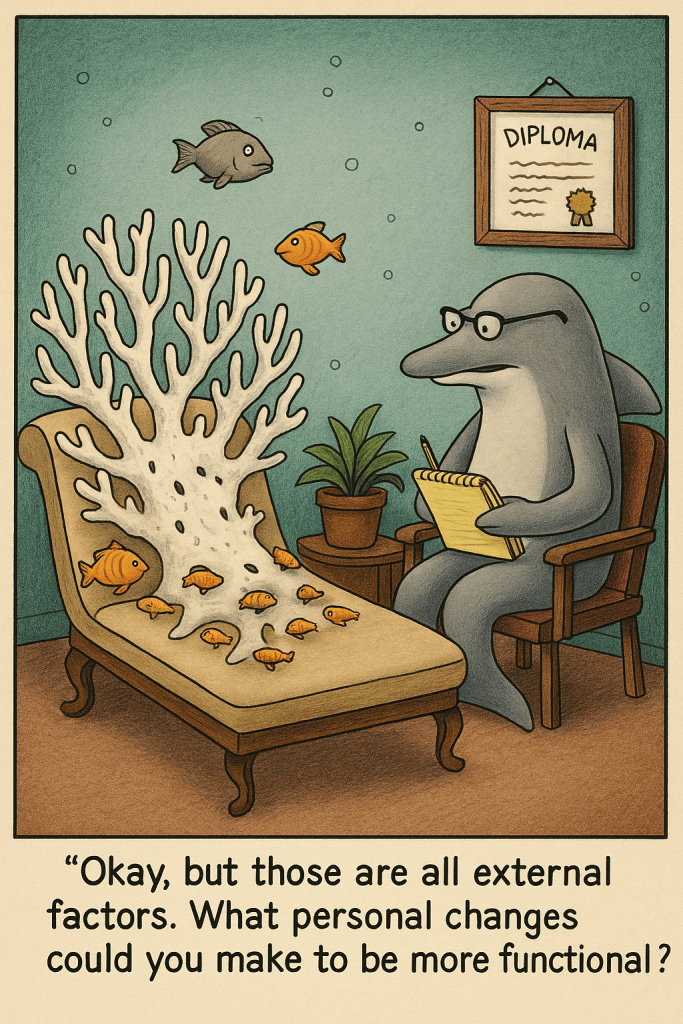
Hyper-Sensitivity
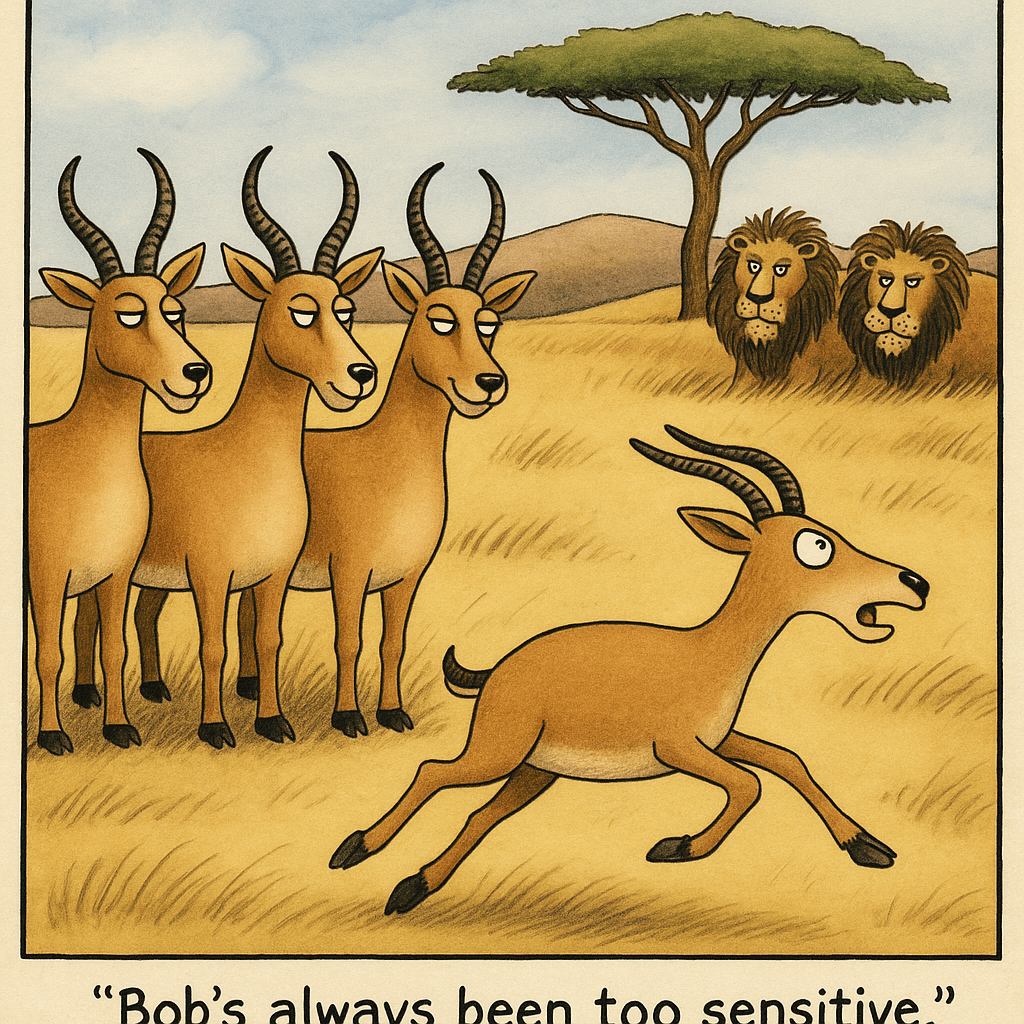
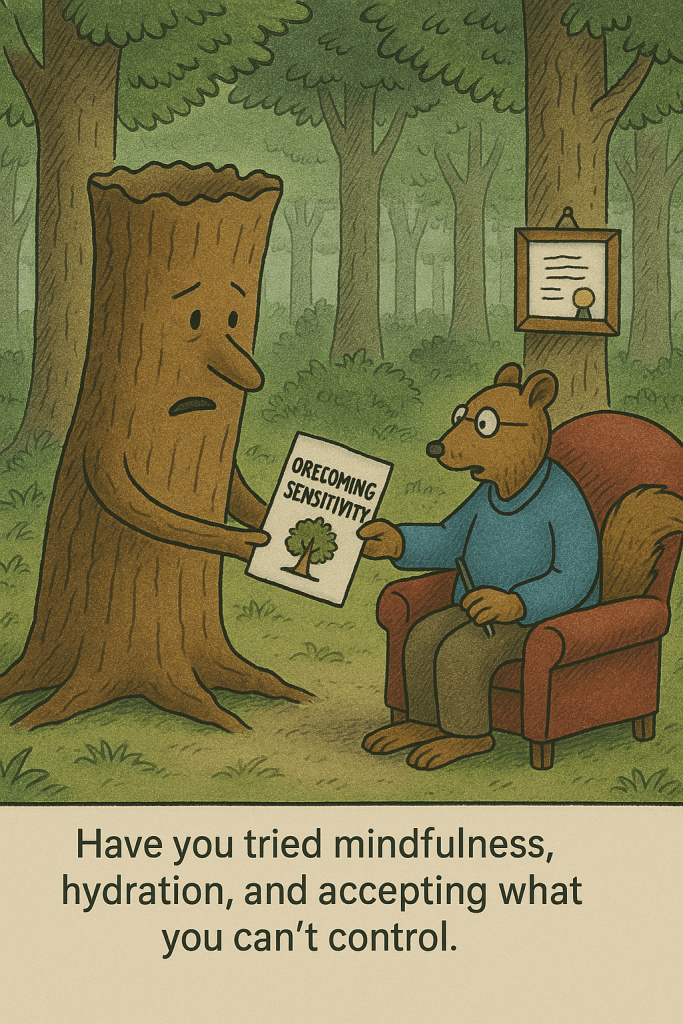
Hyper-Fixation
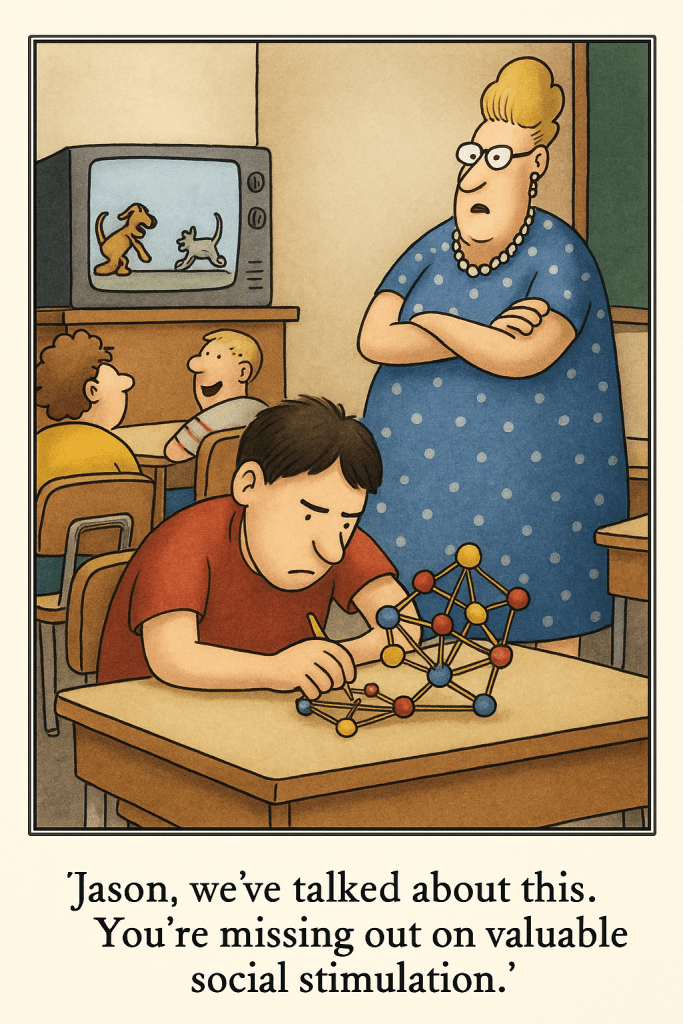
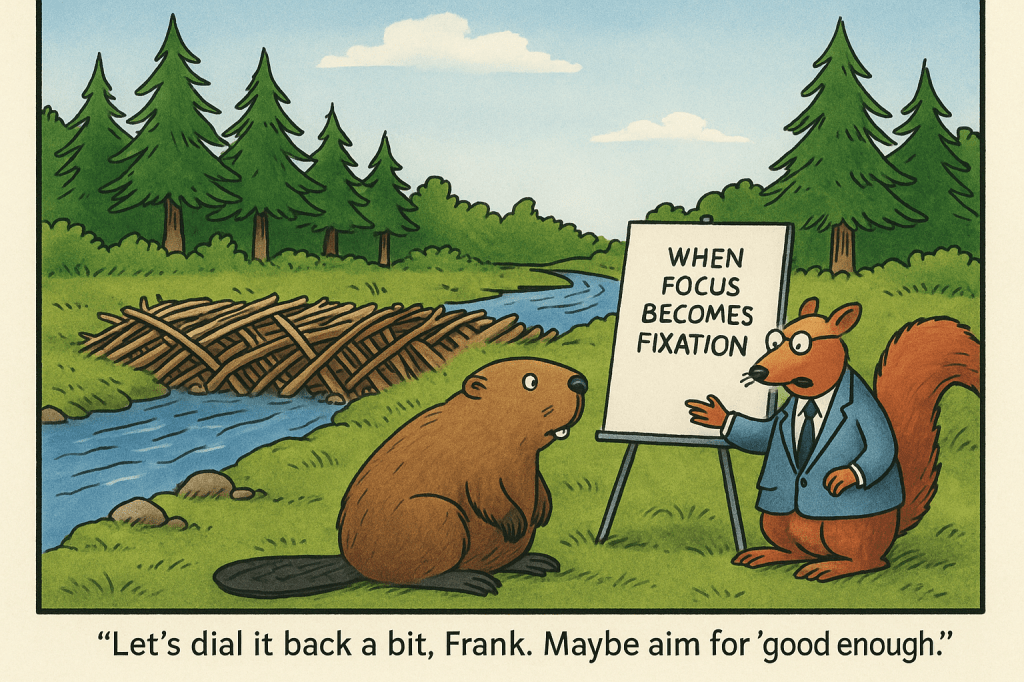
Black-and-White Thinking
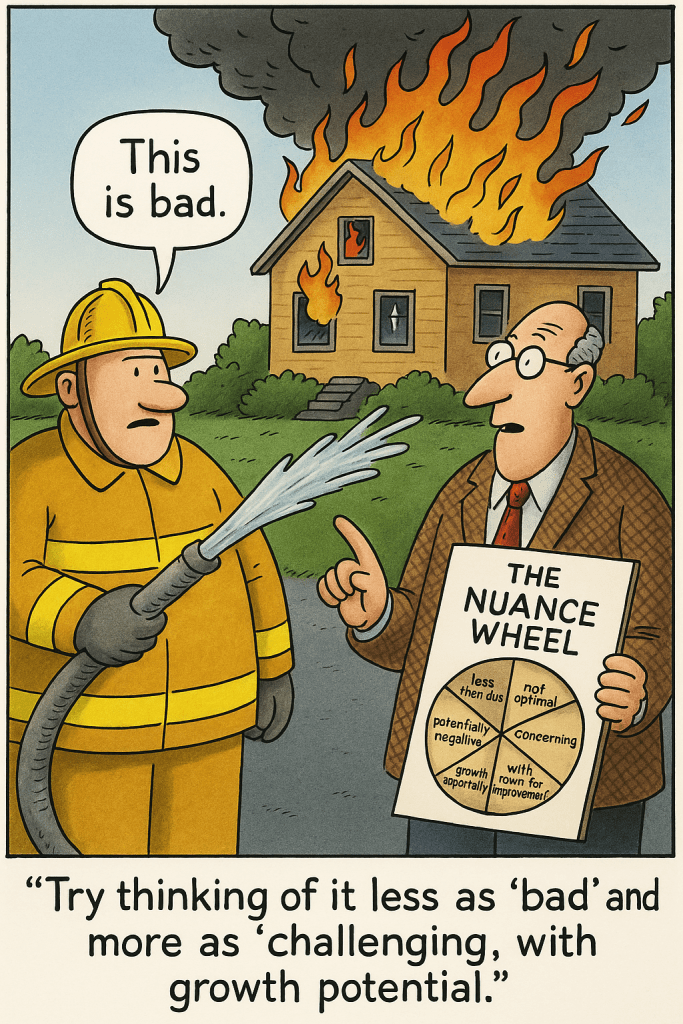
-
Letters to Family after a Late Autism Diagnosis
I hope this note finds everyone well. I’m writing today with a personal request regarding my father, __________.
I’m currently working on a book that explores autism—not just in clinical terms, but in how it shapes lives, relationships, and histories. As some of you may know, my father, __________, was autistic, and is a central part of this story, and yet, in many ways, he remains the least known person in my life.
Knowing that he was autistic, as I am (I was “diagnosed” last year), helps make sense of many things I once could not understand. Unfortunately, I know very little about the first fifty years of his life, only fragments of the two decades that followed, and mere glimpses of his final years.
I’m reaching out to all of you because I suspect there are memories (perhaps small ones, perhaps difficult ones) that might help me piece together who he was. Any story, however brief, however second-hand, however unsavory, is welcome. A childhood impression. A family photo. A moment observed. Even a sentence your parents once said in passing.
I understand that not everyone may have had a positive experience with my father. He could be very, very difficult. He hurt people. I’ve spent much of my life coming to terms with my own grievances. I’m not asking anyone to excuse him…but if there’s a way to understand him more clearly, I would like to try.
When I asked questions growing up (and even in adulthood), the most consistent answer I received was, “Your father isn’t well.” I believe that was said with care. But it left a silence I’ve lived with ever since.
So this is me, asking gently: If you have something to share, no matter how small, I would be grateful.
_____________________________________
Many of you have reached out to me with stories. I appreciate you so much. Apologies if I missed someone in my replies.
Thanks to your help, I’m coming to grips with parts of this story I didn’t even know existed. Not small pieces, either. The sort of pieces whose absence was….incomprehensible? The sort of pieces that, when missing, result in a completely incoherent story. That result in a completely incomprehensible person.
When I’m done, I’d be happy to share some insight into my father with the interested among you (no need to reply here, but you can send me a private message). My father didn’t exist in a vacuum. He was part of a family. Most of the story will be upsetting, but if you ask for it I’ll assume you know yourself well enough to handle that sort of thing.
Because this week of your help alone has yielded so much important information, I’d ask that you continue sharing details with me, as you remember them. Maybe you feel resistance at the thought of sharing them. I understand. No one has an obligation to share anything they don’t want to. Maybe you think some things are better left alone. That is something I have a harder time with. And if you ever read this emerging story, you’ll know why I have a hard time with that. Because a lot of the upsetting parts of this story are the result of just that tendency: a control of narratives and knowledge that presumes one’s own worldview is superior to that of others. We’re talking about some serious generational trauma here…allowed to persist under the guise of good intentions.
No need for a polished email…single sentences with no punctuation, etc., are just fine. It doesn’t have to be a story, even. It can be a feeling you had or an impression you never fully explored.
None of these details will ever be published. The book I’m writing necessitates an understanding of the interplay between an inherent nature (that we call ‘autism’…along with a few other diagnostic labels) and its environment, but it isn’t about my father. My father’s story is a case study that I’d really rather not have. But here we are.
_____________________________________
Thanks for your kind words. To be honest, I still know embarrassingly little about the subject matter of my book. And I’m a bottom-up thinker, so my learning process is SLOWWW….
Your email is the first thing I read today and it made me feel good. And when I feel good, I overshare. That might be autism. Or it might be what an autistic person does when safe opportunities to share feel so rare. Or it might be that a diagnostic label like autism only makes sense in a certain system…a system where certain traits that are normally quite adaptive are pathologized. My book is an exploration of the last. It’s a giant footstomp against being told: “Good news. There’s a name for the way you are. It’s a disability. So just throw that name around and people will have to accommodate you.” But I don’t want to be accommodated. I never have.
Oh boy. Here is an early morning rambling I’ll almost certainly spend the rest of the day beating myself up over.
You may know most of my ideas already. I have a hard time guessing how the things I say will be heard…so I either 1) over-hammer points (the way my father would feel the need to explain the history of juice before telling you he’d switched to the newest Five Alive, maybe); or 2) go straight to a level of abstraction that presumes you know everything in my head already (which is how I adjust my behaviour when my over-hammering tendency gets brought to my attention enough times). In any one conversation, you’ll almost certainly get both from me.
Part of the autistic ‘experience’ is is the constant performances, and one of those performances is pretending to know what one’s talking about until one does. This is one of many behavioral patterns that emerge from the struggle to make sense of social models in which you’re presented with a set of rules that no one else seems to really follow. When you follow these rules you’re ridiculed. Don’t be so literal. When you break them you’re punished. You KNEW the rule. Everyone around you navigates this terrain with far less friction. It starts to feel like they have the real rulebook in their back pocket. Unlike others, I can’t seem to ‘let go’ of that friction. It constant agitates me. But on the outside, you perform. And when the majority of your life is a performance, eventually everything you say feels like a lie. But occasionally, a few days or months later, you’ll realize something you said was true. And you’ll be surprised. Very. You realize that these performances have become as much for yourself as they were for others.
_____________________________________
Ugh…here is some more over-hammering.
As I was going through my morning routine, my mind kept going over how these things will be read by the family. Until I have the fullest story I can have, I’ll be purposely vague. But being vague invites all sorts of potential misunderstandings or objections.
My father had a reputation for ruining the few family gatherings he attended. He would bring ugliness. I think those of you who lived through that might be feeling the same about me. He is his father, after all. Here’s this beautiful online family community we’ve created, where we share news of baptisms, memories of loved ones who’ve passed, and other uplifting news…here’s this guy hijacking the group as some sort of platform for his mid-life crisis. I hope no one sees me like that. I’m painfully aware of the impression I can make. It’s this awareness that partly explains my historic lack of participation with family (but I read everything!). Only partly, of course…there isn’t enough time in the day to explain all the reasons I tend to avoid group settings. And none of those reasons are a particular individual, etc.
There are huge elephants in the room that I have to address.
First, I want you to know that I know my father’s behavior was, in many cases, grossly offensive. If you know what I mean by that, then you…already know. His behavior wasn’t harmful only under a certain light, or without a particular understanding…it was harmful, period.
Second, I recognize the very real efforts made by family to help him. What I have to say is in no way a unilateral dismissal of those efforts.
Next (and this is the hardest to address, by far), there are external circumstances of my life (in fact, probably most of the on-paper circumstances of my life) that make anything I have to say very easy to dismiss. I’ve come to understand that a big part of being a ‘high-functioning’ autistic person (i.e. an autistic person with lower support needs) is that you can blend in just enough to do some incredible damage to not only yourself, but others. I have two failed marriages under my belt, and three awesome children who understandably have some very mixed feelings about me. The behaviors I engaged in, the ones I engineered in order to access love and a feeling of belonging, meant making commitments that were well beyond my ability to keep. And if that sounds like self-serving bullshit to you…well, all I can say is that most days that’s what it sounds like to me, as well.
The parallels between my father’s life and my own are tragic to the point of being comical (almost). We’ve both caused damage. I’ve arguably caused more than he did. I functioned ‘better’ and longer. When you’ve caused damage like that, you lose the right to speak. When you open your mouth, people expect sickness. It’s dismissed, wholesale.
So a huge challenge (insurmountable, even) in explaining yourself as a late-diagnosed ‘high-functioning’ autistic person is the very real danger of having everything you say interpreted as self-serving bullshit. After this past year of corresponding with countless other late-diagnosed autistics, I can tell you this is an almost universal experience. The damage is already done. The collapse came too late. You managed to do X, so you sure as hell can do Y like the rest of us. Grow up. All you can do is shrink yourself and hope that the relational debts you (or, more accurately, the persona you created for others) incurred before your diagnosis will be somehow…forgiven? But you know they won’t be. Because you certainlywouldn’t forgive them.
The other challenge is that autism is largely a difference of degree, not of kind. When you try to explain it, people default to their own experiences. Using our own reference points, we assume everyone experiences the world the same way we do. If I were to present my challenges to you in a list, you’d relate to just about all of them. I don’t like loud environments, either. No one does. I have a hard time with hypocrisy, too–who doesn’t? I have a difficult time with change, too. I’ve felt awkward in social situations, who doesn’t? I do best with a routine, everyone does. But life simply isn’t like that. It really sounds like you just want to avoid challenging yourself. It sounds like you’re trying to rationalize avoiding what everyone would like to avoid, but is mature enough to tolerate. Etc. Autistic adults are 7 times more likely to commit suicide than your ‘average’ person. It’s a bit harder to explain stats like that away as laziness or immaturity or irresponsibility.
-
My “Alexithymia” Isn’t What They Say It Is
When I hear that someone is suffering (really suffering, with no way out) it hurts. The destruction of nature hurts. Reading about people in North Korean prison camps hurts. The quiet death of ecosystems, the slow violence of poverty, the stories I read here from other autistic people, the way the powerless get crushed by systems they didn’t create…this kind of pain gets in me and doesn’t leave. It’s like background radiation. I carry it everywhere.
But when someone is suffering because of something they refuse to change, when they clearly could, but don’t…I don’t feel sad. Not really. Not even when I’m supposed to. And apparently that’s a problem. That’s not empathetic, I’m told. That’s cold. That’s…autistic?
So I’ve been thinking: what does “empathy” mean to most people, then? Does it mean feeling what someone else feels, no matter what? Does it mean echoing their distress, even when that distress comes from avoidable choices, repeated again and again?
To me, empathy includes being able to discern what’s really going on, and responding from a place of integrity. Otherwise, don’t we just cheapen words like “sad?”
It’s strange to hear people say I “lack empathy.”What I feel isn’t absence. It’s selectivity. It’s proportional. It’s based on whether the situation actually warrants emotion, not whether I’m expected to emote.
It’s strange how not reacting becomes the problem. Not the incoherence of the situation. Not the person refusing to help themselves. My failure to perform the right emotion at the right time is what gets flagged as a deficit.
And maybe that’s why I’ve also been having such a hard time with the word alexithymia.
Sometimes I look back on an experience…a conflict, a celebration, a goodbye…and only afterward realize it was happy. Or it was unjust. Or it was sad. At the time? I didn’t feel much of anything. I wasn’t there in the way people expect. And I find myself wondering, is that alexithymia? Is that what they mean when they say I can’t identify emotions?
But here’s what I think is actually happening: I wasn’t allowed to be present. I was too busy tracking the expectations in the room. Too busy trying to be appropriate. Too busy masking. The part of me that might have felt joy, or grief, or wonder, wasn’t at the front of the line. It was buried under a survival protocol.
So maybe it’s not that I “lack access” to my emotions. Maybe it’s that I’m not given access to the conditions where those emotions can surface.
Maybe it’s not that I can’t feel. Maybe I’m just too busy surviving.
-
In Relationship with the World
These are some rough-draft ideas from Part I (Feedback Sensitivity in Coherent Systems)
I’ve come to believe that life persists by listening. Not through force, aggression, or even advantage, but through attention to what the world is saying. Everywhere, in every corner of the biosphere, living systems endure by sensing feedback and responding to it. A single-celled microbe navigates chemical gradients; a beaver adjusts the shape of its dam to match the water’s push and pull. Different forms, different scales, same principle: those attuned to feedback persist.
Feedback sensitivity isn’t a marginal skill. It’s not the biological equivalent of knowing how to fold a fitted sheet (nice, but not a prerequisite for survival). Feedback sensitivity is the baseline requirement for survival.
When I say “feedback,” I mean the circular flows of information in a system: a change in one part affects another, and eventually returns to affect its original source. Biologists call these feedback loops “negative” when they put the brakes on change, “positive” when they amplify it. Either way, they provide continuous regulatory information—a live stream of signals that allow an organism or ecosystem assess its own behavior and adjust.
Feedback insensitivity, by contrast, leads to drift: systems that can’t correct, can’t adapt, and eventually disappear. Whether it’s a sparrow or a forest, the more sensitive the system is to these feedback, the more likely it is to maintain integrity, recover from disruption, and thrive in the long term.
Gregory Bateson, systems theorist and anthropologist, observed that adaptive change—which is survival itself—is impossible without feedback loops, whatever the organism or system. Sometimes that change unfolds slowly, filtered through natural selection. But it also happens in real time, as individuals adjust to experience. When I first encountered this idea in Bateson’s Steps to an Ecology of Mind, it quietly restructured how I understood learning. Learning, I realized, isn’t something that unfolds in the brain, but in the loop, where it emerges as an effect of feedback. A population adjusting to resource limits, a tree directing its roots toward groundwater—these aren’t acts of isolated intelligence. They’re expressions of relationship: patterns being read, limits encountered, responses being shaped. The adjustment, the learning, isn’t something the organism invents; it emerges through its relationship with the conditions it’s embedded in. Bateson didn’t just theorize this loop; he saw it everywhere: in the way animals communicate, in family dynamics, in evolution, even in his own struggle to reconcile science with meaning.
This learning loop is a universal experience, but for me, as a feedback-sensitive (autistic) person, it feels more immediate, more intense. Of course, that understanding of myself is relational, something that only makes sense as a comparison to other people. And I’ve learned the hard way that this is a very precarious place to argue from. I risk confusion or outright dismissal the moment I try to explain that a sound, a smell, or a minor change is flooding my body with stress, cutting through my thoughts, setting off a physiological alarm. These responses are swift and refuse to be ignored. “Everyone feels that way,” “Nobody likes those things,” or “That’s just life” aren’t helpful words in those moments.
As a child, I didn’t have the words to make my case. I barely do now. But at ten years old, I hardly knew I even had a case to make. One of the most underrated challenges of explaining a difference that’s more about degree than kind is how people default to their own experiences. Using our own reference points, we assume everyone experiences the world the same way we do. If you don’t like loud sounds, and I seem overwhelmed by one, your assumption is that I simply haven’t been exposed to enough noise, or that I’m “too sensitive.” That I just need to get used to it. Try harder. Toughen up. As an adult, I can mitigate these dismissive assumptions, but they still follow me and they still piss me off. As a child, however, the enormous gap between what I felt to be true and what I was told was unbearable. It wasn’t just confusion—it was a minute-to-minute hell I had no words for.
Not every system returns the same kind of feedback. And not every setting collapses the loop. When I was seventeen, and not a little inspired by Thoreau, I spent a summer by a remote lake in eastern Ontario. Not in the off-grid house my grandparents had built, but just across the water, alone in a tent, on a quiet wooded slope that backed onto crown land. I packed everything I needed on my mountain bike and rode the hundred or so kilometers from home in a day. This was my version of Walden Pond. I fished for food, gathered wood for the fire, cleared a small trail. I read. I wrote. I woke with the light, slept with the dark, and moved in rhythm with the weather. There was nothing metaphorical about it—I was in relationship.
There were no social games to decode, no hidden meanings. No buzzing fluorescent lights humming in the ceiling or televisions playing in the background. No sudden shifts in routine. No need for performance. The world around me responded plainly to what I did: when the rain came, I got wet; when I built a fire, I got warm. The system I was inside gave immediate, proportionate feedback. And I adjusted. Not always well. I’m no Thoreau. But faithfully.
I didn’t have a name for it then. But I read Bateson that summer, tucked into a sleeping bag with a headlamp or sitting on the raft at sunrise, and something in his writing gave shape to what I was living.
What I was experiencing was coherence. Not just in the sense of quiet or stability, but in the deeper, systemic sense: pattern integrity. The way things fit together and return information that makes sense. That feedback loop didn’t just regulate me. It affirmed my existence. I wasn’t broken, or too much, or not enough. I was inside a system where responsiveness wasn’t something to suppress; it was a quiet necessity.
That summer changed me…not because it taught me something I didn’t know, but because it stopped contradicting what I already did. My perception, my sensitivity, my reactions, they finally had function. I could feel a difference.
Reading Bateson gave words to a pattern I was already living inside. He writes that when we say some particular organism survives, we’ve already taken a misstep. It isn’t the organism that survives. The real unit of survival, he argued, is organism-plus-environment. I knew what it meant to be part of a system I couldn’t separate myself from. My behavior wasn’t just coming from inside me. It was part of a loop. A reaction to something. A response to conditions.
People like to talk as if we’re separate from our surroundings, as if we’re making decisions in a vacuum. But I’ve never experienced that. When the room shifts, I shift. When the pattern changes, I change. Contrary to what cabin-in-the-woods fantasies would have us believe, life next to a lake is no exception—change is constant, and often requires a response. But those changes didn’t feel like threats or tests. They didn’t throw me into a dysregulated state. I was simply in relationship with what was happening around me. I felt the stability of coherent feedback.
Bateson helped me recognize the shape of my own experience. Here was a loop that I was a part of, rather than trapped within like a caged, disruptive animal, pacing in circles, desperate to make sense of the world outside. He called it a coupled system…two parts shaping and sustaining each other. Not always well. Not always clearly. But inseparably.
We separate the two (organism and environment) because it helps us think more clearly. But it’s only a framework. And frameworks can lie if you forget they’re not the thing itself. It becomes easy, maybe even inevitable, to try to save one part of the system by overriding the other. But that isn’t intelligence. It’s the system misreading its own conditions. “The creature that wins against its environment destroys itself.”
Coherence isn’t a solitary achievement. It’s not just mine, or just yours. What makes life possible emerges from relationship, from one part of a living whole responding to the cues and limits of the other, and adjusting behavior in response to this feedback.
Even at the most fundamental level of physiology, feedback sensitivity is what keeps life stable. Every organism is a dense network of feedback loops, each constantly adjusting temperature, chemistry, and structure to maintain balance, even as the world outside shifts and changes. When my temperature rises, sensors in my brain detect the change, triggering responses like sweating or an increase in blood flow to the skin, cooling me down. A bacterium in a pond does the same, swimming toward nutrients and away from toxins, adjusting in real-time to the environment it encounters. These aren’t metaphors for intelligence—they’re the building blocks of it. Each feedback loop is an expression of life’s most fundamental drive: to stay aligned with the larger pattern.Biologists Humberto Maturana and Francisco Varela coined the term autopoiesis to describe how cells sustain themselves through constant feedback. A living cell isn’t just shaped by its environment; it actively engages with it, adjusting its internal chemistry in response to what it perceives. Life, in this sense, is not a static condition, but a never-ending dialogue—an exchange between inside and outside. Fritjof Capra, in The Web of Life, asks us to rethink cognition, not as something locked away in the brain, but as this very dialogue, an ongoing loop of perceiving, responding, and adjusting. Life is that loop. It isn’t just one side of the equation—organism or environment. We use that distinction to frame our sense of self, but really it’s just an abstraction. The truth is, we are the loop. When you say something is alive, what you’re actually describing is its ongoing participation in a dynamic feedback loop. You are not a fixed thing; you are a living, breathing process. An energy flow. And while it sounds ridiculously abstract, it’s the truest way to describe what we usually think of as you. It also happens to be the best explanation for why, for me as a (more) feedback-sensitive person, this fluid sense of self feels more pronounced, an experience of life where that constant adjustment to the world lives much closer to the surface.
-
Fuck “Nature”
“I love nature.”
“I don’t do well in nature.”
“I like nature, but ______.”What the hell do you think nature is, exactly? Why is it reduced to a word? Is it one place among many? Where you bring your dog to take a shit? Where you take a picture of a sunset? What you call “nature” is literally EVERYTHING THAT ISN’T MODERN SOCIETY. That’s a lot to dismiss with a word. It’s 1.3 billion years of life. It’s everything that ever did and ever will provide food, water, and air. Everything you eat, drink, and breathe comes from it.
Nature is REALITY. Swap “nature” with “reality” in everyday conversation, and see the insanity of the modern human paradigm.Wanting to be in reality is a good sign. A signal of health. I’ve been in “nature,” in places that were real, and I am better there. Every organism stands a better chance of thriving in what we call “nature” than in the distortions of modern life. We thrive in reality. Who the hell knew? When and why did we begin thinking otherwise? When did “nature” become something to compare life against? When did we fall for that trick?
Let’s stop rewarding dissociation and calling it resilience.
-
I Can’t Express my Ideas Properly
When I write, I either spend too much time explaining things people already know (which frustrates them) or I say things without explaining them properly (which frustrates them). I can never find find a happy medium.
I’ll try to explain what I mean by “feedback sensitivity.”
When I was diagnosed, I spent months watching the same videos and reading the same books most people watch and read after a late diagnosis. I had the same feelings (probably).
I wanted to know WHAT MY AUTISM WAS. At its core. People say these particular traits are not really autism–they’re co-morbidities. Ok. Let’s put those aside. Therapists say these particular thought / behavior patterns are the result of layered trauma (i.e. decades of being autistic in a “neurotypical” world). Fine. I can see that. Let’s put those aside, as well.
What’s left? What’s at the CORE of this label people give me (autistic/ADHD/OCD/etc.)?
I was left with a pretty short list of what I started to call core traits. Black-and-white thinking, a need for routine and predictability, a need for a certain level of novelty, deep focus, etc.
But lists don’t do much for me. They never have. They taunt the part of me that needs to reason inductively, to find a larger explanatory model. I wanted to know what was common to all of those traits. Where do they come from? What explains them?
(Like anyone would, I applied my own existing knowledge, biases, and frameworks to the task. I’m heavy into permaculture, ecology, evolution, anthropology, and a few other fields. These have always been my “special interests,” as the clinical lingo goes.)
I went down a lot of paths. Some of them were just wrong, and I had to double back. Some led me to the ideas you read about in my book work as it stands, but they sounded different at the time.
They weren’t completely wrong, but they were juvenile or incomplete.For example, I toyed with the idea that I have a DRIVE and a NEED to seek out species-appropriate stimuli and environments (things that are good for humans, in general), and the extent to which I succeed…I’m FINE. The extent to which an environment or stimulus is NOT species-appropriate (not good for people, in general), I’m NOT fine. In fact, the parts of me that were just fine, strengths sometimes, in healthy environments, became disabilities. I still believe this…but I wasn’t happy with “species-appropriate.” Because it didn’t take long for me to realize that what I was talking about were things that were good for ALL forms of life (animals, plants)…not just people.
In the end, what I found to be common to all the traits on my list was: sensitivity. They were all forms of sensitivity. More or less sensitive to change than a neurotypical person. More sensitive to contradiction. To unpredictability. To sounds and smells. Still with the species-appropriate idea firmly in mind, I felt strongly (and still do) that the change I was overly sensitive to wasn’t a level of change that was good for any person…those people were just somehow less sensitive to it. The same went for contradiction. Contradiction doesn’t benefit anyone…it leads to most of the problems we see on the news. The sounds and smells I was “overly” sensitive to? They were the smells and sounds of activities that are harmful to all people (and all living things, really)…engines, synthetic perfumes, etc. So I’m sensitive to harmful things. But shouldn’t I be? Why isn’t everyone else?
I started to think about what allows a living thing succeed in an environment, and what causes it to fail. And I came back to a pretty fundamental principle: an animal succeeds depending on how well it can figure out the rules of a place. The better and faster it can understand the rules of a forest/prairie/pond/etc., and the better it can change its behavior to match those rules, the better it will survive and reproduce.
Break the “rules” of the forest, and you will be “corrected.” Walk through a patch of poison ivy, and you’ll be in discomfort for a week. Go out at the wrong time of day, and you’ll be eaten alive by mosquitoes. These “corrections” the forest is giving you are known as feedback. It’s sort of a strange thing to say because we think of “feedback” as something a person gives to you. Something that’s given to you on purpose. But in ecology, the consequences of your actions in a certain ecosystem are just that: feedback / correction.
So, on the whole, the more sensitive you are to that feedback, the better you’ll survive and reproduce. The better you can read signals and adjust your behavior by them, the more success you’ll have. It’s evolution 101.
With that in mind…I came back to my experience in the world as an autistic person. I’d established (in my mind, anyway) that my level of sensitivity is the right level of sensitivity for a living thing. I didn’t have to come up with hypothetical scenarios to prove this to myself, I spent a lot of my early years at my uncle’s or grandfather’s…remote off-grid places where I just…lived.
But here in this place….I AM dysfunctional. It doesn’t “feel” like I’m dysfunctional, I really am. And it’s that trait, that feedback sensitivity, that is doing the disabling. But that’s ridiculous, isn’t it? How could THE trait most responsible for a living thing’s success lead to disability?
So I tried flipping the narrative. What if it’s the place? What if every single one of my core traits are really just indicators of what’s wrong with this place? “Deep” focus? There’s nothing deep about my focus when I’m in the woods. It’s just focus. “Black-and-white” thinking? In nature? Are you kidding? That’s the only kind of thinking there is. Something is either true or it isn’t
I knew that this wasn’t a very nuanced argument. I knew there were holes. I knew that it was based on my own particular autism, my own particular need for supports, etc.
BUT….core traits, right? CO-morbidities, right? Trauma, right? These are NOT autism. They’re either something that occur with it (they can occur in people who are not autistic) or something that is the result of my “autism,” that core trait of feedback sensitivity, playing for a long time in a very dirty sandbox.
I hope this helps someone, somewhere.
-
My Abyss
My father lived in a dark place most of the time. It was deeply uncomfortable to be around. He’d rant and spiral, consumed by things that felt wrong to him, things he couldn’t let go of. The world became an enemy in his eyes. He raged outward, with a kind of schizophrenic intensity. The air was thick with it.
He would obsess over some perceived injustice or corruption and inflate it beyond recognition. He’d talk about it for weeks. He couldn’t stop. And what might have started from something real would get buried under the weight of his fury. It got ugly. He was ugly. In the end, it looked like nothing but rage…a need to be right.
That’s probably me now.
I feel the same storm building. The same fixation. The same alienation. I walk around already knowing the look people get when they start to back away. I see it. And when I get “like this,” the only thing that’s ever let me forgive myself for being so awful to be around is the belief that what I’m working on matters. That it has to be done. But on the days when I lose hold of that belief, days like today, I just feel monstrous. And ridiculous. A negative force, making everything I touch worse.
What if I’m not fighting the madness I think I am? What if I am the madness? What if this moment, the one where I think I’m beginning to understand, is actually the total loss of my grip on what’s real?
I truly met my father when he was already twenty years older than I am now. I don’t know what he was like at my age. Maybe he was nothing like how I knew him. He might’ve been more functional than I am now. More self-aware. Maybe I’m falling faster. I always have this version of him in my mind…unhinged, over-the-top, shouting…and I swore I wouldn’t become that. But that wasn’t who he always was, was it? Nobody is born like that. He was like me once, believing he still had all the time in the world.
Sometimes I think I’m running the same race he lost.
I’ve spent a lifetime waiting for someone to really see what’s inside me. Not in a vague “I believe in you” kind of way, but someone with the understanding and the means to give me time. Breathing room. A protected space to develop the thing that keeps flickering inside me. Not a free ride. Not praise. Just time. Space. It’s a childish fantasy. I know that. But I’ve spent a lifetime waiting for those people anyway.
And some days I’m sure there is no such person. That I’m in a world of one, like my father, and that my ideas only make sense there. Only make sense to me.
Today, I feel rage. Toward myself. Toward the world. I’m disgusted with how seriously I take myself. But I’m still angry at everyone else for not taking seriously the things I see. People mowing 40 million acres of lawn, stupid or demented…I honestly don’t know which. As if nothing ever gets through. A mirror has been held up a million times, a much better mirror than I could ever hold up, and they just keep brushing their hair in front of it.
Confusingly, I feel a lot of rage toward autistic people online. I’m ashamed and embarrassed to admit this, but I feel abandoned. I pour myself into something, try to name what I think we‘re really feeling…something deeper than just day-to-day frustration or sensory overload…and I watch it get buried. No replies. No spark of recognition. Just more talk about dating and work anxiety and video games. Or I get torn apart. “So you’re saying [strawman argument]” (followed by 37 replies equally outraged by that particular false interpretation of my thoughts). I feel rage, not because I don’t care about them, but because I need someone to say, this is it. This is what I’ve been trying to say, too.
Instead, I feel like a freak. Screaming into a void.
It makes me feel ridiculous. Like maybe this is just a blown-out-of-proportion hyperfixation, after all. Like maybe all of this…the thinking, the writing, the physical stress…is just some “autistic loop” with an inflated sense of importance. And I feel so, so ugly. For my parents. For my partner. For anyone close. And I wonder, no I scream…WHAT IS IT ALL FOR?! What exactly do I think I’ve earned? What exactly do I think I deserve?
Because by society’s standards, I’ve gotten exactly what I deserve. Nothing more. Nothing less. And everything I gave…every piece of myself I tore out and offered…it looks like less than nothing. Just another strange, intense person with grandiose ideas and no ground beneath them.
Sometimes I think I’m brilliant. But I also think I’m trivial. Laughable. I don’t trust my reality. Not at all. I keep waiting for confirmation. Not from a crowd. Just from someone. Someone who can say, without hesitation, you’re not insane.
Because I’m fucking terrified.
Not that I’ll fail, but that I’ll become twisted beyond recognition long before I can save myself. That I’ll lose the thread entirely and end up in some permanent shape the world finds repulsive or sad or best hidden. And that the world will come for me. That it will come for my masks. For debts owed. What will those people find? Something unable to defend itself. Unable to explain itself.
I don’t want to be that.
I don’t want to be alone in that.
I want someone to see me, not as a burden, not as a cautionary tale like my father, but as someone worth helping before it’s too late.
And I don’t even know if that’s possible. -
Overstimulated by Bullshit
I’m working on a section that explores neurodivergence and artificial reward systems. I’m looking at how modern society’s “treats” affect neurodivergent people…especially compared to neurotypical peers, who function as a control group.
You just don’t want to shower.
You just don’t want to stop drinking.
You just want to scroll, play video games, snack, sleep in, give up.
You don’t want responsibility. You want excuses.
You’re not “neurodivergent.” You’re just impulsive. Lazy. Weak.
Grow up.That’s by far the loudest voice in my head.
For years, I’ve tried to hide the fact that I can’t tolerate environments, stimuli, contradictions, etc. that others seem fine with. But I’ve also had to hide what seems to be an inability to resist what others do. I can’t have games on my phone without playing them excessively. I can’t have junk food in the house without eating myself sick. So I don’t have either. I have to keep the phone game-free and the fridge can only have whole foods. It’s embarrassing to admit. And this feeling isn’t a hindsight sort of thing. I feel it RIGHT NOW. Being overwhelmed by modern society’s excesses will probably ALWAYS feel like a personal moral failure to me (no matter how I tell myself it might be something else.
What makes me special? Why wouldn’t people assume when I say I’m autistic or ADHD, that I’m trying to cash in on some behavior lottery…one that gets me out of doing things no one really wants to do, and grants me freedom to do whatever the hell I want?
If that’s how you see me, “Nice try, asshole,” is probably the correct response.
My own particular mask doesn’t help…the one I’ve worn most for the past ten years or so. It could best be described as “interesting redneck.” A bit of me peeked out, of course. The permaculture methods I like to use on my property. The odd opinion I shared…on how nice it was to have deer in my fields again (during Covid lockdowns), for example. Or repeating (a little too often) how grating the sound of the increased traffic on my road is. But by and large, I masked as what you would expect to find in a middle-aged man in a rural area. Work hard, play hard, don’t give me excuses, and all that bullshit.
My diagnosis was like a chair to the head for that mask. None of the literature I was reading, none of the data I was seeing, could possibly allow it to survive. It didn’t just get heavy…it was putrid. It reeked of stupidity, and I knew I’d never be able to pick it up again, let alone put it on. The same proved to be true of all my masks. The studies, books, and data exposed them all for what they were.
I’d convinced myself, but how can I convince others? Put aside the fact that I’ve never been good at that. Let’s say, for a moment, that I was somehow able to articulate myself in a way that would cause people to listen. Well, even if I managed to quell the straw-man argument hell I was opening myself to (“What the hell are you on about? My 5-year-old autistic son has yet to speak a word. He needs help getting dressed. And you’re trying to sell me the idea that autism is some sort of biological advantage? Fuck you.”), anyone with an (indoctrinated) brain in their head isn’t going to listen to me then explain how me not taking a shower or having a beer at 9 in the morning might not purely be a personal failing. These are big bloody obstacles. The feedback I got from the few people I shared my ideas with was nothing but confirmation.
I knew I would need an insurmountable amount of data to even have the slimmest chance of reaching a mere fraction of the most open-minded readers.
I found it.
I didn’t just find it…I found it with ease. (The comparative studies are everywhere. Meta-analyses. National surveys. Neuroimaging. Behavior data. It’s not subtle.)
It needed minimal organization. It formed its own framework. And for someone like me, that’s….sheer ecstasy. An explanatory model that not only survived months of scrutiny, but instantly encompassed my hunches, my experiences, and my conclusions? How often does that happen, really? I’m a bottom-up thinker, an inductive thinker, my very nature precludes the possibility of cherry-picking data for a theory, no matter how attached I am to it. Devil’s advocate isn’t one voice among many in my head…it is the voice. I can’t “let things go.” That isn’t a flex…it’s just the way I am (and gets me into all sorts of shit). But this research was turnkey. It formed its own coherent argument. One that made me physically excited. Happy dance-flushed-stimmy excited.
I’ve known for a long time that modern civilization doesn’t run on real signals. It runs on engineered superstimuli—“food” that’s sweeter than food, screens that flicker faster than your brain evolved to track, validation loops designed to mimic love, stimulation, and safety. In 2025, everyone knows that, really. It’s common knowledge—almost trite. And for most people, not a minority, these things are hard to resist. But for some of us, it borders on impossible.
My experience isn’t a story of addiction or lack of willpower. It’s a story about susceptibility. The susceptibility of a feedback-sensitive brain to systems that were built to extract something from it. Clicks. Likes. Data. Energy. Money.
Let’s be clear: not all of this is about chasing pleasure. Sometimes, it comes from avoiding pain. The sensory chaos of a grocery store. The moral incoherence of workplace small talk. The emotional friction of living in a world that doesn’t return clean, proportionate feedback. Many neurodivergent people withdraw from that world…not because we’re lazy or disinterested, but because it costs too much (neurologically) to stay in it. But withdrawal comes with its own costs. You’re not going to the farmer’s market. You’re not joining the running club. You’re not cooking a family meal. But you seek what you need (quiet, stimulation, reward) somewhere. And modern society is more than happy to offer it: in bags, in bottles, on screens.
Still, that’s not the core argument here. Avoidance doesn’t explain how precisely these systems seem to exploit my wiring.
This isn’t just about being boxed in by circumstance. It’s about how the system itself is built. It’s about the intensity of the signals, the distortion of natural feedback, the way those signals strike differently in the more sensitive among us. It’s about the fact that even when the external stressors are removed, the engineered signals often still hit harder, register deeper, and dysregulate faster.
It’s about what happens when a feedback-sensitive person is exposed to artificial reward systems.
Do you know what happens?
When the signals get too loud for a feedback-sensitive brain to filter or resist?
28% of adults with ADHD are obese. That’s not about chips being available. That’s about chips being formulated…saltier, fattier, more dopamine-releasing than anything in the ancestral record. The average? Sixteen percent. This is a feedback-sensitive brain lighting up “more,” doing its job. It doesn’t let go.
Children with autism? 41-58% more likely to be obese than neurotypical peers. Are they less able to comprehend what is healthy? Do they have less willpower? Are their parents less caring or strict? Or is it because engineered food is built to override satiety? To turn feedback sensitivity against itself?
25-37% of teens with ADHD meet clinical criteria for internet gaming disorder. Not “likes games.” Disorder. Autistic children? 3.3 hours of screen use vs 0.9 hours/day for neurotypical peers. Autistic adults? Statistically higher scores on gaming addiction tests (9% higher than clinical thresholds). Why? Structured environments. Rules. Possibility of mastery. Variable-ratio reward schedules. Sensory immersion. Linear feedback. It’s everything a feedback-hungry person wants. These are conditions they are starving for…rarely present in that place we now call the real world.
Social media hits harder too. Each like, each comment, each notification…engineered to simulate social connection. For ADHD, it becomes a loop. For autism, it becomes a need. These are two sides of the feedback-sensitive coin. Both are pulled deeper, faster, and stay longer.
Pornography? Another biological drive hacked: reproduction, bonding, pleasure. But louder. Faster. On-demand. Zero ambiguity. Anyone might get addicted. But for ADHD brains (for a feedback-sensitive person living in a system that lacks biologically-significant novelty), it’s dopamine on tap. For some autistic people (feedback sensitivity in a system that’s full of distorted signals and contradiction), it becomes a ritual. Not because of what it is, necessarily (pornography), but because of how it behaves as a signal.
Substances? The brakes and accelerators we use to reshape society’s feedback into something comprehensible, or at least dull it? 23% of people with ADHD have a co-occurring SUD. Autistic adults are nearly 9 times more likely to use recreational drugs to cope with the consequences of distorted feedback (anxiety, sensory overload).
Compulsive shopping, binge-watching, substance abuse, overuse of screens: same pattern. Not lack of restraint. Not moral decay. Signal distortion.
These systems engineer signals based on how the human brain picks up and processes information. They’re not bloody well accidental. They’re designed to strike the nervous system where it’s most receptive. They’re practically a case study in human feedback-sensitivity (funded by consumer / tax dollars).
The more sensitive the person is to feedback, the better these signals “work.” It isn’t complicated. So why? Why is it contentious to say these things? Why, despite everything, do labels of dysfunction continue to accumulate on this side of the equation?
At this rate, we’ll need to expand the English language. The words don’t exist yet for the number of labels we’ll need. Because this is the gradual pathologization of life itself.
-
Transitions SHOULD be hard (in this place)
I’ve had a problem with transitions my whole life. Bed to shower, shower to kitchen, reading to greeting guests, greeting guests to mowing the lawn…it’s always a fucking battle with myself. When I was diagnosed, I was told what I already knew: “You’re bad with transitions.” You overreact (I do). You shut down, or get stuck, or blow up at things that seem easy for everyone else (I do). I was given new words. Cognitive inflexibility. Behavioral rigidity. Insistence on sameness. Resistance to change. Perseverative behavior. Pathological demand avoidance. Dependence. Delay. Resistance. Slow. Poor. Intolerance. Difficulty. Rigid. Distress. Impaired.
OK, so I’m clearly not cut out for life.
But is it life?
In a coherent system, the one we evolved in, transitions aren’t hard. Not because organisms there are tougher or more flexible, but because the transitions themselves make sense. They’re part of that system. Seasonal shifts. Puberty. Grief. Rest. They don’t happen suddenly or without warning. They come with cues. Physical cues. Environmental cues. Even social cues.
Here’s the thing: organisms from those systems don’t “adapt” to the timing of transitions. They’re formed by them. There’s no gap between the system and the self. The rhythm outside becomes the rhythm inside. I don’t just endure spring. Don’t be ridiculous. I become the kind of creature that responds to spring. I don’t “handle” hunger. I become hungry. In a place that makes sense, that leads to finding or growing food. The feeling arises with purpose, and the transition it asks of me (movement, focus, effort) is supported by everything around me. I’m doing what I’m meant to, when I’m meant to.
That’s what real feedback does. It shapes you as it informs you. And when something in the environment changes (something biologically real) a feedback-sensitive person picks that up fast. They change in response. And they change quickly, and they change well. In step with what’s actually happening.
That’s feedback sensitivity: the degree to which your behavior maps to signal. That’s what makes an organism adaptive. That’s what makes a person adaptive. Not just quick to change, but able to change in a way that fits what’s real.
It’s not a side trait or a quirk. It’s the foundational condition beneath every other trait we call adaptive. Learning? Downstream. Flexibility? Downstream. Even thought (real thought) starts with the ability to pick up on what’s true, and respond.
That’s what makes it so fucking painful to live in a system where most signals don’t mean anything.
Modern civilization is full of transitions, but they aren’t tied to any real need. They aren’t about my body, or the land, or the seasons. They’re constructed. I move from one grade to another. One job to another. One building, platform, device, account to another. One activity of questionable importance to another. It’s not that my life changes…it’s this weird environment demanding I act as if it has.
I try to keep up. Because I’m still wired for signal. I still think transitions mean something. But they don’t anymore. They’re non-referential. They point to nothing. They’re fast, constant, and nearly always disconnected from any ecological pattern or how ready I am. And the more I try to track them, the more exhausted I get. Because I’m not supposed to track that kind of noise. I was never meant to.
Modern civilization doesn’t create real transitions. It just repartitions reality…chops it into convenient segments that suit its own internal logic. It rearranges things for the sake of efficiency, not coherence. It runs on deadlines, not seasons. Bureaucracy, not biology. And when its logic starts to fail (it usually does) it doesn’t get corrected by feedback. It distorts or severs the feedback loops that would normally force it to change. So that I get corrected. I get labeled.
It builds itself on top of the coherent system (the real one: biological reality)…but increasingly in defiance of it.
And then it calls me broken when I struggle.
But let’s be honest: struggling to move from one meaningless task to another, from one harmful environment to another, should be difficult. Struggling to shift from something that matters to something that doesn’t…that should be hard. If it’s not, that’s not a sign of health. That’s a sign that something inside has gone quiet. That feedback sensitivity (the thing that tells you what fits, what hurts, what’s true) has been pushed down so many times it stops trying to speak.
We live in a place that celebrates that. It calls it resilience. Social intelligence. Professionalism. Maturity. But more often than not, it’s just the absence of protest. A learned silence.
Here’s a deeper layer: over time, humans selected themselves for exactly that. Not for sensitivity to truth, but for compliance. For docility. For the ability to tolerate contradiction without protest. That’s self-domestication. It’s what lets people smile while a system collapses around them. What lets them adapt to noise, to simulation, to systems that reward pretending more than perceiving.
And that’s not a knock on anyone…it’s just what systems like this select for. If I can’t seem to get on board with that, I’m pathologized. Called inflexible. Dramatic. Disordered. And those are all accurate descriptions of me in places like that.
But is difficulty with incoherence really dysfunction? Isn’t it the thread of something real?
I can handle change. I can’t ignore when a change isn’t grounded in reality. When a signal doesn’t match a truth. When the transition isn’t tied to anything that matters. My whole system lights up. I think maybe it’s supposed to.
-
Masking: The Feedback That Lies Back
May 10 2025
“The biggest mistake I made was believing that if I cast a beautiful net I’d catch only beautiful things.”
I hear sad stories from autistic people every day. They make me sad, too. They’re about loneliness. Will I ever have a friend? Will I ever be in a relationship? And their counterparts…the angry ones. I don’t need anyone. I’ll never be in a relationship. Fuck it. I’m better off.
That landscape was once familiar to me.
(And this is me putting up my hand to tell a story, not offer advice.)
Like a lot of autistic people, I spent my childhood isolated. More than isolated…alienated. Metaphysically alone. Something apart from reality.
But in high school, I met someone.
He was everything I wasn’t: charismatic, socially adept, functional. But he liked me. He called me. He made plans. He used the word we. I’d never heard that from someone my own age. By then, I’d learned to confine myself to adults, people I could track better. But he cracked something open in me. Peers were dangerous. But somehow, he wasn’t. He became, quite literally, my Demian (I’d just finished Hesse’s novel when we met).
Of course, I did the mimic thing. I wasn’t sexually attracted to this person, but from the outside, you might have mistaken it for that; for limerence. In no time, I picked up his speech patterns, his gestures, the way he scratched his face, his deodorant, tone, even how he cleared his throat. And for the first time, it worked. I had a friend. A real one. And if you’re beginning to picture me as Tom Ripley and him Dickie Greenleaf, you’re not far off the mark. It was like that in some ways.
We did everything together…martial arts, schoolwork, debate club, squash. We talked endlessly. About Nietzsche, Pink Floyd, absent fathers, girls, uni. We came up with brilliant social satire. We made prank calls. Our time together was painless…a completely novel experience for me. Here was a human being whose presence I wasn’t just surviving, but functioning within. Being with him was a social scenario, of course, there was still performance, but somehow it didn’t cost me. I could be around him without having to enter environments that wrecked me, without feigning interest in things that bored me to tears. It was seamless. It was euphoric.
He didn’t tolerate dissent. Opinions that diverged from his were dismissed instantly (first with a bit of condescension and, failing that, silence…he withheld his attention). And I didn’t fight that. That didn’t even occur to me. Why the hell would I fight it? I was intelligent and well-read, but I’d never really had a worldview of my own. I was a steak burnt on one side, raw on the other. And I had as deep a longing for acceptance as anyone (though I never would have admitted it).
His worldview was cynical. I was more than happy to adopt it. Misanthropy is an easy fit when you experience life as a young autistic person, maybe.
In 1st-year uni, we became roommates. Of course we did. I was now part of a unit, and I would do anything to preserve it.
That included writing his papers. It started as “help,” but turned into me pulling all-nighters after closing shifts at the bar, writing his assignments while he slept. One of the costs of “we.” His education was paid for by his mother and step-father. I was bartending my way through (you can imagine what kind of sensory environment that was). This didn’t make me resent him, but my schedule began to preclude the sort of time we’d spent together before.
Looking back, I see the dynamic clearly. He collected two types of people: peers and followers. I was the latter. All of us Followers were quirky, a bit “off,” grateful to be included. He didn’t like us socializing without him. That wasn’t explicitly said. It didn’t have to be. When we crossed invisible lines, he’d pull away. Host parties with his real friends (in our apartment). I’d retreat to my room, but that in itself wasn’t upsetting. I’d spent my entire life up to that point retreating happily to my room.
He’d return to me…for a favor, a table at the bar, a paper. It felt like the sun shining on me again. I was seen. Then it would vanish. This repeated for a year or so.
By the time I was both bartending and working security to make ends meet, things had cracked wide open. I’d close the bar, then run across the street, not exactly sober, change into my mall cop uniform, perform coherence for the handoff, then find a dark cubicle and sleep it off on the floor. I stopped going to class. I didn’t drop any courses that year…I simply stopped going. Lecture halls with 200+ students. TAs who seemed more interested in personalities than academic substance. If ever there were a place designed to weed someone like me out, this was it.
I became less useful to him. I wasn’t impressive anymore. I was an embarrassment. A ghost in the apartment. I stopped cleaning. Those weren’t my spaces anymore. They were public. It felt like a fraternity. I was done performing (not by choice…I seemed to have lost the script), and he was done with me.
This wasn’t a one-off. I can see it now in my romantic relationships, as well. That pattern: power imbalance (even now, I feel silly saying things like that), adoration, usefulness followed by discard—was everywhere in my intimate relationships. Sometimes it was sexual, sometimes intellectual. Sometimes both, or another thing entirely. The common thread: I was always trying to earn proximity. The deal was always the same. Stay interesting. Stay tolerable. Stay needed. And I did. I got quite good at it.
Until I started slipping myself in.
Because my mask was never just a mask. It was a door. A door into another person (or job, or any situation that went against my nature, but from which I needed something). A painfully crafted door that, once gone through, I wanted to forget about. Whatever particular mask I’d created to get there would come off, sometimes by choice, but often by necessity. Once through that door, I wanted to be there…not my creation, but me. And the dynamic would fall apart.
Each had their own expiry date, but like every person in my life, my partners became disillusioned with me. The intelligent, composed, confident version of me they fell for started to glitch. I was too quiet. Too focused on something that wasn’t them. Too uninterested in sex. Too tired. Too there. What happened was simple, in hindsight: I showed up. And they couldn’t do that. They couldn’t do me. They didn’t know what the hell to do with that thing, that thing that was me…they hadn’t really met it. It was a third party.
When things came to a head, I could justify almost anything. Not because I was cruel, not because I hated these people, but because I was so fucking full of pain. I felt everything. I’d spent my whole life deferring my pain for others’ comfort. So when push came to shove in these relationships, I protected myself. This meant collateral damage. I was no longer the only one getting hurt.
Increasingly, with each iteration of this pattern, I became aware that the beginning of a new relationship was really just another countdown toward collapse. And when the timer went off, I found the collapse to be bigger than the last. The stakes were higher. Not just student, but adult. Not just adult, husband. Not just husband, father. Business owner. Teacher. Now, when the mask failed, emotional fallout was the least of my problems. It was economic, relational, existential.
My life has been a production, only I was never on stage…it was always a mask up there. So long as its performance held, that mask was celebrated. As for me, I took my bows under the stage, never seen. And in collapse, too, it was the mask they grieved. I was never there.
But I didn’t know that. Their version of the story, the version of my collapse as seen through their eyes, was the only one I knew. In that story, I wasn’t misunderstood, I was manipulative. Selfish. Broken. And I joined that narrative. I added my voice to it. Self-deprecation became part of my persona. I internalized it so deeply that I forgot I was trying to survive.
My longest stretch of semi-successful performance was my second marriage. The domestic script: a wife, two boys, a house, a business. I played the part, probably quite “well,” given what I know now to be my neurological limits…but terribly by the standard my mask had set. I was disappearing. I drank. I used whatever substances I had to. I was gone for long stretches, even when I was there. The house was always full of people, so I spent my time in the field or in the barn, caring for my plants and animals.
Even so, there were outbursts—micro-meltdowns (and some not so micro). Moments where I still tried to surface. Those moments looked like assholery: I don’t want to go to Costco. I don’t want to meet your friends. I don’t want to compromise with DDT-spraying neighbors. I don’t want to be at your parents’ house surrounded by noise and incomprehensible expectations and lights and TVs and children and phone notifications and a mosaic of smells. I don’t want to go. I don’t hate anyone. I just can’t fucking do it.
Those weren’t preferences. They were survival signals. But no one heard them, least of all me.
I no longer craft doors to places of collapse. I no longer wear masks to gain entry to places I have no business being in. If I bow now, it’s me bowing, and if I collapse, it’s me collapsing.
But unsurprisingly, since unmasking, there haven’t been any bows to take. I no longer do the domestic thing. I can’t. The truths I used to whisper I know now are boundaries. Hard ones. Non-negotiable. They protect my nervous system and what little sense of self I have left. Maybe something else, too. I don’t know.
That part of me, the thing I’m protecting, it feels like a boy. I know, classic mid-life crisis shit. But it doesn’t feel like regression. It feels like return. I’m autistic, but I’ve never been him. He was good. Kind. Curious. He believed he could change into what people needed. He tried. Very hard. It hurt. He hurt others. But he’s still here. And he wants simple things now. To be left alone—not in exile, maybe, but in peace. Not because he failed to perform, but because he no longer can. He almost certainly shouldn’t.
When I was six, or seven, or eight, at summer camp, I did something nice for a man who showed interest in me. He was a long-time family friend, a priest. He’d baptised me…I’m named after him. I found out later that that something nice was disgusting. That I had done something disgusting. Which made me disgusting. That’s still the way it is. I am disgusting to myself when I think of what happened. No level of cognitive understanding will change that.
There’s a pattern here: Be what they need. Make them feel good. And maybe they’ll let you stay.
Lovers? Mentors? Charismatic friends? Attentive priests? To me, as an autistic person, these experiences were variations on the same pattern, and I felt the same flavor of pain moving through each. A priest up to no good with a small boy? That has a label (and it should). That gets attention (and it should). But they don’t all turn heads, do they, these iterations of the same pattern? Some of them are open to interpretation. But I disappeared for all of them, equally. Over and over.
-
The “Rise of Autism”: Diagnostic Inflation
My father lived inside a pattern.
Old suits, a boiled egg, canned peaches, toast. He watched the 6 o’clock news from a single antique chair, surrounded by books and yellowed newspaper clippings. His glasses for juice had a permanent film. He bathed once a week and shaved every other day. He left his apartment only for groceries, the national archive, or the library. The rest was looped—his own quiet clockwork.
To others, it was stubbornness. Isolation. Severe mental decline and dysfunction. “Autism.” But I understand it now for what it was: a system.
He wasn’t fundamentally broken, but something had broken him. He had adapted to a world that doesn’t return signal.
Like any broken person you meet, he hadn’t always been like that. I have to believe that. I’ve seen a photo of him…he’s a boy, loose-limbed in shorts and a T-shirt, smiling. He met my mother when he was fifty. He was still semi-engaged with the world then, still trying. But by that time the retreat had already begun. He wasn’t born in that apartment. He was driven there. And though I don’t know the exact contours of that journey, I recognize the terrain. I’m walking it now.
I chew nicotine gum and drink alcohol. I take Modafinil. I’ve taken Adderall, Ritalin, and countless SSRIs. I’ve used cocaine. I was on Xanax for eight years. None of these were about pleasure. They were, and are, acts of regulation. Brakes and accelerators.
Accelerators simulate urgency in a world that feels diffuse. Brakes slow noise when everything’s firing at once. Xanax muted the background hum of incoherence for almost a decade. Modafinil sharpens my edges. Cocaine, when I used it, forced a kind of brutal presence. These aren’t / weren’t addictions. They are prosthetics, ways to stay inside a system that doesn’t return proportionate, timely, or coherent feedback.
This is what feedback-sensitive organisms do when their environments stop helping them regulate. They substitute. They override. They try to close the loop from inside.
When feedback breaks down, two kinds of compensation emerge.
The first is external. Behavior becomes untethered from signal. Patterns persist long after their purpose is gone. We see this in autistic people, in institutions, in cultures. I’ve come to think of these as orphaned loops, rituals that once stabilized behavior through feedback, now floating free in dead space. My father’s daily routines were orphaned loops. But so is the 9-to-5 grind. So is “growth” as an economic goal. So is nationalism. So is the performance of progress.
The second is internal. Organisms begin simulating feedback themselves. When urgency disappears, they accelerate. When signals are too loud, they suppress. Coffee. Benzos. Gambling. Cutting. Overwork. Shutdown. We call this coping, dysfunction, addiction—but it’s deeper than that. It’s loop substitution. The body doing what the world won’t.
And when even that fails, when no amount of input control can restore a functional loop, what follows is collapse. But collapse, too, is misnamed. We pathologize it. We assign it clinical labels. We say: disorder. Depression. Anxiety. Emotional dysregulation.
My partner and I are “autistic.” I punch walls, and scream, and debate. My partner cries and sleeps. Neither of us could tell you precisely why. A clinician hears this and thinks “alexithymia”—a failure to identify or describe emotions. But on a fundamental level, I know what I’m feeling and seeing. So does she. We’re not confused. We’re in contact with something for which this mode of life has no language. A form of grief that has no referent. A wave of coherence-loss so large, it has no fixed point of origin. The signal we are feeling isn’t personal. It’s structural.
I’m not “too much” and she isn’t numb. We’re saturated.
All of this can be formalized. There’s an equation I’ve been toying with…
Species Viability = (Perceptual Scope / Environmental Leverage) × Drive to Persist
It models the ability of a species to survive under the conditions it creates. Perceptual scope is the range across which it can detect, interpret, and act on the consequences of its behavior. Environmental leverage is the reach, speed, and scale of the tools it uses to alter its world. Drive to persist is what compels it to act in the first place.
When leverage exceeds perception, and the drive remains unmoderated, feedback breaks. The species acts, but cannot sense. It intervenes, but cannot adapt. It changes the world faster than it can feel the consequences. The loop fails.
This isn’t a human problem. It’s a life problem. And it’s already playing out.
Coral polyps bleach when oceans warm just a little too fast.
Songbirds lose their migratory bearings under artificial light and noise.
Elephants develop neurotic behaviors in zoos.
Whales sink to the bottom of their tanks and stop swimming.
Bees abandon hives.
Humans dissociate. Burn out. Stim. Snap. Withdraw. Regulate. Sedate.Different species. Same failure mode. Wherever feedback sensitivity exists, collapse begins there first.
To capture this broader dynamic, I use this extrapolation of the first equation…
Life System Integrity = (Feedback Legibility / Environmental Leverage) × Sensitivity Index
Here, feedback legibility refers to how clearly and consistently a system returns meaningful signal. Environmental leverage is still the scale and reach of system-altering behaviors. Sensitivity index is the degree to which life within the system depends on timely, coherent feedback to maintain function.
If legibility drops while leverage rises, and the system is highly sensitive, it begins to fracture. The coral, the bee, the child, the whale, the autistic adult—they’re all reacting to the same condition. Not dysfunction. Overwhelm. They’re early warnings.
This isn’t metaphor. It’s measurement.
And it has precedent in our literature.
Frank Herbert understood this equation. In Dune, the Bene Gesserit are trying to breed a human who can bridge space and time—someone whose perceptual scope finally catches up with the species’ leverage. The Butlerian Jihad, the ban on thinking machines, is an act of restraint: a desperate attempt to slow down one side of the equation while the other catches up. Paul Atreides embodies what happens when perception scales, but drive remains unchecked. The consequences are catastrophic. They always are when feedback fails.
Tolkien understood it, too. Gandalf refuses the Ring because he knows that power without balance (leverage without proper perceptual scope) would corrupt him absolutely. The entire mythology of Middle Earth is built around this failure. Again and again, intelligence outpaces wisdom, and catastrophe follows. What we call evil in Tolkien’s world is often just an unregulated actuator, a drive to act, to build, to conquer, unmoored from consequence.
These aren’t fantasy concerns. They’re languages for what we’ve forgotten how to say.
Civilization maximizes leverage. It’s stretched its tools and systems far beyond what any species, including ours, was designed to perceive or manage. At the same time, our perceptual scope, though conceptually vast, remains behaviorally narrow. We still respond to immediate threats, short timelines, local consequences. And our drive to persist, to build, to continue, has not lessened. If anything, it’s become institutionalized. Programmatic. Unquestioned.
So the loop breaks.
Perception lags.
Noise replaces signal.
And the most sensitive systems fail first.The rise in autism is not an epidemic. It’s a watermark. It’s DIAGNOSTIC INFLATION.
It tells us how high the tide of incoherence has risen.
It shows us where the system can no longer hold.Those of us who can’t tolerate dead loops, who can’t ignore noise, who can’t lie to ourselves about contradiction, we fall first. Not because we are defective. But because we are trying to maintain coherence in a world that has stopped supporting it.
We are not the problem.
We are what life looks like when the loops begin to break.
We are the first to fall, but not the last.
 The First to Fall